A Grammar of Ornament: The Essential Pieces
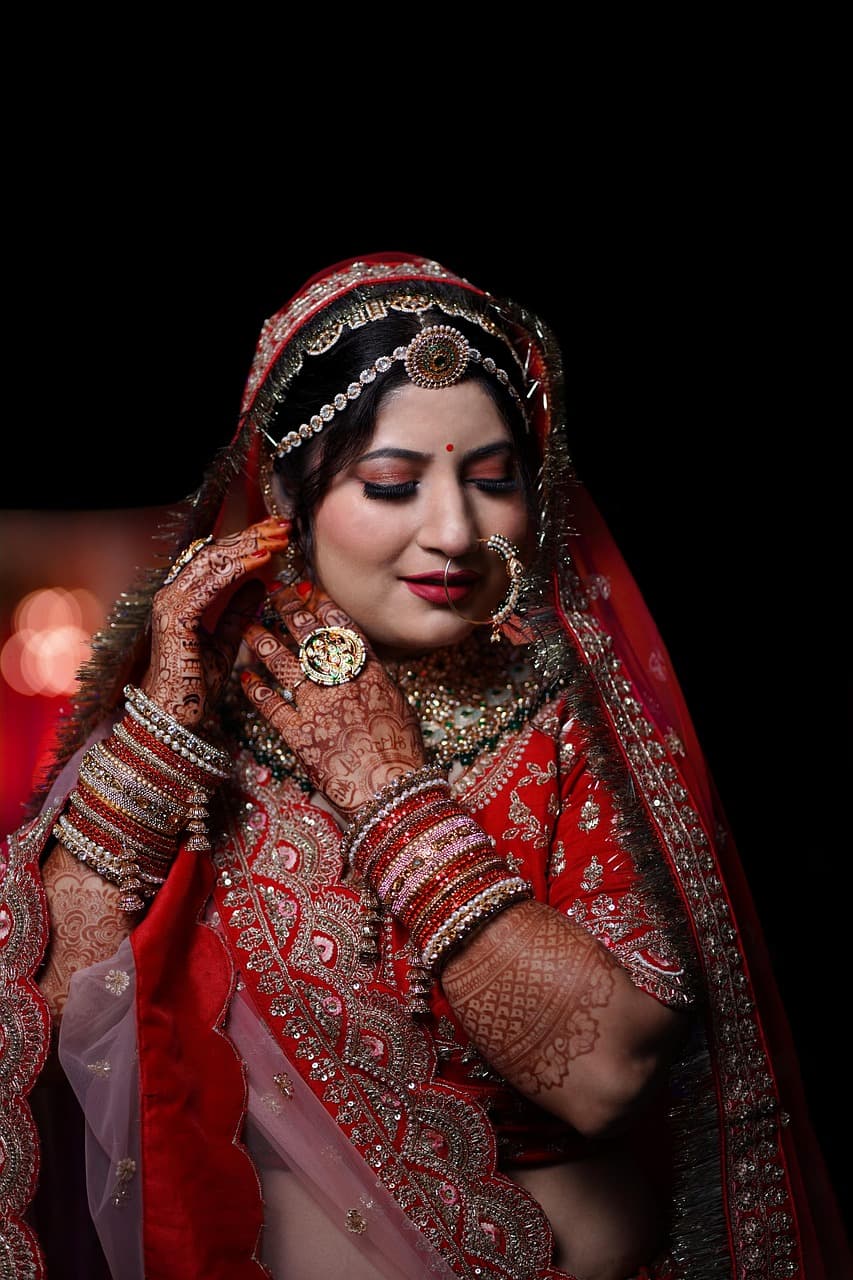
Indian bridal jewellery is best understood not as a collection of objects but as a grammar — a set of named pieces, each occupying a precise position on the body and carrying a particular meaning. The maang tikka rests at the parting of the hair, at a point long associated in Indian tradition with wisdom and intuition. The nath is the nose ring, worn in forms that vary dramatically by region. The haar, or rani haar — the 'queen's necklace' — falls in layers around the neck, while the jhumka earrings, the bangles, the armlet and the anklet each complete the composition.
Together these pieces form a complete system of adornment in which no part of the body is left unconsidered. The effect is cumulative: a bride is not wearing jewellery so much as entering into it, her identity as a married woman inscribed across her body in gold, stone and enamel. This is why Indian bridal jewellery feels unlike bridal jewellery anywhere else in the world — it is not an accessory to the wedding but one of its central texts. The most traditional of these forms is temple jewellery, so called for its origins in the adornment of deities and the temple towns of the south: cast in gold and depicting gods, goddesses and sacred motifs, it carries a devotional register that recalls jewellery first offered to the divine before it was worn by mortals.
“A bride is not wearing jewellery so much as entering into it — her identity inscribed across her body in gold, stone and enamel.”
Regional Variations: A Subcontinent of Styles
The single most important thing to understand about Indian bridal jewellery is that there is no single Indian bridal look. A Tamil bride's temple jewellery, a Rajasthani bride's kundan-meenakari set, a Bengali bride's distinctive pieces and a Kashmiri bride's silver and turquoise are all equally Indian, and all radically different. Each region draws on its own craft traditions, its own gemstones and its own vocabulary of motifs, so that the same wedding, held a few hundred miles away, would dress its bride in an entirely different idiom.
The north and west are the natural home of kundan and meenakari, with Jaipur and its satellite ateliers supplying the dense, polki-set sets associated with Rajasthani and Gujarati weddings. The south favours the gold temple tradition and the layered necklaces of its ceremonial canon. Bengal has its own repertoire, while the hill regions and the far north introduce silver, turquoise and coral into a palette elsewhere dominated by gold. For the contemporary bride, this regional richness is not a constraint but a resource: increasingly brides borrow across traditions, pairing a southern temple necklace with northern kundan earrings, or commissioning a single piece that deliberately blends two regional idioms.
Choosing Well: A Considered Approach
Because bridal jewellery is intended to be worn and kept, choosing it is a different exercise from any other purchase. The considerations are layered: the stone, the craftsmanship, the design's relationship to the bride's heritage, and the piece's capacity to endure — physically and aesthetically — across decades. A bridal set is not bought for a single day but for a lifetime of occasions, and for the generation that will inherit it. This is why the choice rewards patience, and why the most experienced buyers advise looking first at the setting rather than the flash of the design.
In kundan work, the purity of the gold foil and the evenness of the burnish mark a genuinely fine piece; in meenakari, the depth and clarity of the enamel, and the precision of its firing, separate the best workshops from the merely fashionable. The stones themselves — whether uncut polki or faceted gems — should be assessed for their life and, above all, for whether the piece has been made by hands that understand the tradition. There is no substitute for seeing and feeling a piece before committing: jewellery of this kind has a weight, a softness and a quality of light that photographs cannot convey, and a bride who invests the time to examine work closely will rarely regret it.
“A bridal set is not bought for a single day but for a lifetime of occasions, and for the generation that will inherit it.”
Modern Heirlooms: The Contemporary Reinterpretation
A quiet revolution is underway in how Indian brides think about their jewellery. The heirloom set — inherited from a mother or grandmother — was once worn as a matter of duty and pride, sometimes adapted, sometimes preserved untouched. Today's brides are treating heritage more actively: resetting inherited stones into contemporary designs, reworking a grandmother's necklace into something that speaks to their own taste, and commissioning new pieces deliberately conceived as future heirlooms. The jewellery is still an heirloom in the making, but the making is now recognisably the bride's own.
This shift reflects a broader change in the relationship between brides and their jewellery. The contemporary bride is no longer a passive recipient of tradition but an editor of it. She may wear her family's pieces for one ceremony and a commissioned, design-led piece for another; she may pair a modern silhouette with a traditional technique; she may insist on knowing who made the piece and how. For the houses that serve this bride, the implication is clear: provenance and design now matter as much as gold weight. The bride who asks where a stone came from and whose hands set it is the same bride who will one day pass the piece down.
The Royal Gallerys Perspective
Indian bridal jewellery sits at the meeting point of craft, heritage and personal meaning — precisely the territory THE ROYAL GALLERYS exists to cover. We treat it not as a shopping category but as a living tradition, one in which a grandmother's necklace and a young designer's commission belong to the same long conversation. A well-informed bride, in our view, makes a better custodian of that tradition.
We document the pieces, the regions, the makers and the meanings, in the conviction that understanding precedes good choices. Houses and designers whose work deserves this discerning audience may enquire at /advertise.
THE ROYAL GALLERYS is the international magazine for heritage, culture and luxury — documenting the people, places and ideas shaping the worlds of royalty, jewellery, design, travel and contemporary life. Our editorial authority rests on deep engagement with India's cultural ecosystem and a commitment to telling the stories that matter.
For editorial inquiries, story proposals, and partnership discussions, contact our editors at hey.theroyalgallerys@gmail.com.
The Royal Gallerys Editorial
Style & Jewellery Correspondent. THE ROYAL GALLERYS is the international magazine for heritage, culture and luxury — editorial authority on the people, places and ideas shaping our world.
Part of Jewellery
This article is part of THE ROYAL GALLERYS Jewellery section — our international editorial destination for jewellery, heritage and luxury.
Explore All Jewellery Stories →