Banff, in the heart of the Canadian Rockies, is the most beautiful mountain town in North America — a settlement of 8,000 permanent residents surrounded by the peaks of Tunnel Mountain, Cascade Mountain, Mount Rundle, and Sulphur Mountain, in the Bow River Valley, within Banff National Park (Canada's first national park, founded 1885, a reserve of 6,641 square kilometres that is a UNESCO World Heritage Site as part of the larger Canadian Rocky Mountain Parks designation). The town — a main street (Banff Avenue) that aligns, with breathtaking precision, on Cascade Mountain at its northern end, a grid of streets named for animals (Bear, Caribou, Wolf, Lynx), the Bow River flowing through the valley floor — is as charming as its setting demands it to be: a collection of timber and stone buildings, excellent restaurants, and the sort of outdoor shops that sell equipment for every activity the mountains can provide.
The Banff experience is unlike any other mountain resort experience in the world. The town is a real town — people live here, work here, raise families here — and the national park setting (Parks Canada, the federal agency, manages every aspect of development with a rigour that has prevented the worst excesses of commercial mountain tourism from disfiguring the landscape) ensures that the experience of walking along Banff Avenue, beneath the most dramatic mountain skyline in North America, is not marred by the neon signage, the fast-food chains, or the architectural vulgarity that plagues mountain resorts elsewhere.
Banff Avenue at blue hour — Cascade Mountain filling the northern end of the street with its unmistakable pyramidal silhouette, the streetlights illuminating the timber-framed buildings, the Bow River winding through the valley floor to the west, the elk that sometimes wander down from the flanks of Tunnel Mountain grazing (with complete indifference to human presence) on the verges of the town's most famous street
Banff Avenue was deliberately aligned with Cascade Mountain (2,998m) when the town was surveyed by CPR land agent George A. Stewart in 1886, creating one of the most dramatic main street sightlines in any mountain resort town worldwide. Cascade Mountain was named by James Hector of the Palliser Expedition in 1858 for the waterfall that cascades down its eastern face. The Banff Avenue grid, with streets named for local wildlife — Bear, Caribou, Wolf, and Lynx Streets — was laid out the same year.
Lake Louise and Moraine Lake: The Blue That Cannot Be Photographed
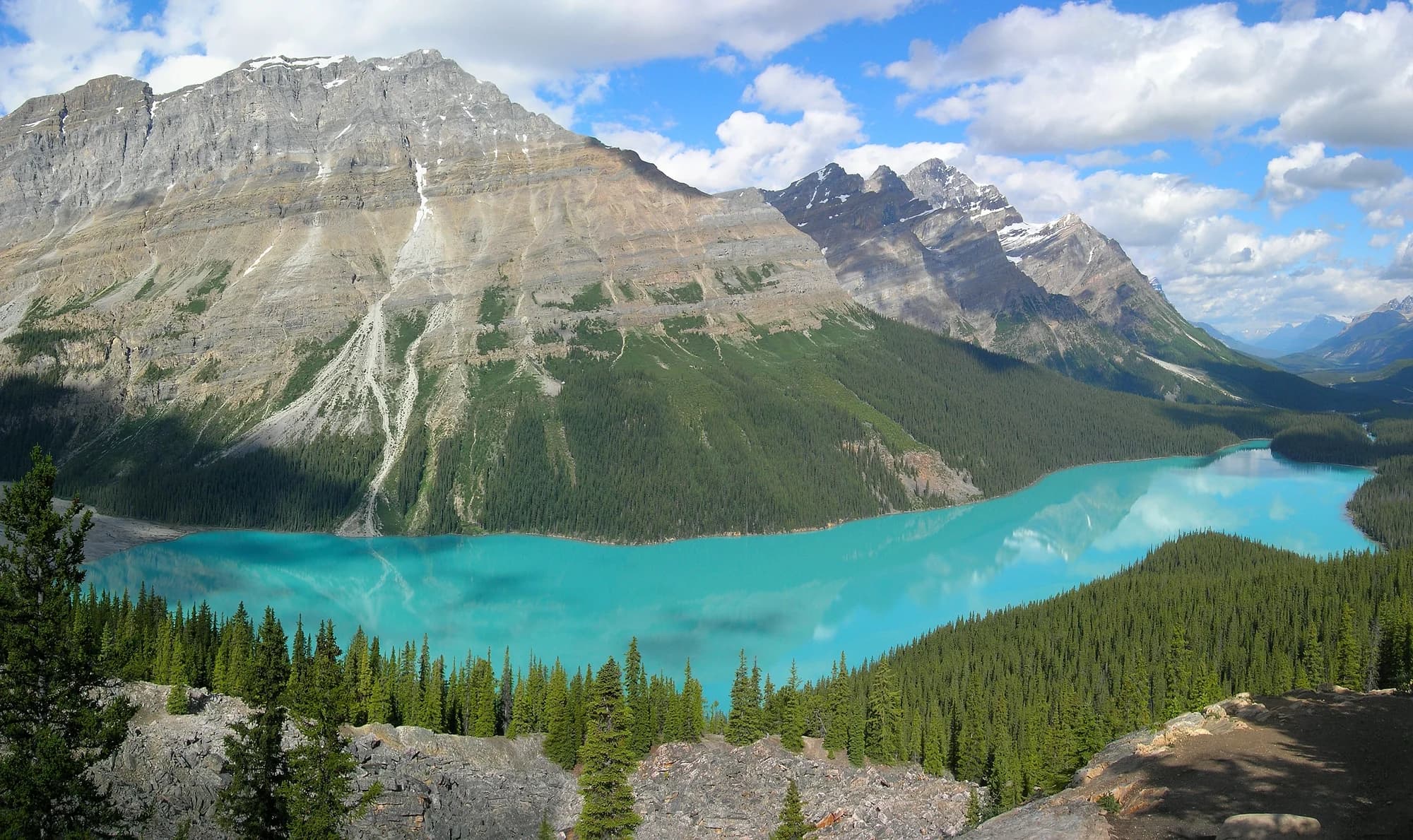
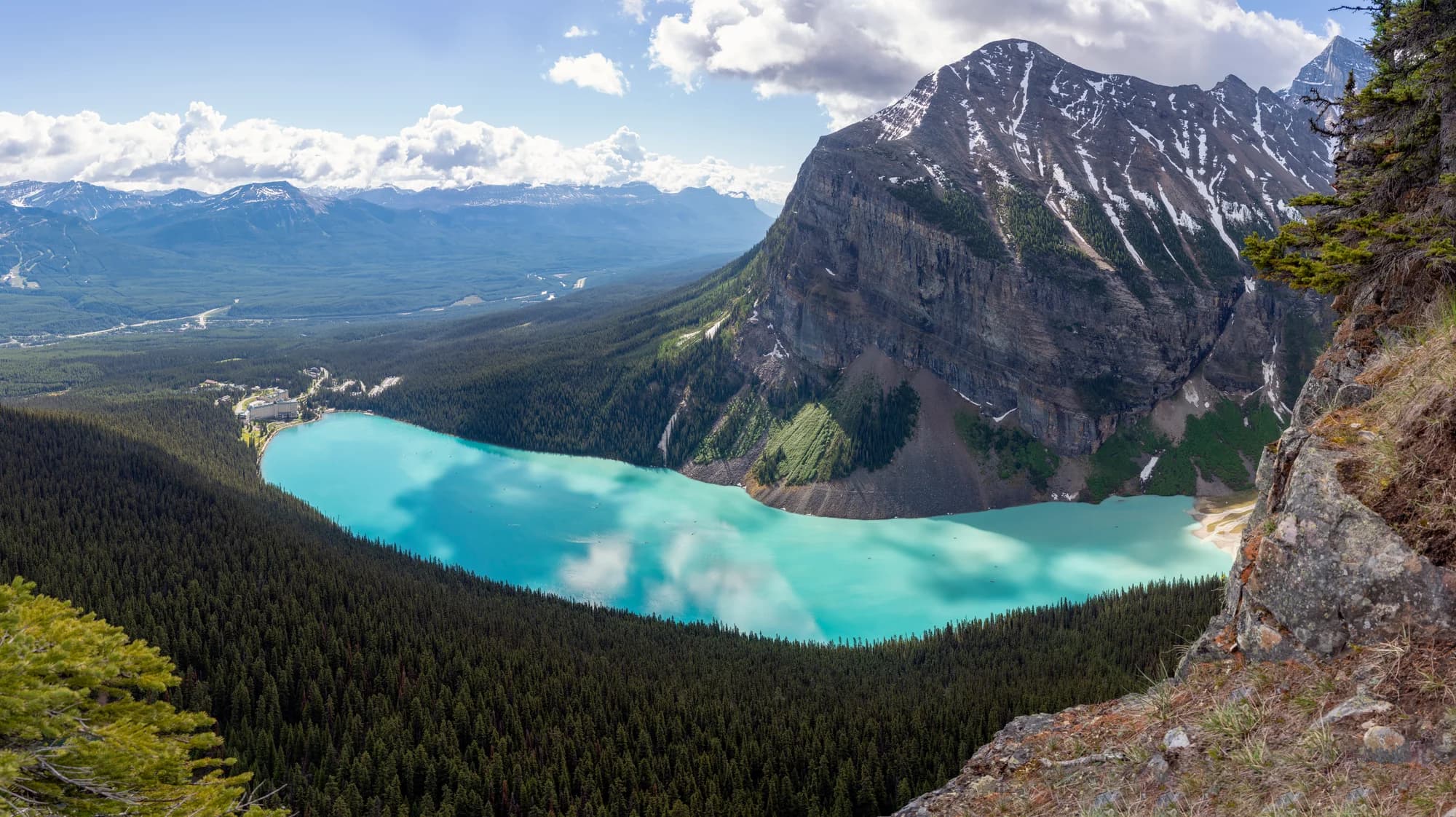
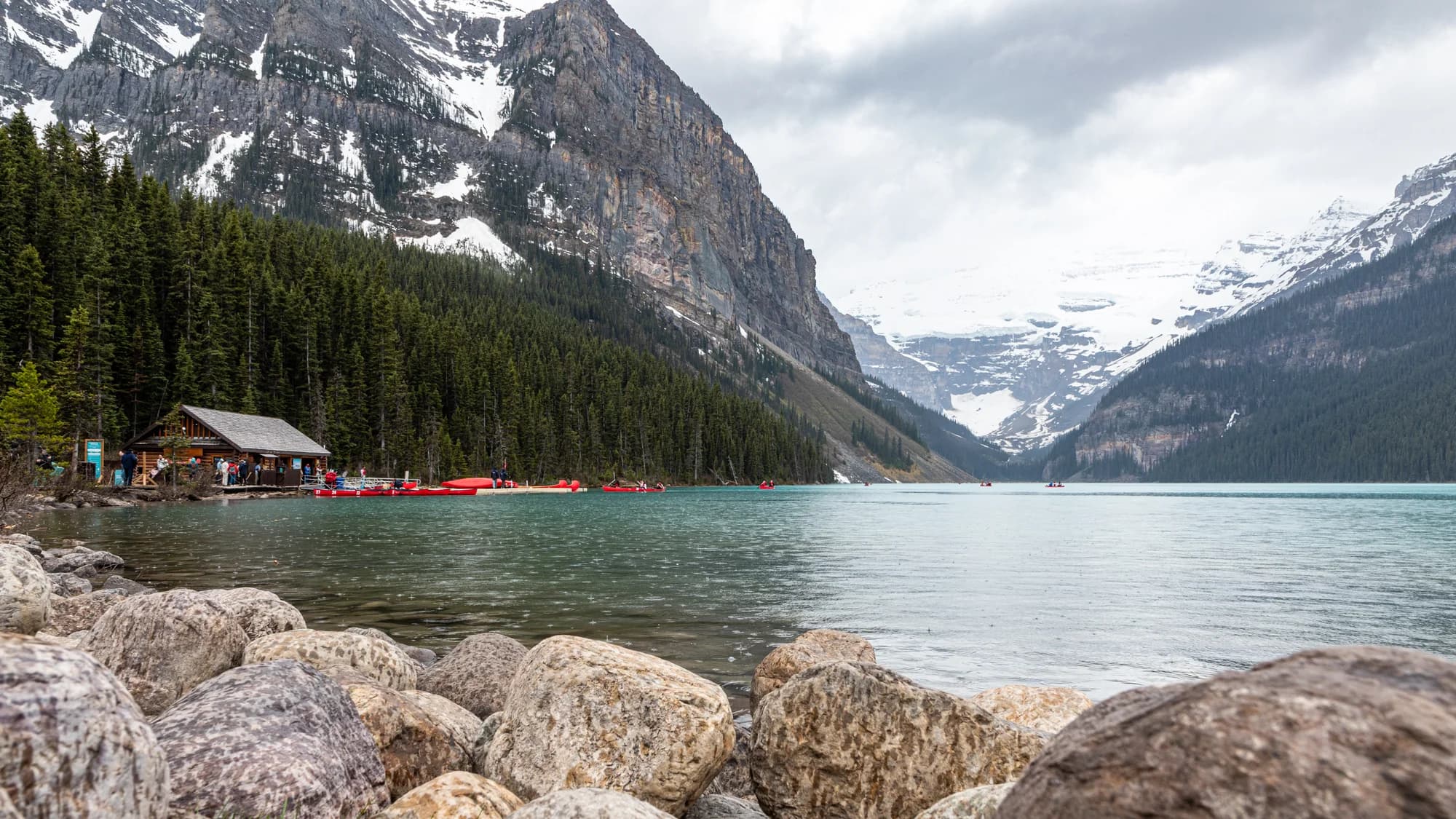
Lake Louise — the most famous lake in the Canadian Rockies and arguably the most photographed body of water in the world — is a forty-minute drive from Banff, and the first sight of it, the water a colour of turquoise so intense it seems chemically enhanced (it is not: the colour is the result of glacial flour — the suspended particles of rock ground fine by the Victoria Glacier, which feeds the lake, and which scatter the blue-green wavelengths of light while absorbing the others — a process that is entirely natural and utterly spectacular), the Fairmont Château Lake Louise (the hotel that dominates the lakeshore, a sprawling pile of early-twentieth-century railway hotel architecture that has been renovated into one of the most expensive hotels in Canada) at its eastern end, the Victoria Glacier at its western end, the peaks of the Continental Divide rising on every side — is one of those travel moments where the reality exceeds the expectation.
The essential strategy for Lake Louise is to arrive before 8 am. The car park fills by 9 am in summer, and the experience of sharing the lake with several thousand other visitors, each of them attempting to take the same photograph, dilutes the majesty of the setting. The early morning — the lake still, the light soft, the crowds absent, the loons calling across the water — is the Lake Louise that the photographs cannot capture, because no photograph can capture silence.
The hike to the Lake Agnes Tea House — a 3.5-kilometre ascent (one way, 400 metres of elevation gain) that begins at the Château and climbs through a forest of spruce and fir to Lake Agnes, a hanging valley of a lake at 2,135 metres, where a tea house has been serving tea and cake to hikers since 1905 — is the essential Lake Louise hike. The tea house, a log cabin of considerable charm at which the staff still pack in supplies on horseback (there is no road, and no electricity, and no plumbing beyond the composting toilets; the tea is made on a propane stove, the cake baked fresh each morning and carried up by a member of the staff, who is almost certainly a university student on a summer job that is, by some margin, the best summer job in Canada), and the views of the Bow Valley, the Victoria Glacier, and the Continental Divide from the Beehive (a short side trail from the tea house that climbs to a viewpoint of such staggering drama — all of Lake Louise, the Château reduced to a speck at the water's edge, the peaks of the Divide stretching to the horizon — that it justifies every litre of sweat produced on the ascent).
Moraine Lake, fourteen kilometres from Lake Louise, is the more beautiful of the two, and the view from the Rockpile — a natural rockfall deposit at the foot of the lake that serves as the essential Moraine Lake viewpoint — is the most famous image of the Canadian Rockies: the Valley of the Ten Peaks rising from the turquoise water, their summits dusted with snow, their reflections perfect on a calm morning. The sunrise at Moraine Lake — the first light catching the summits of the Ten Peaks, the water a mirror of gold and turquoise — is a pilgrimage for photographers from around the world, and the car park, which fills by 5 am in summer, is a testament to the power of this single image (it appeared on the Canadian twenty-dollar bill from 1969 to 1979, the "Moraine Lake Twenty") to inspire the travel decision.
For the luxury traveller, the Moraine Lake Lodge — a collection of cabins on the lakeshore, open June to September, rooms from CAD 800 per night and booked a year in advance — offers the essential Moraine Lake experience: waking at sunrise, stepping onto your cabin's private balcony, and watching the most beautiful lake in Canada do what it has done for ten thousand years, which is to be the most beautiful lake in Canada, in perfect, private silence.
Moraine Lake at sunrise — the Ten Peaks catching the first light of the Canadian morning, the water a mirror of turquoise and gold, the Rockpile crowded with photographers who have been waiting in the dark for this moment, the silence broken only by the shutter sounds and the involuntary exhalation of breath that accompanies the arrival of beauty on this scale
Moraine Lake, discovered by explorer Walter Wilcox in 1899, was named for the massive rockfall moraine deposited by the Wenkchemna Glacier that forms the natural dam at its foot. The Ten Peaks were named in 1894 by Samuel E.S. Allen using the numeral system of the Nakoda (Stoney) First Nations people — Peaks I through X. The lake's distinctive turquoise colour results from glacial flour — suspended particles of rock ground to a fine silt by glacial action — with the deepest colour occurring in late June through August when meltwater reaches its peak volume.
“The mountains are calling and I must go.”
The Icefields Parkway: The Most Beautiful Drive in the World
The Icefields Parkway — Highway 93 North, the 232-kilometre road that connects Lake Louise in Banff National Park with the town of Jasper in Jasper National Park — is the most beautiful drive in the world. This is not a judgement that admits of debate. The road — built during the Great Depression as a Depression-era employment project (it opened in 1940, and the men who built it, working in conditions of extraordinary hardship, created an engineering marvel that traverses two mountain passes — Bow Summit at 2,088 metres and Sunwapta Pass at 2,035 metres — and provides access to the Columbia Icefield, the largest mass of ice in the Rocky Mountains south of the Arctic Circle, a remnant of the Cordilleran Ice Sheet that covered western Canada during the last Ice Age) — passes through a landscape of glaciers, waterfalls, turquoise lakes, and the peaks of the Continental Divide, and every turn reveals a view more spectacular than the last.
The Columbia Icefield, at the Parkway's midpoint, is the essential stop: a mass of ice 325 square kilometres in area and up to 365 metres thick, feeding eight major glaciers (the Athabasca, the Dome, the Stutfield, the Saskatchewan, and the Columbia — the latter the source of the Columbia River, which flows 2,000 kilometres to the Pacific Ocean at Astoria, Oregon). The Ice Explorer — a monster truck of a vehicle, with tyres taller than a person, that drives directly onto the Athabasca Glacier — is a tourist experience that is genuinely awesome: standing on a glacier that has been advancing and retreating for 240,000 years, the ice beneath your feet thousands of years old, the air cold and clear, the landscape of ice and rock stretching to the horizon. The Glacier Skywalk — a glass-floored walkway that extends 280 metres over the Sunwapta Valley, the valley floor 280 metres below your feet — is an engineering feat and a test of nerve. The view — the Sunwapta Valley, the glaciers of the Columbia Icefield, the peaks of the Divide — is for those who can bring themselves to look down.
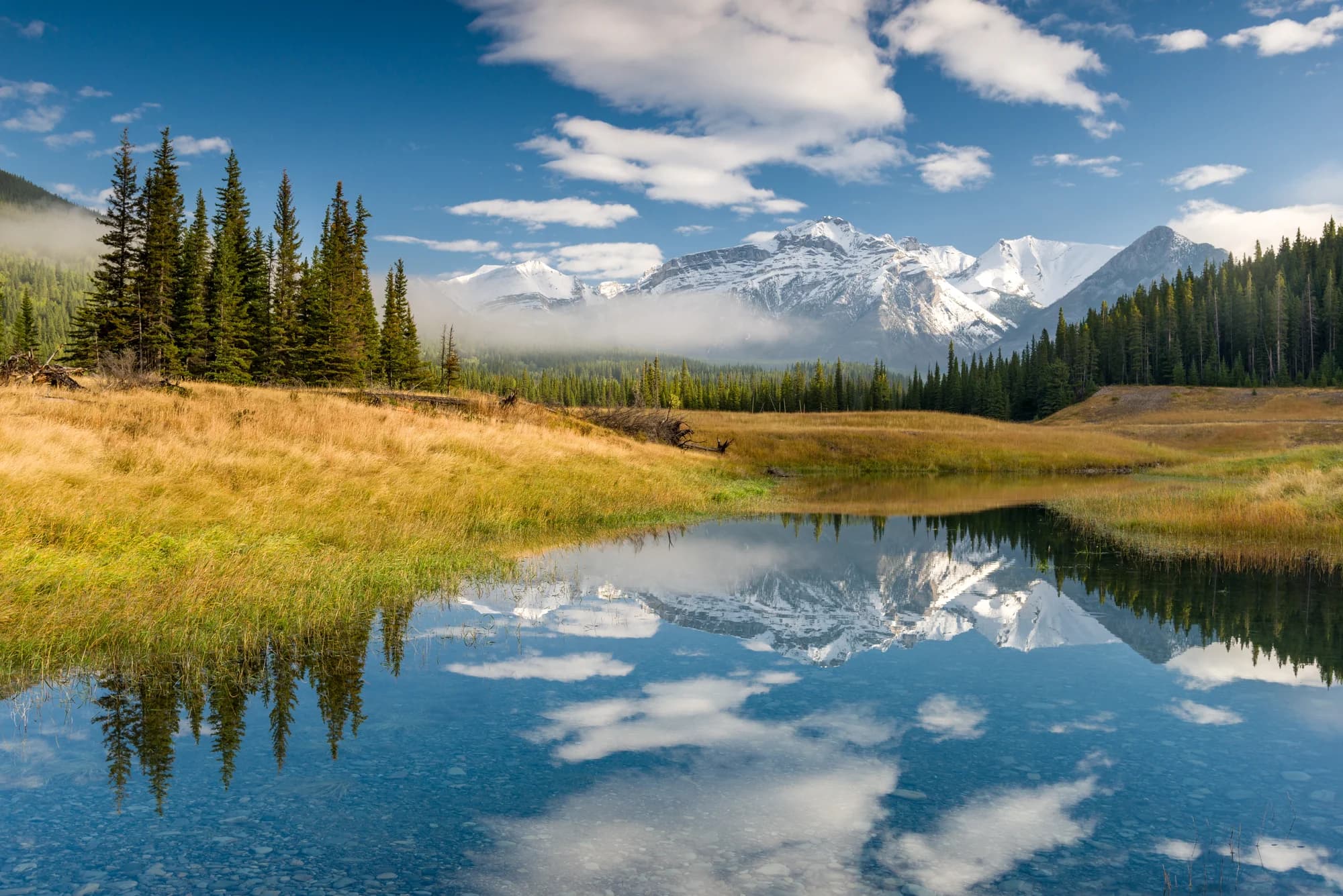
The Icefields Parkway at Bow Lake — the blue-green water reflecting Crowfoot Mountain and the Bow Glacier, the peaks of the Continental Divide a wall of rock and ice on the western horizon, the road a ribbon of asphalt winding through the valley, the scale of the landscape such that the cars on the road — and the people within them — are ant-like, temporary, completely at the mercy of the mountains
The Icefields Parkway (Highway 93 North) was constructed between 1931 and 1940 as a Depression-era federal relief project employing over six hundred men, opening as a gravel road in 1940. Bow Lake sits at 1,920 metres elevation, fed by the Bow Glacier descending from the Wapta Icefield — one of the largest contiguous ice masses in the Canadian Rockies south of the Columbia Icefield. Crowfoot Mountain (3,050m), visually dominant in this vista, was named for the distinctive three-toed shape of the Crowfoot Glacier clinging to its northeastern face.
The Fairmont Banff Springs: Canada's Castle in the Rockies
The Fairmont Banff Springs Hotel — "Canada's Castle in the Rockies" — has been the defining presence in Banff since it opened in 1888. The hotel, built by the Canadian Pacific Railway as part of its strategy to populate the western provinces with tourists (the railway built a chain of luxury hotels across the Rockies — the Banff Springs, the Château Lake Louise, the Jasper Park Lodge — and marketed them, to the European and American elite, as "the Switzerland of North America"), is a Scottish-baronial pile of turrets, gables, and the finest views in Banff. It has been rebuilt, expanded, and renovated multiple times (the original wooden hotel burned down in 1926; its replacement, completed in 1928, is the core of the current building), and it now offers 757 rooms, a Willow Stream Spa of considerable reputation, and a golf course (the Stanley Thompson course, designed by the great Canadian golf architect in 1928, one of the finest mountain courses in the world — the fourth hole, a 192-yard par three with the Bow River on the left and Mount Rundle filling the skyline ahead, is one of the most photographed holes in the game) that is a reason to visit in itself.
The Rundle Bar, in the hotel's lobby, serves afternoon tea with a view of Mount Rundle (the mountain that gives the bar its name — and from which the bar's picture window frames it with a precision that suggests the mountain was positioned for this purpose) and, after dark, cocktails (the "Rundle Sour," the bar's signature, is an excellent gin sour with a splash of Alberta rye) of a quality that would be notable even without the backdrop. The view — Mount Rundle at sunset, the mountain turning gold and rose, the Bow River a silver thread at its base — is one of the great hotel-bar views in the world.
For those who prefer a more intimate mountain experience, the Post Hotel & Spa, in Lake Louise Village, is a Relais & Châteaux property of log-and-stone architecture and an atmosphere of quiet luxury that the Banff Springs, for all its grandeur, cannot match. The restaurant — one of the best in western Canada — has a wine cellar of over 25,000 bottles (the wine list, a leather-bound volume the size of a family Bible, is a life's work by the Swiss owners, George and André Schwarz, who have been collecting for decades), and the dining room, with its views of the Pipestone River and the surrounding peaks, is a temple of mountain gastronomy.
The Fairmont Banff Springs Hotel from across the Bow River — the Scottish-baronial architecture a dark silhouette against the peak of Sulphur Mountain, the windows catching the last light of the Rocky Mountain sunset, the river a ribbon of silver at the hotel's feet, the golf course a green carpet woven around the bends of the Bow, the whole composition an architectural gesture of such confident, improbable grandeur that it seems — a century after its construction — still to belong to a different world
Designed by American architect Bruce Price in the Scottish Baronial style and opened by the Canadian Pacific Railway on June 1, 1888, the original wooden hotel — then the largest in the world — was destroyed by fire in 1926 and rebuilt in concrete and Indiana limestone by architects John W. Orrock and Walter S. Painter, reopening in 1928. The hotel was constructed as part of CPR President William Cornelius Van Horne's grand strategy to populate the western provinces through luxury tourism, marketed to European and American elite as 'the Switzerland of North America.' It was designated a National Historic Site of Canada in 1988, exactly one century after its original opening.
Wildlife Encounters
Banff National Park is home to grizzly bears, black bears, elk, moose, mountain goats, bighorn sheep, wolves, coyotes, and cougars — and the traveller who wishes to see wildlife will do so, almost certainly, from the car. The bears — particularly in spring, emerging from hibernation hungry and focused on the new grass of the roadside verges — are a common sight along the Bow Valley Parkway (the old road between Banff and Lake Louise, closed to through traffic in summer and the best wildlife-viewing road in the park) and the Icefields Parkway. Maintain a distance of 100 metres from bears at all times (Parks Canada fines for wildlife harassment are substantial and the bears — habituated to humans but still wild — are dangerous). Carry bear spray (available for rent or purchase at outdoor shops in Banff and Lake Louise) on all hikes; know how to use it; do not use it unless you absolutely must. The Canadian Rockies are a landscape in which humans are not the apex predator. This is the essential fact. Respect it.
Frequently Asked Questions
When is the best time to visit? June through September is the hiking season: all trails accessible, all roads open, all lakes unfrozen, and the wildlife at its most visible. July and August are peak season — busy, expensive, and the only months in which all facilities are guaranteed to be open. June and September are shoulder months with fewer crowds and the best light — the long golden light of the northern summer. October through May is winter: the lakes freeze, the trails close, the ski season (November through April at Lake Louise Ski Resort and Sunshine Village, two of the best ski resorts in North America) begins.
How many days do I need? Five full days is the minimum: one for Banff (the Banff Springs, the Banff Gondola up Sulphur Mountain, the Bow Falls), one for Lake Louise and the hike to the Lake Agnes Tea House, one for Moraine Lake and the surrounding hikes (the Larch Valley, a two-hour hike that is most famous in September when the larch trees turn gold), one for the Icefields Parkway (the Columbia Icefield, the Skywalk, the drive to Saskatchewan Crossing and back), and one for the town of Banff (the museums, the Cave and Basin National Historic Site — where the hot springs that created Banff National Park still bubble, warm and sulphurous, from the flank of Sulphur Mountain — the shopping, the restaurants, the recovery from four days of hiking).
How do I get there? Calgary International Airport (YYC) is a ninety-minute drive from Banff. The drive — across the prairies and into the foothills, the Rockies rising on the western horizon with each passing kilometre — is a journey into the mountains that every traveller should make once. Car rental is essential; there is no public transport within Banff National Park, and the distances between sites (Banff to Lake Louise: 40 minutes; Lake Louise to the Columbia Icefield: 90 minutes; Banff to Moraine Lake: 70 minutes) require a vehicle.
The view from the top of Sulphur Mountain at sunset — the Bow Valley spread beneath you in its entirety, the town of Banff a cluster of lights in the valley floor, Mount Rundle and Cascade Mountain dark silhouettes against the western sky, the Fairmont Banff Springs a castle of lit windows on the flank of the mountain, the Canadian Rockies stretching to every horizon, and the sense — inescapable, overwhelming — that this is one of the most beautiful places on the surface of the Earth, and that you are, for this moment, privileged to be within it
Sulphur Mountain (2,451m) was named for the hot sulphur springs discovered on its lower slopes in 1883 by three Canadian Pacific Railway workers — brothers William and Tom McCardell, and Frank McCabe — a discovery that led directly to Prime Minister John A. Macdonald's establishment of Banff National Park on November 25, 1885, making it Canada's first national park and the third in the world. The Banff Gondola, carrying visitors 698 metres in elevation to the summit visitor centre and observation deck, opened in 1959 and was substantially rebuilt in 1998 with fully enclosed four-passenger cabins manufactured by the Swiss company Garaventa.