Blenheim Palace: England's Sole Non-Royal Baroque Palace
Gifted by Queen Anne to John Churchill, 1st Duke of Marlborough, following his 1704 victory — Sir John Vanbrugh's titanic monument and the birthplace of Sir Winston Churchill.
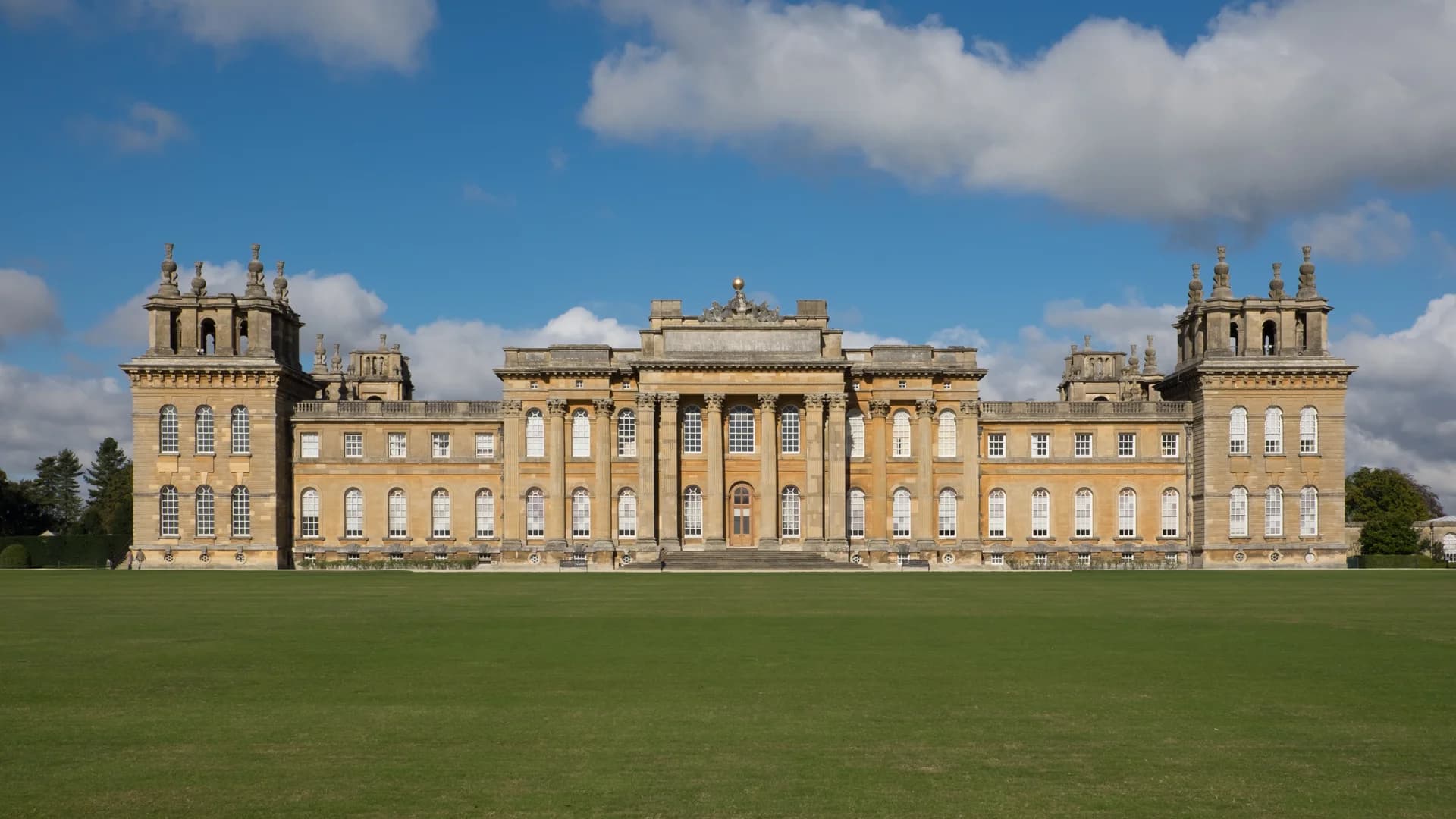
Blenheim Palace occupies a solitary, unmatched status in English architectural history. It is the only non-royal, non-episcopal country residence in the United Kingdom to hold the title of “Palace.” Constructed between 1705 and 1722, it was conceived not merely as a private home, but as an empire's triumphal monument — gifted by Queen Anne and a grateful Parliament to John Churchill, 1st Duke of Marlborough, following his crushing defeat of Louis XIV's French forces at the Battle of Blenheim in Bavaria.
To execute this national statement, Marlborough bypassed Sir Christopher Wren and selected Sir John Vanbrugh, playwright turned radical architect, aided by the brooding structural genius Nicholas Hawksmoor. Together, they raised a titanic exercise in English Baroque that challenged the classical restraint of the age. Blenheim's heroic scale, colossal Corinthian colonnades, martial cannon-and-lion finials, and seven-acre Great Court were designed to project imperial power and martial defiance across Oxfordshire's gentle valleys.
“At Blenheim I took two very important decisions: to be born and to marry. I am content with the decision I took on both occasions.”
The Long Library and Spencer-Churchill Splendour
Inside the palace, the state apartments follow an enfilade of monumental proportions. The Great Hall rises 67 feet to an allegorical ceiling fresco by Sir James Thornhill depicting the Duke of Marlborough pointing to the plan of the battle. Beyond lies the Long Library — stretching 183 feet (55 meters) along the entire western wing. Designed by Vanbrugh as a picture gallery and adapted into a library by Hawksmoor, the room houses more than 10,000 historic volumes and an extraordinary 1891 Father Willis organ.
On 30 November 1874, while attending a ball at the palace, Lady Randolph Churchill (the American socialite Jennie Jerome) unexpectedly went into labor. Her son, Winston Leonard Spencer-Churchill, was born in a modest ground-floor bedroom near the main hall. Churchill retained a lifelong devotion to Blenheim: he proposed to his wife Clementine Hozier in the Temple of Diana in the palace gardens in 1908 and was buried in the nearby churchyard of St Martin's, Bladon, within view of the palace spires.
Capability Brown's Lakes and The Grand Bridge
When Vanbrugh originally built the monumental Grand Bridge across the tiny Glyme river, Horace Walpole satirized it as “an arch that drowned all water beneath it.” In the 1760s, Lancelot “Capability” Brown corrected the disparity with unprecedented landscape audacity: he dammed the river to create two cascading lakes covering over 150 acres, partially submerging Vanbrugh's bridge into the water.
The resulting panorama — where the baroque palace is reflected across the glassy surface of the Queen's Pool against 2,000 acres of ancient oak parkland — represents one of the defining landscape vistas of European romantic art.
Visiting Blenheim & Woodstock
- Churchill Exhibition:The permanent Churchill suite traces the wartime leader's life through letters, personal artifacts, and paintings he created at the estate.
- Private Estate Stays:Woodstock offers exquisite 18th-century coaching inns, including The Bear Hotel and The Feathers, just steps from the palace's grand triumphal arch entrance.
- Blenheim Horse Trials: The annual autumn international equestrian competitions draw royalty and world champions to the palace parkland each September.