Highclere Castle: Barry's Jacobethan Triumph & The Carnarvon Archives
The ancestral seat of the Earl of Carnarvon — where Sir Charles Barry perfected Victorian pinnacles and Howard Carter uncovered the golden mask of Tutankhamun.
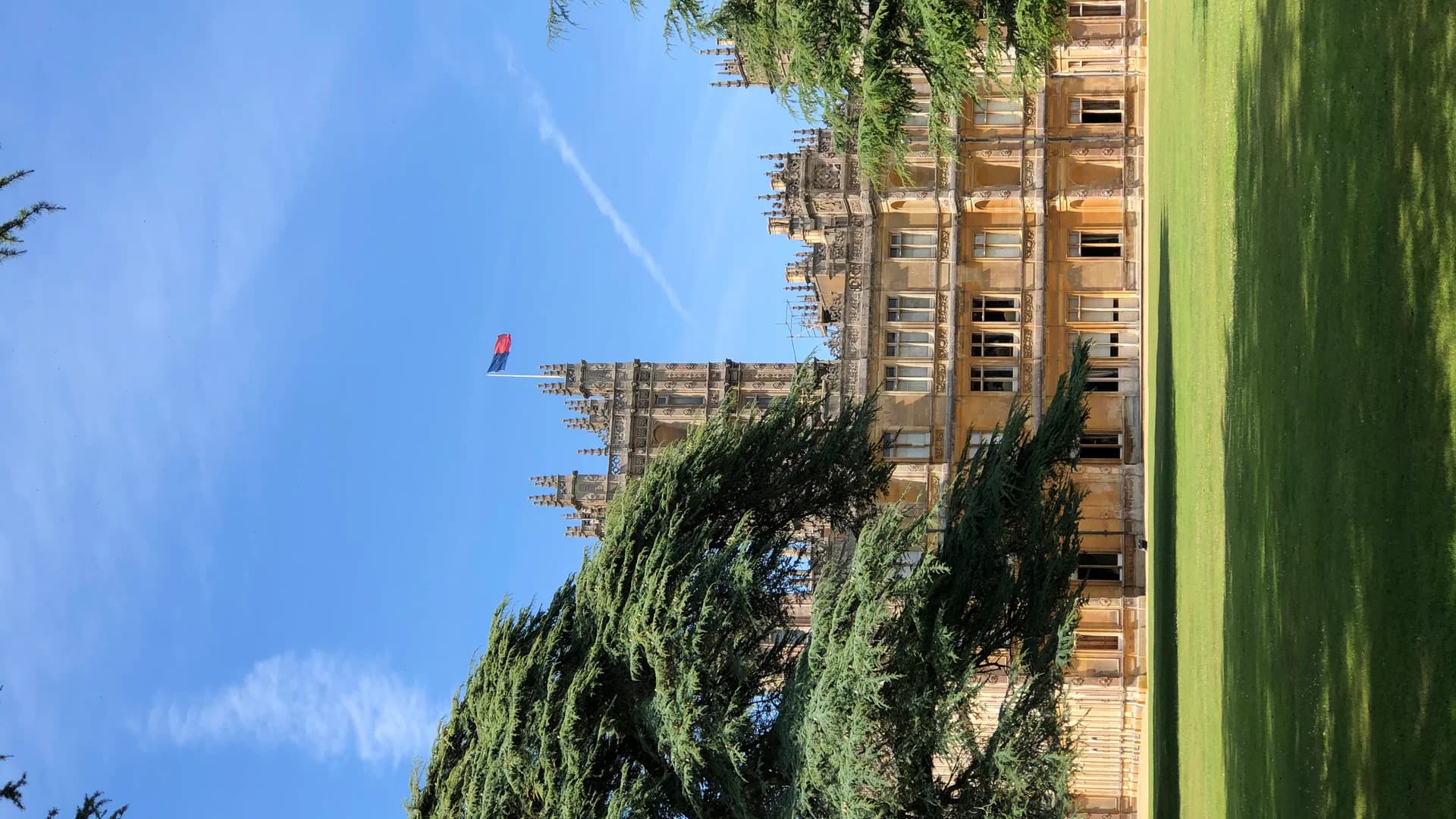
While known globally to millions of television viewers as the real-world setting of Downton Abbey, Highclere Castle possesses an architectural and historical resonance that far transcends popular culture. In 1838, Henry Herbert, 3rd Earl of Carnarvon, engaged the preeminent architect of Victorian Britain — Sir Charles Barry — to transform a classical Georgian mansion into an imposing Jacobethan palace.
Barry was simultaneously designing the new Palace of Westminster (the Houses of Parliament) on the banks of the Thames, and the stylistic affinities between the two landmarks are immediate. Clad in golden Bath limestone, Highclere is defined by its soaring central tower, ornate strapwork cresting, corner obelisks, and rhythmic mullioned fenestration. It represents the supreme apotheosis of the High Victorian Renaissance revival, floating effortlessly above 1,000 acres of parkland originally landscaped in the 1770s by Lancelot “Capability” Brown.
“Highclere stands as living proof that an English country house is not a museum frozen in time, but a vibrant organism carrying the weight of history into modern light.”
The Tutankhamun Discovery and Egyptian Antiquities
Beyond its architectural grandeur, Highclere holds a permanent place in the annals of global archaeology. George Herbert, 5th Earl of Carnarvon, was an intrepid explorer and patron who funded Howard Carter's sixteen-year quest in Egypt's Valley of the Kings. On 26 November 1922, Lord Carnarvon stood behind Carter as he chipped a small hole through the sealed plaster doorway of Tomb KV62. When Carnarvon asked, “Can you see anything?”, Carter uttered his immortal reply: “Yes, wonderful things.”
Following the 5th Earl's tragic death in Cairo a few months later from an infected mosquito bite — giving rise to the famous sensationalist myth of the “Curse of Tutankhamun” — a portion of his private collection remained secretly tucked away inside hidden wall cabinets between the Drawing Room and Smoking Room at Highclere. Rediscovered in 1987 by the 7th Earl's family, these original Egyptian antiquities are now exhibited in the castle's atmospheric vaulted cellars.
Living Estate Stewardship in the 21st Century
Today, Highclere remains the private home of George Herbert, 8th Earl of Carnarvon, and his wife, Fiona, 8th Countess of Carnarvon. Under their stewardship, the estate has pioneered sustainable farming, produced award-winning Highclere Castle Gin distilled with botanicals harvested from the estate gardens, and maintained the house's vast library of 5,600 volumes, including Napoleon Bonaparte's desk and chair taken from Fontainebleau.
Visiting Highclere & Hampshire
- Public Openings: The castle is open for select public seasons during spring and summer, alongside exclusive private evening champagne tours hosted by Lady Carnarvon.
- The Monks' Garden & Secret Garden: Highclere boasts historic gardens cultivated since the 13th century when the Bishops of Winchester owned the estate, featuring ancient cedar trees imported from Lebanon in 1774.
- Nearby Accommodations: Stay at The Vineyard in Stockcross (renowned for its 30,000-bottle wine cellar) or Heckfield Place, a restored Georgian estate in Hampshire.