Hoi An is the antidote to Vietnamese urban chaos. After the cardiac-arrest traffic of Hanoi, the relentless commercial energy of Ho Chi Minh City, the humid intensity of the coastal cities, you reach this ancient trading port on the Thu Bon River — a perfectly preserved fifteenth-century town of wooden shop-houses, Japanese merchant halls, Chinese assembly buildings, and French colonial villas, all of it illuminated at night by ten thousand silk lanterns — and something in your nervous system recalibrates. Your pulse slows. Your shoulders drop. You begin to understand why travellers who planned to stay two days end up staying two weeks.

/images/experiences/28-hoi-an/img-01.webp
Hoi An emerged as a major Southeast Asian trading port in the 15th century under the Cham kingdom before becoming part of the Vietnamese Nguyen lords' expanding territories. By the 17th century, the town hosted permanent communities of Chinese, Japanese, Dutch, Portuguese, and Indian merchants — a cosmopolitan trading entrepot whose prosperity funded the astonishing concentration of wooden shop-houses, assembly halls, and temples that survive today. The Thu Bon River siltation in the late 19th century, which rendered the port inaccessible to larger vessels, was the economic disaster that paradoxically preserved Hoi An — the trade moved downstream to Da Nang, and the town, its raison d'etre gone, froze in amber for a century until UNESCO's 1999 World Heritage inscription sparked a tourism-driven renaissance.
Photo: Photo courtesy of Vietnam National Administration of Tourism
The town's UNESCO World Heritage listing, awarded in 1999, recognised what the Vietnamese have always known: that Hoi An is a unique survival — a Southeast Asian trading port that has preserved its architectural fabric, its cultural institutions, and its intangible heritage (the crafts, the foods, the festivals) with an integrity that few historic towns in the world can match. The wooden buildings, painted in ochre and faded yellow and the distinctive blue-green of Vietnamese shop fronts, have been standing since the fifteenth century. The ancestors of the families who built them still live above their shops. The recipes served in the market today are the same recipes that fed the Chinese, Japanese, Dutch, Portuguese, and Vietnamese merchants who made Hoi An one of the busiest ports in Southeast Asia during the Age of Sail.
The Ancient Town: A Living Museum
The Ancient Town's geography is simple: three streets running parallel to the Thu Bon River — Tran Phu, Nguyen Thai Hoc, and Bach Dang — connected by narrow alleys that reward exploration. The architecture is a fusion of Vietnamese, Chinese, and Japanese influences, with a touch of French colonial thrown in for good measure, and the ensemble — the carved wooden facades, the tiled roofs, the internal courtyards open to the sky — is like nothing else in Southeast Asia.
The Japanese Covered Bridge, built in the 1590s by the Japanese community that once formed a significant portion of Hoi An's population, is the town's icon — a wooden bridge with a pagoda-like roof, its interior decorated with faded paintings of the zodiac, its foundations guarded by a pair of stone dogs and a pair of stone monkeys. The bridge connects the Japanese quarter (on the far side) with the Chinese quarter (on the near side), and crossing it — from the sun-bright Tran Phu side into the shadow of the covered passage — is a small, daily pleasure that the thousands of tourists who photograph it from the outside miss entirely.
The Chinese assembly halls — the Cantonese Assembly Hall, the Fujian Assembly Hall, the Hainan Assembly Hall, and several others — are the town's most elaborate buildings, each one a temple dedicated to the deities of the province from which its founders emigrated. The Fujian Assembly Hall, with its central courtyard, its golden altar to Thien Hau (the goddess of the sea and protector of sailors), and its swirling coils of incense suspended from the ceiling, is the most spectacular. The incense, lit by visitors making offerings, burns for months, filling the hall with a fragrance that clings to your clothes and your memory.

/images/experiences/28-hoi-an/img-02.webp
The Chua Cau, or Japanese Covered Bridge, was built in the 1590s by Hoi An's Japanese merchant community to connect their enclave on the western bank of a narrow canal with the Chinese quarter on the eastern. The bridge's architectural anomaly — it functions simultaneously as a thoroughfare and a temple, with a small shrine to the Daoist deity Tran Vo Bac De built into its northern side — reflects the syncretic religious culture of a trading port where Japanese animism, Chinese Daoism, and Vietnamese folk worship coexisted for centuries. The pair of stone dogs and the pair of stone monkeys guarding the bridge's entrances correspond not to the Chinese zodiac but to two years of the Japanese zodiac cycle in which construction began and was completed.
Photo: Photo courtesy of Vietnam National Administration of Tourism
“Hoi An is the town that time forgot, and then remembered just in time. It is a place to wander without purpose — the highest form of travel.”
The Lanterns and the Full Moon
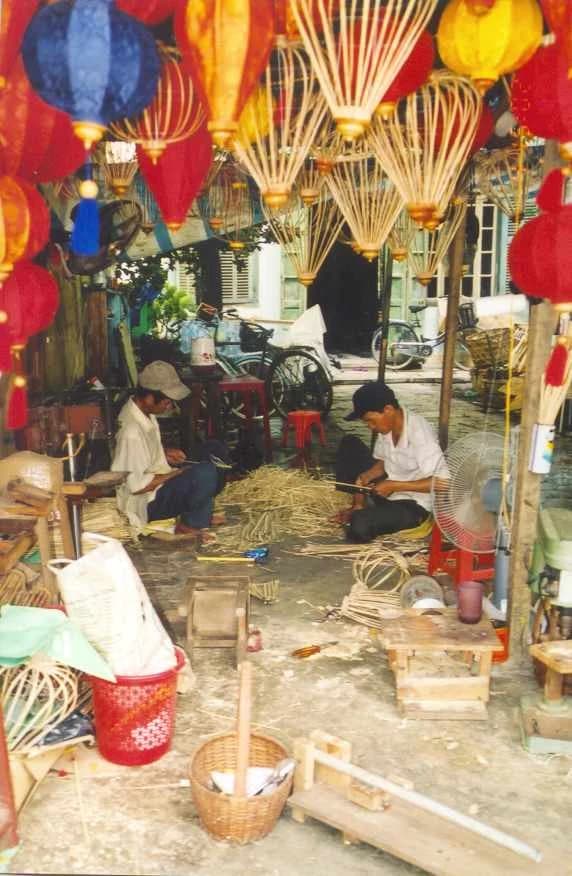
Hoi An's lanterns are its signature. They hang from every building, are sold from every second shop, and are floated on the river by tourists and locals alike during the monthly lantern festival held on the full moon. The festival — Hoi An Legendary Night — is, on one level, a tourist event: the electric lights of the Ancient Town are switched off, the streets are illuminated by thousands of silk lanterns and candles, and the town transforms into a medieval dreamscape of flickering coloured light.
It is also, on another level, genuinely magical. The lanterns floating down the Thu Bon River — each one a paper boat carrying a candle and a wish — create a river of light that drifts slowly toward the sea. The streets are filled with locals in traditional ao dai (the Vietnamese tunic dress), children carrying paper animals, and the sound of traditional music drifting from the assembly halls. Yes, it is crowded. Yes, it has been discovered by every tour group in Vietnam. And yes, it is still worth it. The festival transforms Hoi An from a beautiful town into something transcendent — a reminder that beauty, deliberately created and communally celebrated, is a perfectly legitimate reason for a town to exist.

/images/experiences/28-hoi-an/img-03.webp
The Hoi An Legendary Night, held on the 14th day of each lunar month, is a modern revival of traditional mid-autumn celebrations that the town's Chinese immigrant community brought to Hoi An in the 17th century. The silk lantern tradition itself traces back to the 16th century, when Chinese merchants introduced the craft of lantern-making to Hoi An; local artisans adapted the designs, incorporating Vietnamese motifs and the town's distinctive colour palette of crimson, amber, and jade. During the festival, the electric street lights of the Ancient Town are switched off by municipal order, and businesses are required to replace their standard lighting with lanterns and candles — a rare instance of a local government deliberately reducing modern infrastructure to honour cultural heritage.
Photo: Photo courtesy of Vietnam National Administration of Tourism
The Tailors: A Town That Can Make Anything
Hoi An is the tailoring capital of Vietnam, and its hundreds of tailor shops — ranging from hole-in-the-wall operations run by a single seamstress to multi-storey emporiums with international shipping — can replicate any garment you bring them. A photograph, a sketch, or a description of a dress you saw in a magazine will, within twenty-four hours, become a finished garment fitted precisely to your body.
The quality varies wildly. The cheap tailors — the ones who approach you on the street offering a suit for thirty dollars — are cheap for a reason. The fabric is polyester, the stitching is hurried, and the suit will not survive its third dry cleaning. The good tailors — Yaly, A Dong Silk, Bao Diep, among others — charge significantly more but deliver garments of genuine quality: Italian wool, Vietnamese silk, hand-stitched details, multiple fittings. A three-piece suit from a top Hoi An tailor will cost $200-400, compared to $2,000-4,000 for equivalent quality in London or New York.
The strategy: bring a garment you love and ask the tailor to replicate it in a different fabric. The copy will reveal the tailor's skill (or lack thereof) with fewer variables than a new design. Plan for at least two fittings, and longer for complex garments. And avoid the temptation to order ten things at once — start with one, assess the quality, and return for more only if the first garment meets your standards.

/images/experiences/28-hoi-an/img-04.webp
Hoi An's tailoring industry has its roots in the town's history as a textile trading port, where Chinese and Vietnamese silk merchants supplied fabrics to the ships that called here before their return voyages to Europe, Japan, and the Middle East. The modern custom-tailoring phenomenon began in the early 2000s, when Vietnam's economic liberalisation coincided with the rapid growth of international tourism, and today Hoi An has approximately 400 tailor shops employing an estimated 5,000 seamstresses and tailors. Many workshops still use treadle-operated Singer sewing machines from the French colonial era — their cast-iron durability, the availability of replacement parts, and the precise control they offer over stitch tension make them preferred over modern electric machines for the fine silk work that defines Hoi An's best tailors.
Photo: Photo courtesy of Vietnam National Administration of Tourism
The Food of Hoi An: A Cuisine Entirely Its Own
Hoi An's cuisine is distinct from the Vietnamese mainstream — a legacy of its history as an international trading port and the prosperity that sustained a sophisticated culinary culture. The town's three signature dishes are each, in their way, perfect.
Cao lau — thick, chewy noodles in a small amount of broth, topped with sliced pork, crispy croutons, and fresh herbs — is the dish that defines Hoi An, and no one outside the town can replicate it. The water, according to tradition, must come from the Ba Le well, an ancient Cham source whose mineral content supposedly gives the noodles their distinctive texture. The story is probably myth, but the noodles — thicker and chewier than any other Vietnamese noodle, with a smoky flavour that comes from the lye water in which they are soaked — are undeniably unique.
Banh mi, in Hoi An, reaches its finest expression at Banh Mi Phuong, the stall that Anthony Bourdain declared made the best sandwich in Vietnam. The bread is baked locally, the fillings (grilled pork, pâté, egg, cheese, a dozen variations) are layered with precision, and the experience of eating it on a plastic stool on the pavement, washing it down with a bottle of green tea, is one of the great cheap meals of the world.
White rose dumplings — banh bao banh vac — are translucent rice-flour wrappers filled with minced shrimp or pork, shaped to resemble flowers, and served with a dipping sauce of fish sauce, sugar, chilli, and garlic. The dumplings are the speciality of a single family, the Tran family, who have been making them for three generations and supply most of the restaurants in town. They are delicate, beautiful, and impossible to eat just one.

/images/experiences/28-hoi-an/img-05.webp
Cao lau is a culinary palimpsest — the thick, chewy rice noodles resemble Japanese udon (from Hoi An's 17th-century Japanese community), the roast pork is Chinese-style char siu (from the Cantonese merchants who dominated the spice trade), and the fresh herbs and broth reflect Vietnamese culinary sensibilities. The legendary claim that the noodles can only be made with water drawn from the ancient Cham-era Ba Le well has a basis in mineral chemistry: the well's water, filtered through layers of Cham brick and laterite, carries a distinctive alkalinity that reacts with the rice flour to produce a unique texture and a characteristic smoky-tan colour. Local noodle-makers still collect the water before dawn, and any attempt to produce cao lau using municipal tap water yields noodles that are, by universal consensus, "wrong."
Photo: Photo courtesy of Vietnam National Administration of Tourism
Timing Your Visit
The best times to visit Hoi An are February through April (dry, warm, and pleasant) and September through November (the tail end of the monsoon, with dramatic skies and fewer tourists). May through August is hot (35°C+) and dry. December and January can be cool and wet. The full-moon lantern festival is held on the 14th day of each lunar month — check the calendar and book accommodation well in advance if your visit coincides.
Frequently Asked Questions
How many days do I need? Three full days is the minimum: one for the Ancient Town (the assembly halls, the bridge, the museum, the market), one for the tailors and the food trail, and one for a bicycle ride through the countryside to the sea. Four to five days allows for the lantern festival, a cooking class, and the deeper unwinding that Hoi An rewards.
How do I get there? The nearest airport is Da Nang International (DAD), thirty kilometres to the north. The drive takes forty-five minutes. Hoi An is also 3-4 hours by train or car from Hue, the former imperial capital to the north.
Is Hoi An crowded? Yes, in the Ancient Town during the day and particularly during the lantern festival. But the crowds thin significantly in the early morning and late evening, and the countryside around the town — the rice paddies, the beaches, the small villages — remains uncrowded throughout the day. The secret to Hoi An is to explore the Ancient Town at dawn, retreat to the countryside or the beach in the middle of the day, and return in the evening for dinner and the lanterns.
Should I stay in the Ancient Town or at the beach? Both. Two nights in the Ancient Town for the culture, the food, and the lanterns; two nights at An Bang or Cua Dai Beach for the sea, the sand, and the sound of waves. The town and the beach are fifteen minutes apart by bicycle or taxi.
Is it suitable for families? Yes — Hoi An is among Vietnam's most family-friendly destinations. The streets are largely pedestrianised, the beaches are safe for swimming, and the food (mild, fresh, endlessly customisable) suits young palates. The lantern festival, with its fairy-tale atmosphere, is particularly magical for children.

/images/experiences/28-hoi-an/img-06.webp
The distinctive yellow-ochre pigment that colours the facades of Hoi An's Ancient Town is not a UNESCO-imposed preservation standard but a practical choice inherited from the 19th century, when local builders mixed lime plaster with yellow ochre clay sourced from the Thu Bon riverbank as a waterproofing agent against the tropical monsoon. The round bamboo coracles used by local fishermen are among the world's oldest boat designs — basked boats depicted on Dong Son bronze drums from 500 BC suggest the design has been in continuous use on Vietnamese waterways for over 2,500 years. The glassy stillness of the river at dawn is, in part, a product of geography — the Thu Bon's broad, shallow mouth creates a tidal reach that slows the current to near-stillness for the first hours after low tide, creating the mirror-like surface that makes Hoi An's dawn reflections among the most beautiful in all of Southeast Asia.
Photo: Photo courtesy of Vietnam National Administration of Tourism