The Royal Kitchen: Where Indian Cuisine Was Refined
Every great cuisine has an aristocracy, and India's was its royal kitchens. For centuries, the palaces of the subcontinent maintained kitchens of extraordinary scale and refinement — staffed by hereditary cooks, supplied by the best of every region, and governed by a single obsession: that the table of a king should be unlike any other.
The royal kitchen was a laboratory of technique. It is here that slow cooking reached its most exacting form, that spices were balanced to a precision ordinary households never attempted, and that presentation was elevated from serving to ceremony. A royal banquet was not merely a meal; it was a statement of power, hospitality and discernment, in which the quality of the food was inseparable from the authority of the host.
What survives today is more than a collection of recipes. It is a set of culinary traditions — each tied to a particular court, a particular region and a particular idea of what luxury tastes like — that together constitute the most sophisticated cooking India has produced.
“Refinement is not the addition of richness but the control of it.”
Awadhi and Hyderabadi: Two Schools of Refinement
The two most celebrated royal cuisines of India are the products of two very different courts. Awadhi cuisine, from Lucknow, is the cooking of the Nawabs of Awadh — famous for the dum pukht technique, in which ingredients are sealed in a pot and cooked slowly over a low flame so that flavours deepen without escaping. It produced the refined kebabs, the delicate gravies and the fragrant biryanis that define North Indian courtly food.
Hyderabadi cuisine, by contrast, carries the influence of the Deccan's Persian and Central Asian connections, filtered through the kitchens of the Nizam. Its signature is the Hyderabadi biryani — layered rice and meat, seasoned with saffron and slow-steamed — and a tradition of rich, carefully spiced dishes that reflect centuries of culinary exchange at one of India's wealthiest courts.
Between them, Awadh and Hyderabad established the principle that has governed Indian luxury cooking ever since: that refinement is not the addition of richness but the control of it. Restraint, timing and balance — not mere extravagance — are what separate the royal table from the merely generous one.
Rajasthani and Mewari: The Cuisine of the Desert Courts
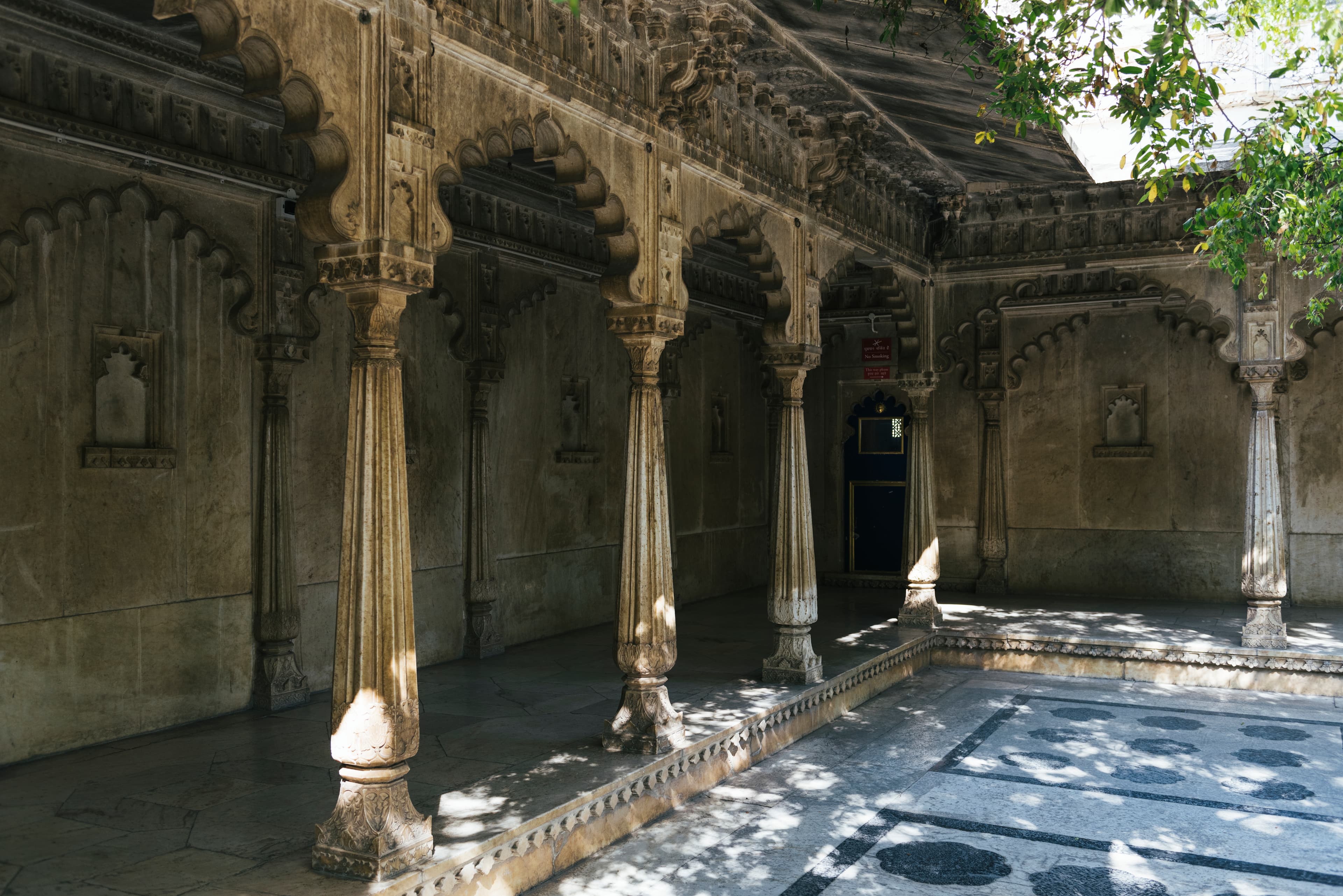
If Awadh and Hyderabad refined richness, the royal kitchens of Rajasthan mastered something harder: abundance in a landscape of scarcity. The desert courts of the Rajputs produced a cooking of extraordinary character, built for a climate where ingredients were limited and preservation was essential.
Rajasthani royal cuisine is often remembered for its heat and its game — laal maas, the fiery red mutton curry of the Rajput kitchens, is its most famous export — but its true sophistication lies elsewhere: in the ingenuity of dishes that used dried ingredients, dairy and spice to create depth where fresh produce was scarce. Mewari cuisine, from the court of Mewar around Udaipur, shares that foundation while developing its own register of sweet-savoury balance and festive thalis.
To dine at one of Rajasthan's palace hotels today is to encounter this tradition intact — served in dining rooms that once fed the court, and prepared by kitchens that trace their methods to the households of the Maharanas. It is history that can be tasted.
“It is history that can be tasted.”
How the Royal Table Survives Today
The question of how these cuisines have survived is answered, in large part, by the same institutions that preserved the palaces themselves. The palace hotels of India did not only save the buildings; they saved the kitchens. Hereditary cooks and their recipes passed into the employment of heritage properties, where the cooking of the courts continues to be served, adapted and studied.
At the same time, the traditions have moved outward. Chefs trained in these kitchens have carried the techniques into India's fine-dining restaurants and into the international understanding of Indian food. Dishes that were once the privilege of a court are now made in home kitchens across the country, their origins gradually forgotten even as their flavour endures.
For the contemporary diner, this presents an opportunity. To eat Awadhi food in Lucknow, Hyderabadi food in Hyderabad, or a royal Rajasthani thali in a restored palace, is to taste something that has passed through centuries of refinement — a direct, sensory connection to the courts that created it.
The Royal Gallerys Perspective
THE ROYAL GALLERYS treats cuisine as part of the same heritage we document everywhere else — not as a sidebar to the palaces, but as one of the most immediate ways their culture remains alive. A royal recipe is an archive in edible form, carrying decisions about technique, ingredients and hospitality across generations.
For the traveller, the royal table offers the rare chance to consume heritage directly rather than merely observe it. For the restaurants, hotels and chefs who carry these traditions forward, it offers a provenance that no marketing campaign can manufacture. We write about these kitchens with the same seriousness we bring to the architecture that housed them, and we offer the platform that connects their custodians with readers who value authentic lineage. To learn more about placing your story before that audience, visit our advertising page at /advertise.
THE ROYAL GALLERYS is the international magazine for heritage, culture and luxury — documenting the people, places and ideas shaping the worlds of royalty, jewellery, design, travel and contemporary life. Our editorial authority rests on deep engagement with India's cultural ecosystem and a commitment to telling the stories that matter.
For editorial inquiries, story proposals, and partnership discussions, contact our editors at hey.theroyalgallerys@gmail.com.
The Royal Gallerys Editorial
Heritage & Luxury Correspondent. THE ROYAL GALLERYS is the international magazine for heritage, culture and luxury — editorial authority on the people, places and ideas shaping our world.
Part of Royalty
This article is part of THE ROYAL GALLERYS Royalty section — our international editorial destination for royalty, heritage and luxury.
Explore All Royalty Stories →