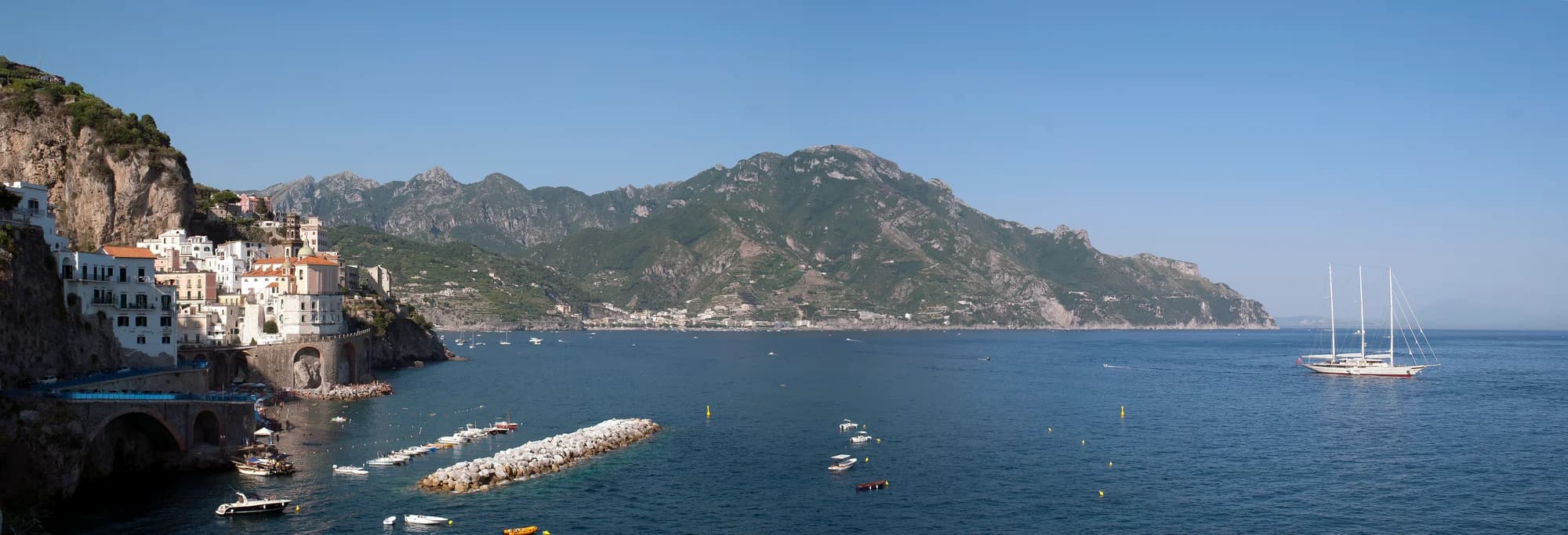
There are coastlines, and then there is the Amalfi Coast. This fifty-kilometre stretch of southern Italy's Sorrentine Peninsula does not merely meet the sea — it defies it, sending pastel-hued towns tumbling down vertiginous cliffs into waters of a blue so intense that Renaissance painters would have deemed it excessive. The Amalfi Coast is a UNESCO World Heritage site not because of a single monument but because the entire landscape constitutes a work of art: terraced lemon groves clinging to near-vertical slopes, medieval watchtowers standing sentinel against the Tyrrhenian horizon, and villages that appear to have been carved from the rock itself by a divine hand with an immoderate sense of drama.
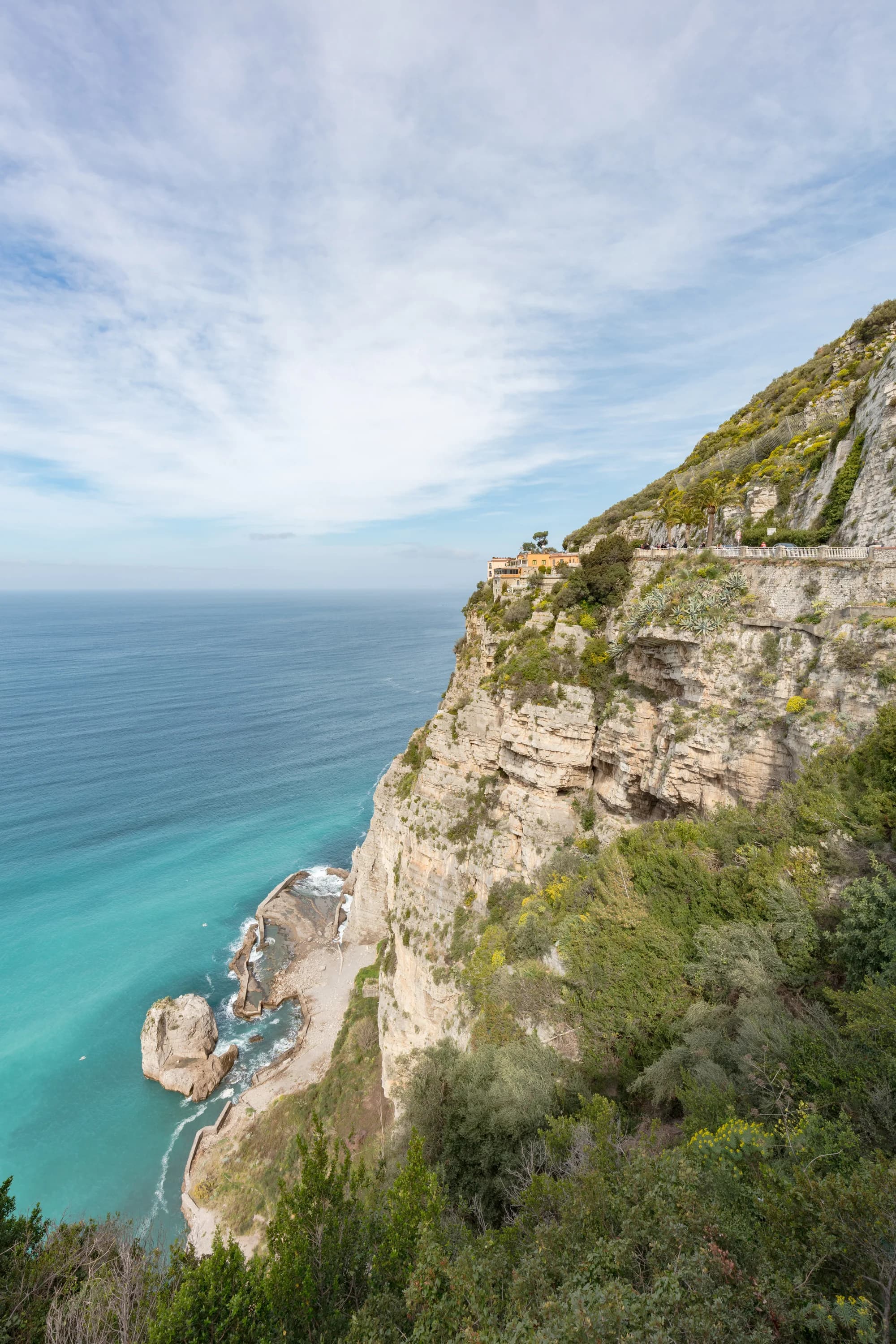
To drive the SS163 — the legendary Amalfi Drive carved into the cliffs between Sorrento and Salerno — is to experience one of the greatest roads on earth. Every hairpin bend reveals a new impossibility: a church dome balanced on a promontory, a saracen tower silhouetted against a setting sun, the island of Capri materialising on the horizon like a mirage. The road is narrow, the buses audacious, the parking spaces aspirational, yet the drive remains an essential pilgrimage. Do it in a vintage convertible if you can, preferably one that matches the lemon-yellow of the region's limoncello, and do it early in the morning before the coaches claim the curves.
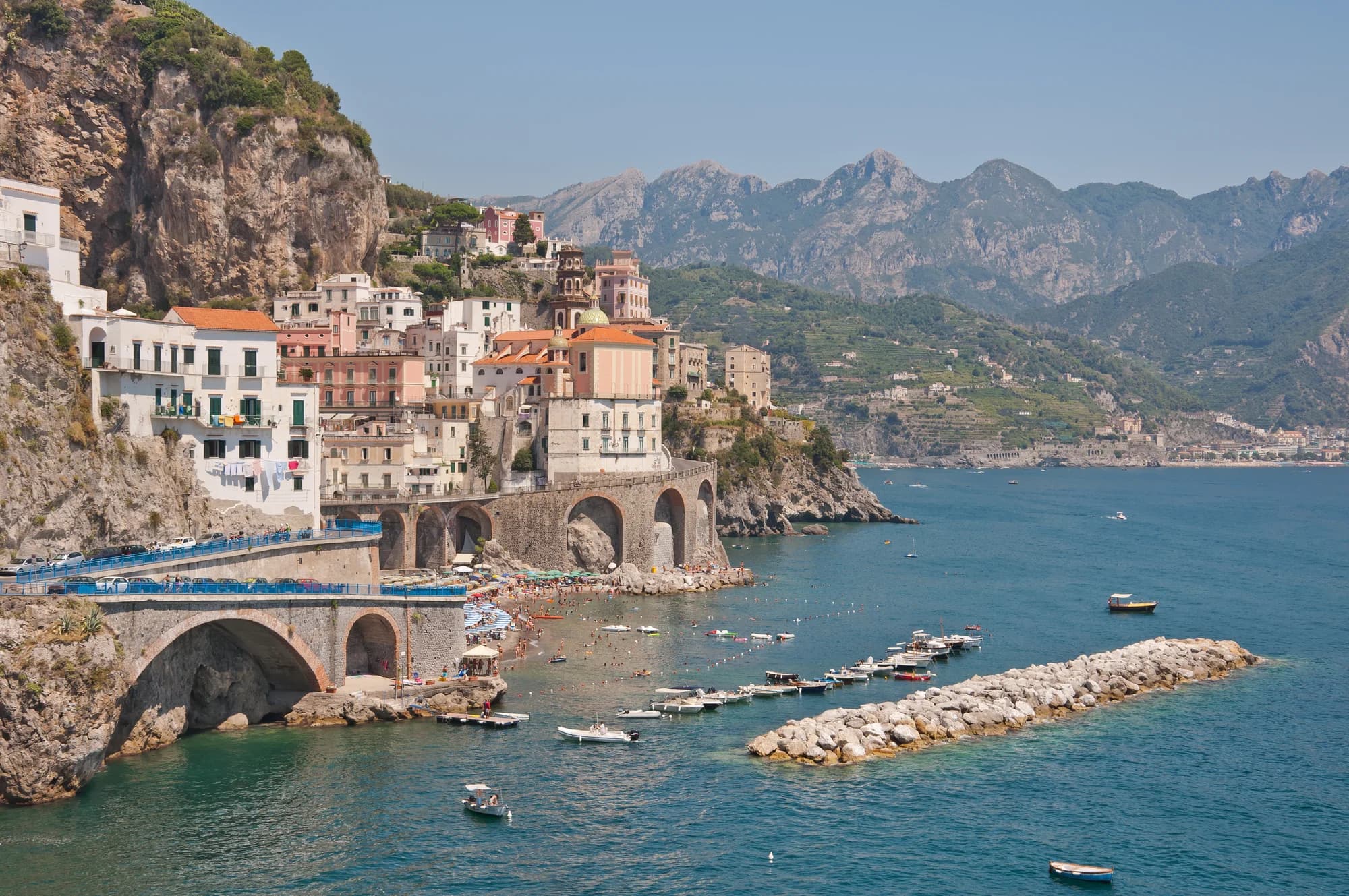
Positano's pastel houses cascading down to the Tyrrhenian Sea at golden hour
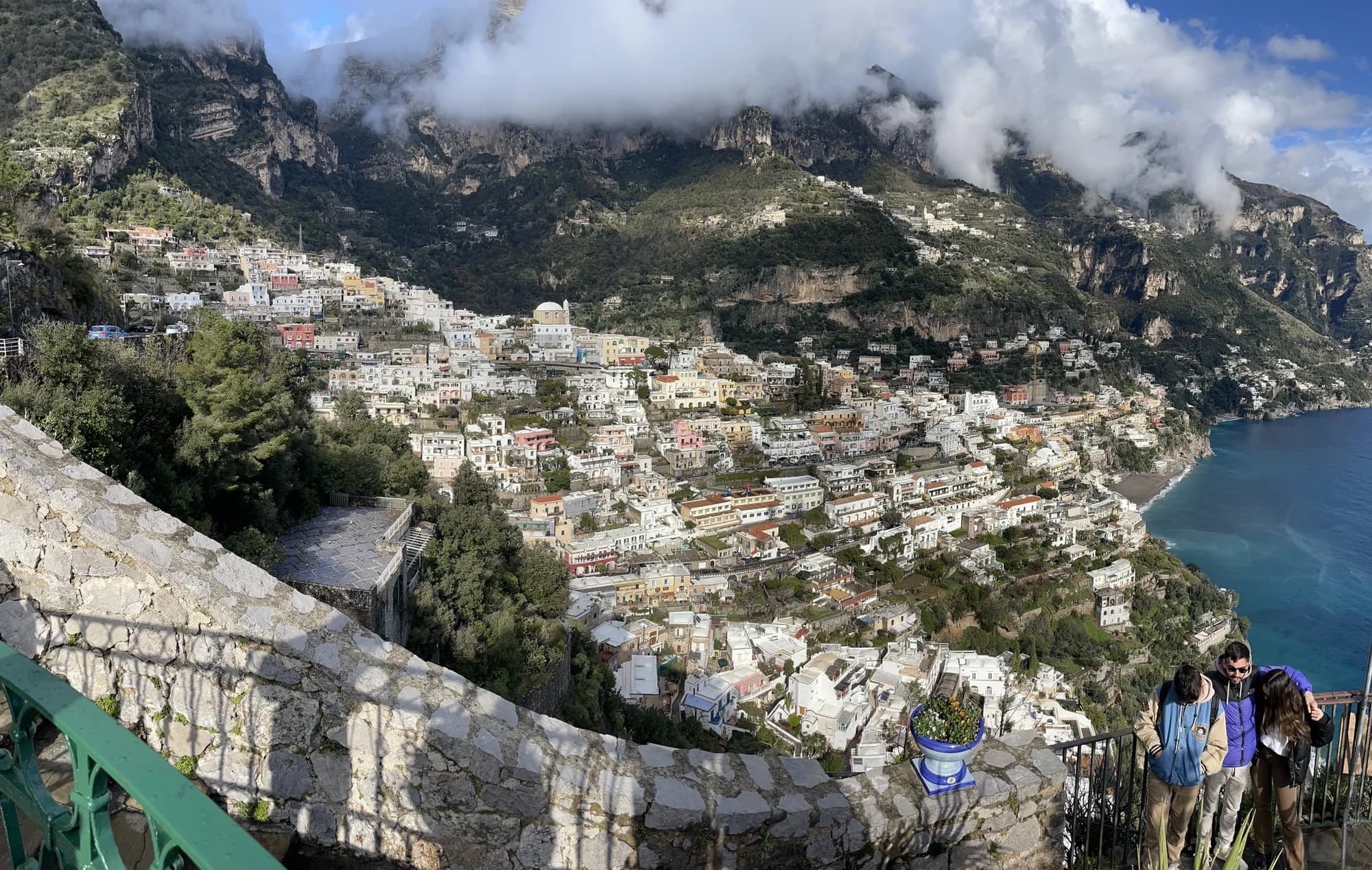
Positano's vertical architecture — houses stacked one upon another in tiers of pastel stucco — evolved from its origins as a medieval fishing village whose inhabitants built upward rather than outward on the near-vertical limestone cliffs. The town earned its fortune as a maritime power in the 10th to 12th centuries, part of the Amalfi Republic, whose ships traded spices and silks across the Mediterranean, and the distinctive majolica-tiled dome of the Chiesa di Santa Maria Assunta dates from this period of prosperity. John Steinbeck's 1953 essay for Harper's Bazaar transformed Positano from a sleepy fishing village into an international icon of Mediterranean glamour virtually overnight — the pastel houses, the bougainvillaea draped over wrought-iron balconies, the sheer impossibility of the town's verticality becoming exactly the image of Italian summer that the post-war world craved.
Positano: The Vertical Village
Positano is the Amalfi Coast's undisputed poster child, a town that climbs the cliff in stacked pastel layers like a Tiffany box of gelato shades — pistachio, strawberry, lemon, and peach — each house seeming to rest on the roof of the one below. John Steinbeck visited in 1953 and wrote that "it is a dream place that isn't quite real when you are there and becomes beckoningly real after you have gone." Seven decades of tourism have not diluted the truth of those words.
Positano demands physical engagement. The town is built on a near-vertical axis, and the only way to know it is to climb it. The warren of stepped alleyways — scalinatelle — rewards the effort with moments of pure intimacy: a tiny ceramics workshop where a third-generation artisan paints lemons onto maiolica plates, a wrought-iron balcony groaning under bougainvillaea, a church doorway that frames the sea like an altarpiece. The Chiesa di Santa Maria Assunta, with its gleaming majolica-tiled dome, holds a thirteenth-century Byzantine icon of the Black Madonna, said to have been stolen from Constantinople and guided to Positano by divine winds.
Down at sea level, the Spiaggia Grande is the social theatre of Positano. Here, sunbeds are arranged with the precision of a military parade ground — though the mood is anything but martial. The beach club culture here is sophisticated and deeply Italian: at places like Da Adolfo, reached by a free boat from the main beach, lunch means grilled mozzarella on lemon leaves, just-caught red mullet, and carafes of white wine mixed with peach juice, consumed at rustic wooden tables with your feet almost in the water. Reserve ahead, arrive early, and surrender to the rhythm of the Amalfi summer — which is to say, no rhythm at all.
“Positano bites deep. It is a dream place that isn't quite real when you are there and becomes beckoningly real after you have gone.”
Fresh seafood spaghetti at a cliffside trattoria in Positano, with the sea beyond
The Amalfi Coast's signature pasta dish, scialatielli ai frutti di mare, takes its name from the Campanian dialect — a thick, hand-cut noodle whose shape catches the briny juices of the vongole (clams), cozze (mussels), and gamberi (prawns) pulled from the Tyrrhenian Sea hours earlier. The recipe was formalised in the 1970s by chef Enrico Cosentino of Cetara, though fishermen's wives had been making variations on the dish for centuries. The sea that serves as the dining room backdrop — the Tyrrhenian — is 3,785 metres deep at its maximum point and has been fished since Greek colonists established trading posts here in the 8th century BCE.
Ravello: The City of Music and Gardens
If Positano is the Amalfi Coast's dazzling smile, Ravello is its soaring soul. Perched 365 metres above the sea — a different view for every day of the year, locals will tell you — Ravello has drawn those in search of transcendence for centuries. Wagner found the inspiration for Parsifal's magic garden here. D.H. Lawrence wrote Lady Chatterley's Lover in a villa up the road. Gore Vidal chose it as his final home, describing it as "the most beautiful place I have ever seen in all my travels around the world."
The two great villas of Ravello — Villa Rufolo and Villa Cimbrone — are essential, and they could not be more different in character. Villa Rufolo, with its Arab-Norman architecture and cascading gardens, hosts the Ravello Festival, an annual summer programme of classical music performed on a stage cantilevered over the sea. Book tickets for a concert here and you will understand why Wagner, after visiting in 1880, declared the gardens the very image of Klingsor's enchanted realm.
Villa Cimbrone is something else entirely: a private obsession made public marvel. Its Terrazza dell'Infinito — the Terrace of Infinity — is a belvedere lined with marble busts that projects into the void, the Amalfi Coast unfurling three hundred and sixty-five metres below. The gardens are a curious and magnificent blend of the formal and the fantastical, with a Temple of Bacchus, a Grotto of Eve, and avenues of cypress and wisteria that feel more English than Italian. The villa itself is now a hotel; book a room if you can, but if not, the gardens alone justify the journey up from the coast.
The Terrace of Infinity at Villa Cimbrone, Ravello, suspended above the Mediterranean
The Terrace of Infinity (Terrazza dell'Infinito) was created in the early 20th century by Ernest William Beckett, a British aristocrat who acquired the dilapidated 11th-century property in 1904 and spent decades transforming its gardens into a fantastical collaboration between English horticultural sensibility and Amalfi topography. The marble busts that line the balustrade — anonymous Roman figures, 18th-century copies — frame the void where the land falls away 365 metres to the sea, creating the vertiginous illusion that the terrace projects into pure sky. Gore Vidal, who spent the last decades of his life in Ravello in a villa built into the cliff below, described the view from the Terrace of Infinity as "the most beautiful thing I have ever seen, anywhere, at any time."
Getting to Ravello
The road up to Ravello is not for the faint-hearted driver. If you are not comfortable with hairpin bends and aggressive Italian overtaking, park at the bottom and take the SITA bus or arrange a private driver. The bus costs a few euros and departs from Amalfi town regularly. A private driver from Positano to Ravello will cost approximately €80-100 and can be arranged through your hotel — worth every cent for the stress saved and the views enjoyed from the passenger seat.
Amalfi: The Republic That Ruled the Waves
The town that gives the coast its name is often rushed through by visitors heading to Positano or Ravello, and that is a mistake. Amalfi was once a maritime republic that rivalled Venice and Genoa — the first maritime republic, in fact — with a population of more than seventy thousand and a code of maritime law, the Tavole Amalfitane, that governed Mediterranean trade for centuries. The Duomo di Sant'Andrea, its magnificent Arab-Norman cathedral, climbs a monumental staircase of sixty-two steps, its facade a riot of striped marble, gilded mosaics, and bronze doors cast in Constantinople before the year 1066. Inside, the Cloister of Paradise — Chiostro del Paradiso — is a quiet masterpiece of interlaced arches and palm trees, a place where the scent of orange blossom mingles with the cool of ancient stone.
The streets of Amalfi's old town are a labyrinth of whitewashed passages, sudden piazzas, and fountains that have run with spring water since the Middle Ages. The paper-making tradition — brought here by Arab traders in the twelfth century — continues at the Museo della Carta, housed in a thirteenth-century paper mill that still operates hand-presses. Buy some hand-made Amalfi paper as a souvenir; it carries a weight and texture that no digital photograph can convey.
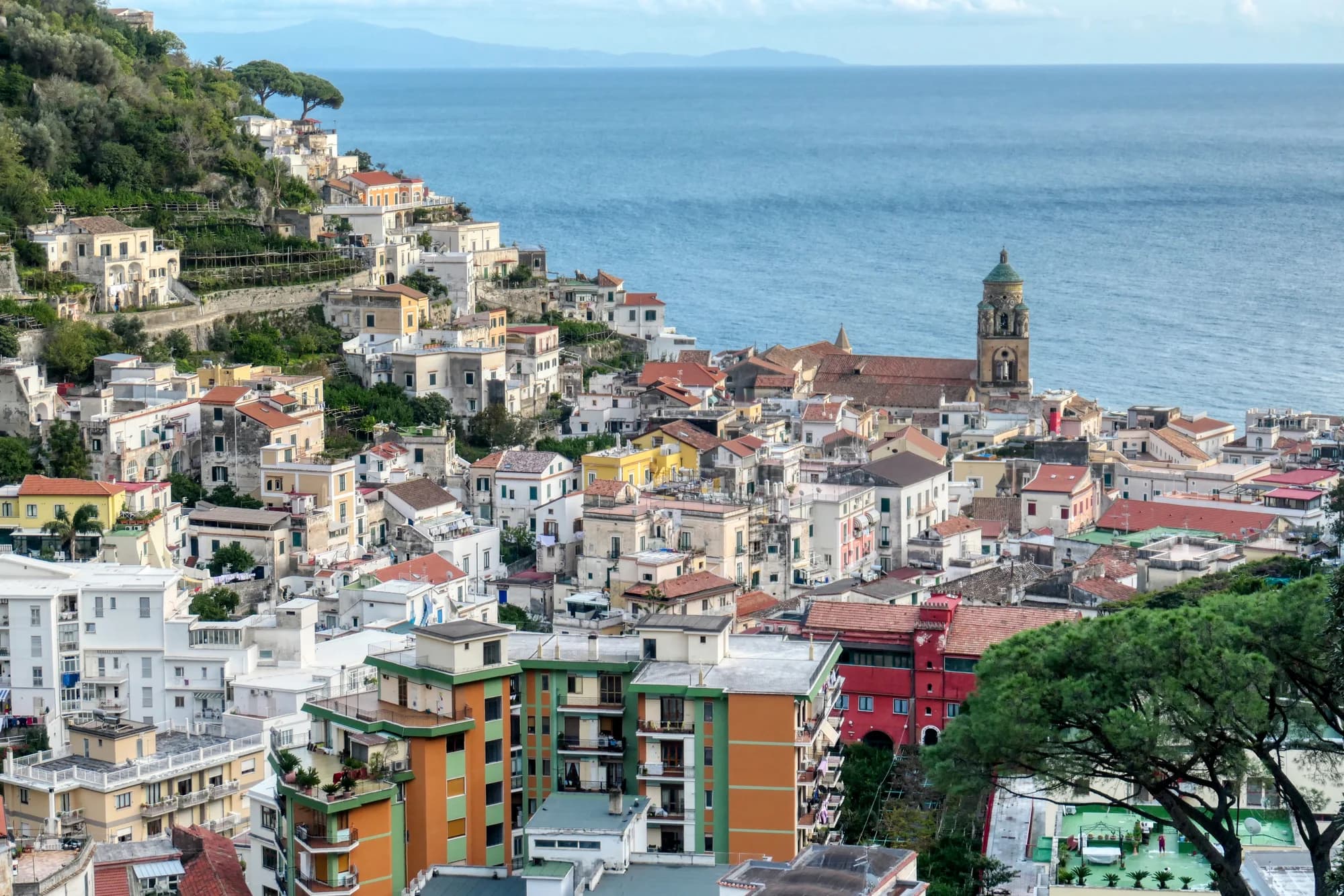
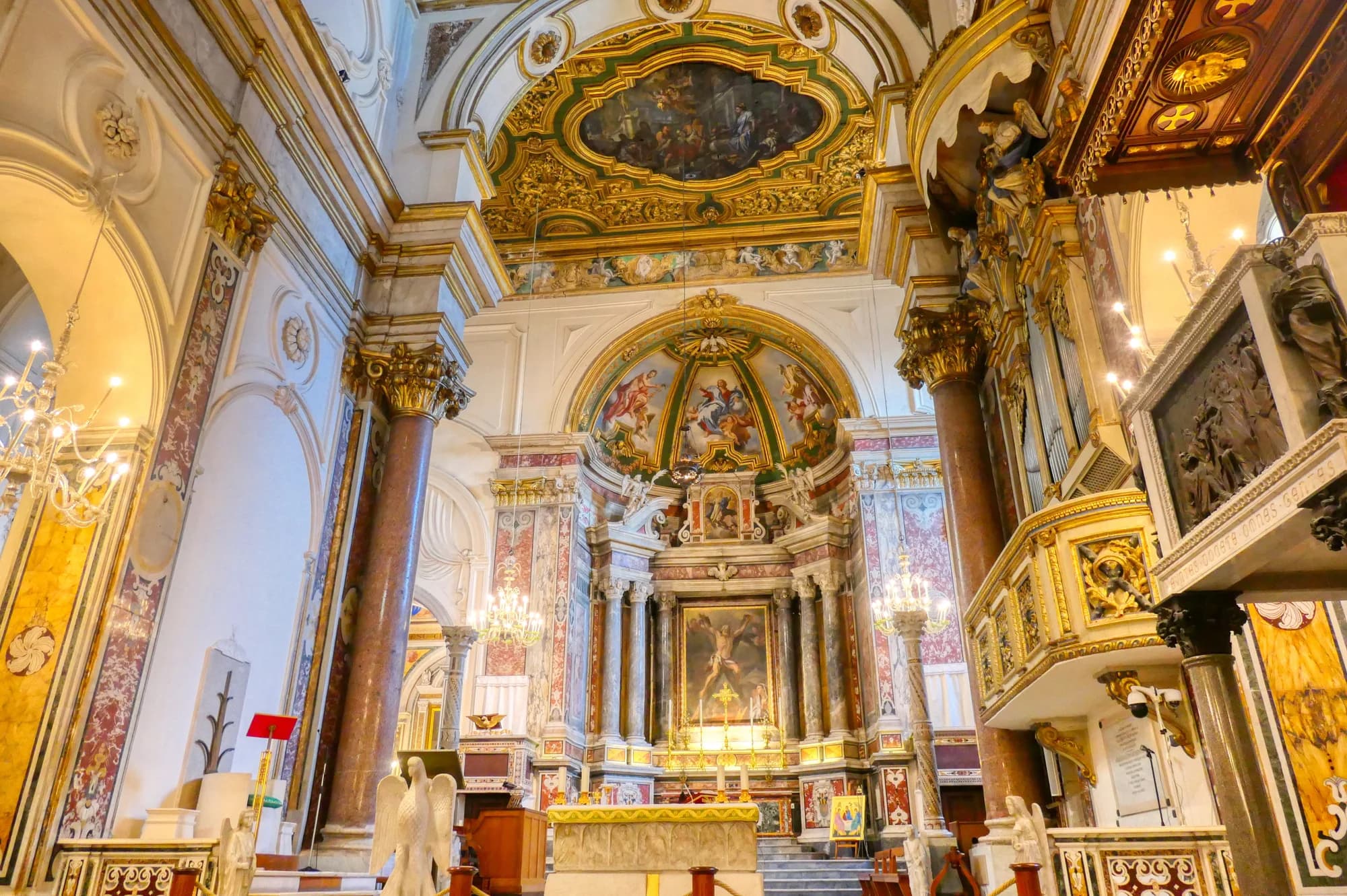
The Duomo di Sant'Andrea in Amalfi, its Arab-Norman facade climbing sixty-two steps to heaven
The Duomo di Sant'Andrea, whose 62-step staircase was begun in 1203, is a masterpiece of Arab-Norman architecture — the striped marble facade, interlaced arches, and geometric mosaics the product of Amalfi's centuries as a maritime republic that traded as far as Constantinople, Alexandria, and beyond. The cathedral's bronze doors were forged in Constantinople before 1066 and donated by a wealthy Amalfi merchant, Pantaleone di Mauro Comite, who had trading interests in the Byzantine capital. Beneath the cathedral, the Crypt of Saint Andrew holds relics of the apostle — taken from Constantinople during the Fourth Crusade in 1206 — that emit a mysterious liquid known as the Manna di Sant'Andrea, a phenomenon first recorded in 1304 and still occurring irregularly.
Praiano: The Quiet Soul
Between the two poles of Positano and Amalfi lies Praiano, a village that the guidebooks tend to skip and that the cognoscenti guard jealously. Praiano has no monument-level sights, no marquee cathedrals, no souvenir-lined streets — and that is precisely its gift. This is the Amalfi Coast as it was before the jet age discovered it: fishermen mending nets in the tiny Marina di Praia, old women shelling fava beans on their doorsteps, the church bells marking time rather than announcing tours.
The sunsets from Praiano are, by general consensus, the finest on the coast. The village faces due west, and as the sun sinks towards Capri, the entire sky turns the colour of peach skins and the sea becomes hammered gold. The Africana nightclub, carved into a cave on the cliff face, was once a venue where Jackie Kennedy danced barefoot; today it is more civilised, but the setting remains as improbably glamorous as ever. For the best sunset experience, book a table at Il Pirata, a restaurant perched on the rocks near the Grotta dello Smeraldo, where the seafood is as fresh as the view is eternal.
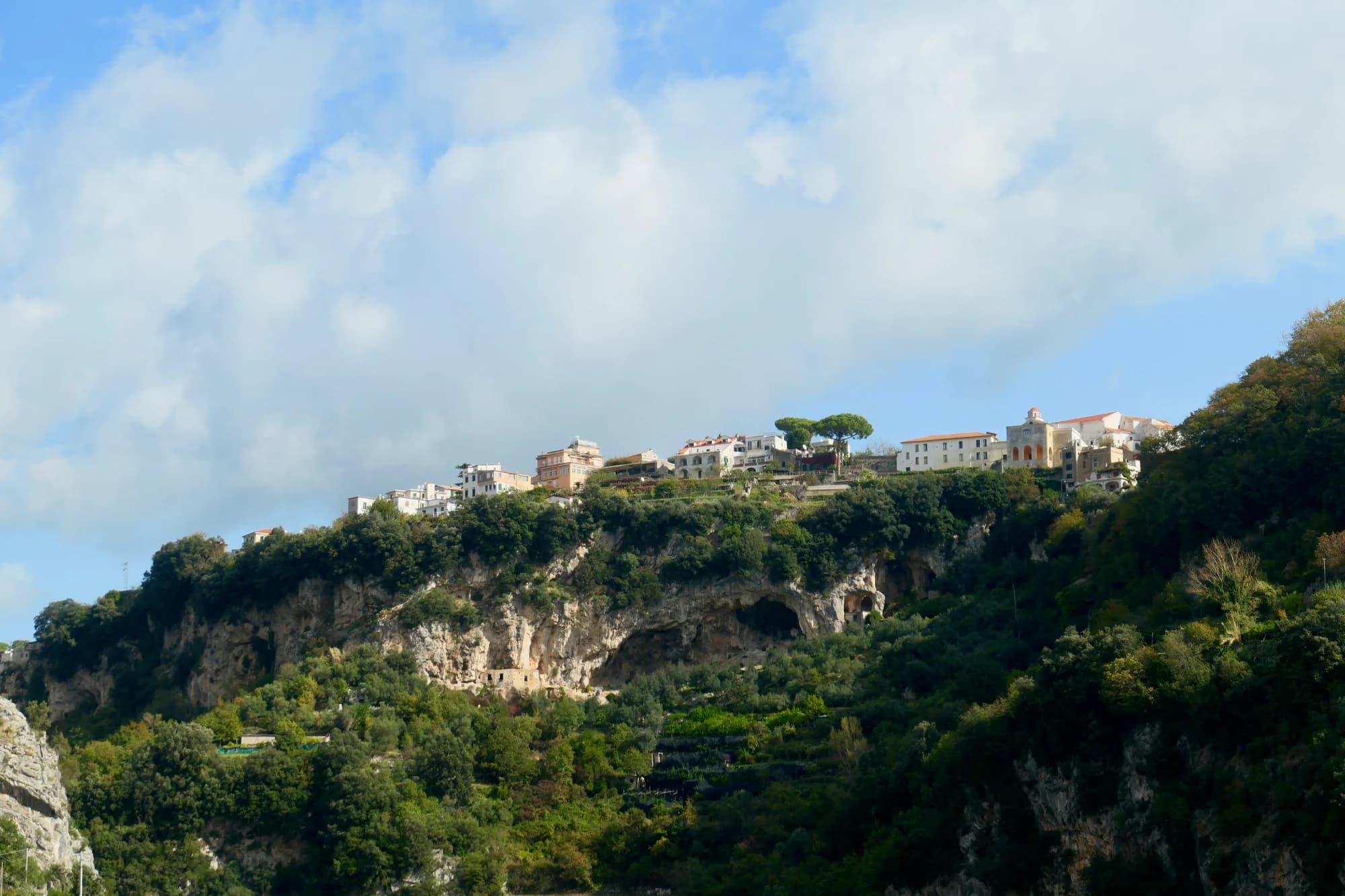
Sunset over Praiano, the quietest and most romantic village on the Amalfi Coast
Praiano, wedged between Positano and Conca dei Marini, is the Amalfi Coast's best-kept secret — a village that was once the doge's summer residence during the glory days of the Amalfi Republic (9th-12th centuries), chosen for its westerly orientation that guarantees unobstructed sunset views to Capri. The village's name derives from the Latin word plaga, meaning "beach," and its Marina di Praia is a narrow fjord between limestone cliffs that was once a busy fishing harbour exporting the prized anchovies of the Amalfi Coast. The church of San Gennaro, with its majolica-tiled dome visible from the sea, has stood on its clifftop since 1589, its bell tower serving for centuries as a navigational marker for ships rounding the Sorrentine Peninsula.
The Path of the Gods
Il Sentiero degli Dei — the Path of the Gods — is the Amalfi Coast's essential hike and one of the most beautiful walks in Europe. The path runs for approximately eight kilometres between Bomerano (a hamlet above Agerola) and Nocelle (above Positano), following the line where the mountains meet the sky at around five hundred metres above the sea. The name is not hyperbole: walking this path, with the entire coastline stretched out below you like a map of paradise, you will feel closer to the divine than you ever have in a cathedral.
Path of the Gods Practicalities
Start early — no later than 7:30 am between June and September — to avoid the midday heat. Bring at least two litres of water per person, wear proper hiking shoes (the path is rocky and uneven in sections), and carry a swimsuit for a post-hike dip at the Spiaggia di Arienzo below Positano. The walk takes approximately three to four hours at a moderate pace. There are no shops or water fountains along the route. From Nocelle, you can descend 1,700 steps to Positano or catch the local bus — after the hike, you have earned the bus.
The path itself is not technically difficult — there are no scrambles or exposed sections — but it is exposed to the sun for almost its entire length. The views, however, compensate for every drop of sweat: Capri floating in the haze, the Li Galli islands (once owned by Nureyev) below Punta Campanella, the pastel smear of Positano growing larger as you approach. Along the way, you pass ancient stone farmhouses, terraces of wild fennel and rosemary, and caves once inhabited by shepherds. The silence, broken only by the bells of goats and the distant murmur of the sea, is a luxury rarer than any five-star hotel.
Hikers on the Path of the Gods, the Amalfi Coast unfurling hundreds of metres below
Il Sentiero degli Dei (the Path of the Gods) runs from Bomerano to Nocelle along an ancient mule track used for centuries by farmers and traders transporting goods between the mountain villages above Agerola and the coastal settlements below — a journey that predates the SS163 coastal road by at least a millennium. The path's name, according to local lore, was given by a 19th-century priest who walked it with a visiting bishop; at a particularly spectacular bend, the bishop paused, looked at the coastline unfurling below, and asked "but is this not the path of the gods?" The path follows the contour line at approximately 500 metres above the Tyrrhenian, the elevation at which sea breezes meet mountain thermals, creating a near-constant updraft that makes the hair stand up — which ancient Greeks, who had a colony at Paestum to the south, would have interpreted as divine presence.
The Lost Art of Limoncello
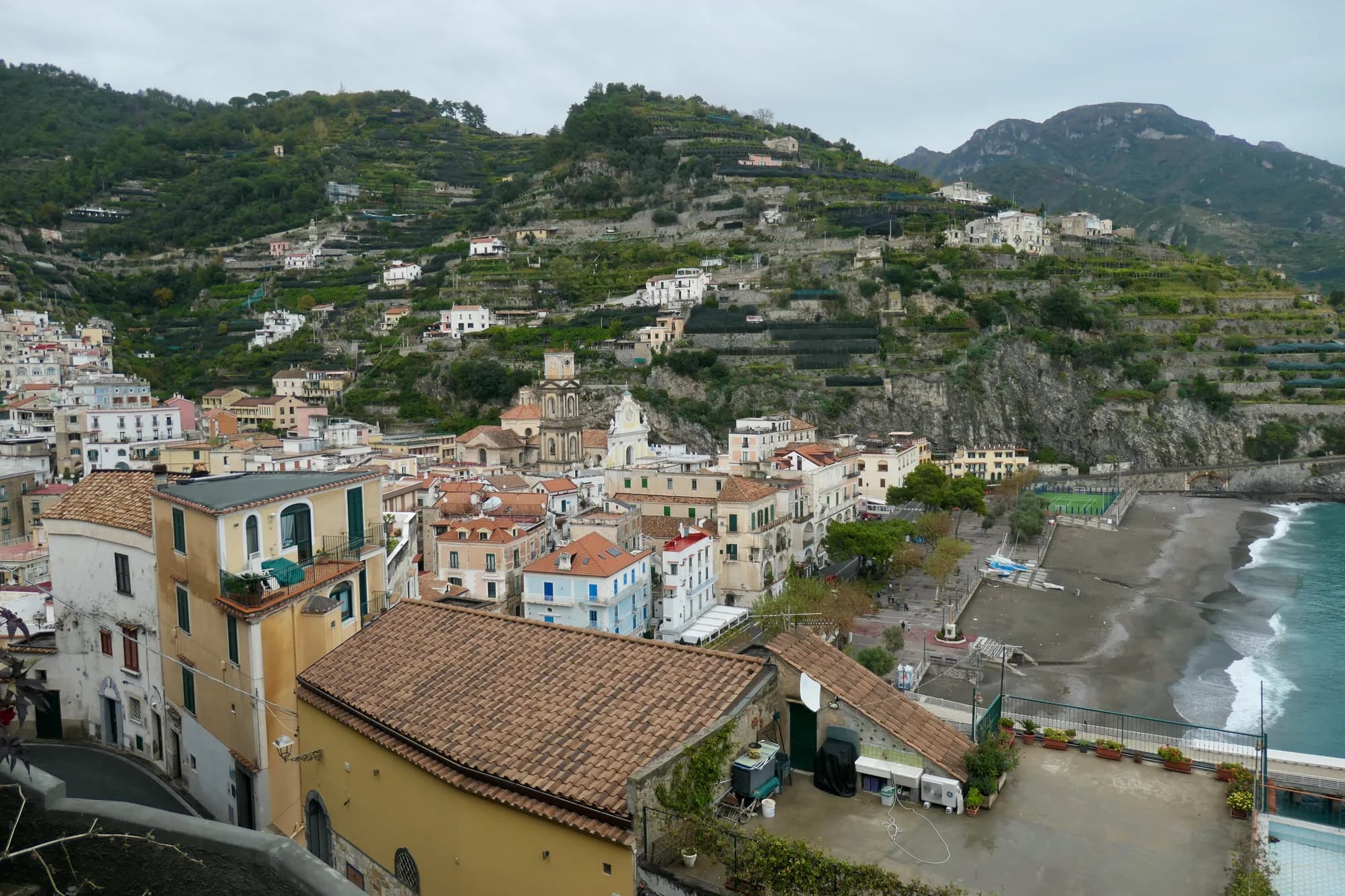
The Amalfi Coast is scented with lemons. Not the standard supermarket varieties but the sfusato amalfitano, a local cultivar of astonishing size — some are as large as a child's head — with thick, intensely aromatic peel and a sweetness that balances the sharpness. The lemons grow on pergolas of chestnut poles that terrace the hillsides, creating a patchwork of green and yellow that defines the agricultural landscape.
Limoncello, the bright yellow liqueur that has become the coast's liquid ambassador, is made by steeping the zest of these lemons in pure alcohol, then blending with a simple syrup. The best limoncello is homemade, and the best of the homemade is served ice-cold from a bottle kept in the freezer, poured into a chilled ceramic cup at the end of a long lunch. In the village of Minori, the pasticceria Sal De Riso produces a limoncello-infused dessert called "Riccione" that has achieved cult status; queue for it alongside the Neapolitans who drive down specifically for a slice.
Sfusato amalfitano lemons, as large as a child's head, growing on a pergola in Minori
The sfusato amalfitano lemon, a Protected Geographical Indication cultivar grown exclusively on the Amalfi Coast since the 11th century, can weigh up to 3 kilograms each — its elongated, spindle-like shape (sfusato means "tapered") distinguishing it from other Italian lemons. The chestnut-pole pergolas (pagliarelle) on which the lemons grow are a UNESCO-recognised agricultural structure dating to the 12th century, designed to shelter the fruit from winter winds while allowing maximum sunlight penetration — each pole requiring replacement every 15-20 years, and the entire structure a testament to the engineering ingenuity of Amalfi's medieval farmers. The thick, intensely aromatic skin of the sfusato, rich in essential oils, is the sole source of authentic Amalfi limoncello, a liqueur whose commercial production began in the early 20th century but whose domestic origins extend back to the citrus-growing kitchens of the Middle Ages.
Vietri sul Mare and the Ceramics Tradition
At the eastern gateway to the Amalfi Coast lies Vietri sul Mare, a town synonymous with ceramics. The tradition of Vietri ceramics dates to the fifteenth century, and the evidence is everywhere: on the dome of the church of San Giovanni Battista, on the tiles that decorate every street corner, on the signs that name the alleyways. The workshops along the Via Madonna degli Angeli and the Corso Umberto I are still family-run affairs, where artisans paint the characteristic patterns — lemons, roosters, scrolling vines — onto plates, vases, and tableware in brilliant Mediterranean colours. Buying directly from the workshop is cheaper than the boutiques of Positano, and you can watch the piece being painted before your eyes.
Vietri's beach, the Spiaggia della Marina, has a more local character than the glossier sands further west. The beach clubs here are simpler, the seafood trattorias more affordable, the pace distinctly less frenetic. It is an excellent base if you are driving along the coast and want a less expensive, more authentic alternative to Positano or Amalfi.
Sorrento: The Gateway
Sorrento is not technically part of the Amalfi Coast — it sits on the northern side of the Sorrentine Peninsula — but it serves as the traditional gateway. It is a proper town, not a vertical village, with a grid of shopping streets, a clifftop public garden with views across the Bay of Naples to Vesuvius, and a population that goes about its business regardless of the tourist seasons. The Grand Hotel Excelsior Vittoria, perched above the port, has been hosting royalty and artists since 1834; Caruso sang on its terrace, and the garden still holds a sense of Belle Époque languor.
From Sorrento's Marina Piccola, regular ferries and hydrofoils depart for Capri, Naples, and the Amalfi Coast villages. If your time is limited, a day trip to Capri is easy: the boat takes around twenty-five minutes, and the island offers a concentration of beauty — the Blue Grotto, the Piazzetta, the Gardens of Augustus, the chairlift to Monte Solaro — that justifies the crowds.
The Bay of Naples and Vesuvius from Sorrento's clifftop gardens at dusk
Mount Vesuvius, visible across the Bay of Naples from Sorrento's clifftop Villa Comunale, is the only active volcano on the European mainland and has erupted more than 30 times since its most famous eruption in 79 AD — which buried Pompeii under 4-6 metres of pumice and Herculaneum under 25 metres of pyroclastic flow. The volcano's height currently stands at 1,281 metres, though it was some 800 metres taller before the 79 AD eruption collapsed its cone into the caldera now ringed by Monte Somma. Sorrento itself, a Greek foundation from the 6th century BCE later absorbed by the Romans, was famous in antiquity for its wine — the Surrentine vintage praised by Pliny the Elder and Horace — though today it is the gateway to the Amalfi Coast, its clifftop gardens (where lemons and oranges scent the evening air) planted on the same volcanic tufa that makes the entire Bay of Naples one of the most fertile and densely inhabited volcanic landscapes on Earth.
Beach Clubs and Coastal Eating
The Amalfi Coast is not a long sandy beach destination. Its beaches are pebbly coves wedged between cliffs, and the swimming is vertical — you descend steps from the road, pay for your sunbed, and lower yourself into water of startling clarity. The compensation is the beach club culture, perfected here like nowhere else.
At Conca dei Marini, the Santa Croce beach club offers lunch in a restaurant carved into a cave, the sea lapping at the entrance. At Marina di Praia, the Africana's beach platform is the most dramatic on the coast. Near Positano, Arienzo Beach Club — a cascade of terraces down the cliff — is accessible by steps (many of them) or by boat shuttle from the main pier. The formula at all of them is consistent: reserve your sunbed, order a spritz, swim, read, eat a long lunch of spaghetti alle vongole and fritto misto, swim again, and do not look at your phone except to take photographs of the water.
The cuisine of the Amalfi Coast is anchored in the sea and the lemon. Scialatielli ai frutti di mare — thick, hand-cut pasta with clams, mussels, and prawns — is the definitive first course. Delizia al limone, a dome of lemon-scented sponge and cream, is the definitive dessert. The local white wine, Costa d'Amalfi DOC, is crisp and mineral, made from Falanghina and Biancolella grapes grown on terraces so steep they must be harvested by hand. Anchovies from Cetara — a fishing village just beyond Vietri — are preserved in salt or transformed into colatura, an amber liquid that is essentially the Mediterranean answer to fish sauce, used to dress spaghetti in one of the coast's most distinctive dishes.
The Anchovy Village
Detour to Cetara, a working fishing port between Vietri and Maiori, for a lunch that has nothing to do with tourism and everything to do with the sea. The anchovy is king here — fresh, salted, or fermented into colatura, the amber elixir that dates to Roman garum. At Acquapazza, a Michelin-starred restaurant on the harbour, the tasting menu revolves entirely around seafood from the waters you are looking at. For something simpler, the anchovy sandwich from a harbour stall, drizzled with olive oil and lemon, costs a few euros and tastes of the Tyrrhenian.
Frequently Asked Questions
**When is the best time to visit the Amalfi Coast?** Late May to early June and September are the sweet spots. The weather is warm but not oppressive, the sea is swimmable, the flowers are in bloom (May) or the light is golden and the crowds are thinning (September). July and August are hot, crowded, and expensive — book everything months in advance if you must travel in high summer. April and October can be beautiful but risk cool weather and some hotel and restaurant closures. November to March is the off-season; many establishments close entirely, and the coast takes on the quiet, introspective character of a place resting before the next wave of visitors.
**Should I rent a car?** This is the most contested question of Amalfi Coast travel. A car gives you freedom but brings the stress of navigating the SS163, finding parking, and dealing with the ZTL (limited traffic zones) in many town centres. If you are comfortable with narrow, winding mountain roads and are travelling with a small group, a compact car is viable — but book accommodation with parking. If you prefer relaxation, use the SITA buses, ferries, and the occasional private driver. The ferry network connects all the main towns from April to October and is the most pleasant way to travel: no traffic, no parking stress, and the coast seen from the water is even more beautiful than from the road.
**How many days do I need?** A minimum of three full days to sample Positano, Amalfi, and Ravello. Five days allows a deeper exploration including the Path of the Gods, a day trip to Capri, and time at beach clubs. A week enables you to truly settle into the rhythm of the coast, with side trips to Pompeii (from Sorrento) and Paestum (from Salerno).
**Is the Amalfi Coast suitable for families with young children?** Yes, with caveats. The steps, steep streets, and limited pushchair accessibility can be challenging. Choose accommodation with a pool and garden rather than a vertiginous cliffside villa. Positano's main beach is pebbly but well-serviced. The ferry rides are delightful for children. Avoid the height of summer if possible — the heat and crowds test even adult patience.
**What should I pack?** Comfortable walking shoes with good grip — you will climb thousands of steps. Swimwear (at least two sets), a wide-brimmed hat, high-factor sunscreen, and a cover-up for beach-to-town transitions. Evenings are smart-casual; Italians dress well, and while you will not need a jacket and tie, the beach-to-table look is frowned upon at good restaurants. A light jumper or wrap for the breezy ferry rides and the Ravello evenings, which are cooler given the altitude.
The pastel cascade of Positano at twilight, the Amalfi Coast's most enduring and beloved image
Positano at twilight — when the houses' pastel pigments, originally coloured with local mineral oxides, catch the last light and seem to luminesce from within — is a spectacle that has launched a million postcards and a thousand wedding proposals. The town's modern fame was secured by John Steinbeck's 1953 essay, but its first international visitors were German Romantic painters of the early 19th century, followed by Russian aristocrats and British aesthetes who formed an expatriate colony here in the 1890s. The Amalfi Coast was designated a UNESCO World Heritage Site in 1997, the citation noting that "the area constitutes an outstanding example of a Mediterranean landscape, with exceptional cultural and natural scenic values resulting from its dramatic topography and historical evolution" — but the Positano twilight, when the sun drops behind the Li Galli islands and the sky turns the colour of sfusato lemon zest, is a UNESCO-worthy phenomenon all its own.