Cairo is not a city. It is a galaxy of twenty-two million souls, the largest metropolitan area in Africa and the Arab world, and the cultural and political capital of the Middle East for much of the last thousand years. Greater Cairo — the city and its satellite conurbations, stretching from the Pyramids of Giza in the west to the New Administrative Capital in the east — is a place of such overwhelming density, noise, and vitality that it can take visitors several days to adjust to its rhythms. But once the adjustment is made, Cairo reveals itself as one of the world's greatest cities: the only surviving member of the Seven Wonders of the Ancient World (the Great Pyramid of Khufu, rising from the desert plateau at Giza); the richest collection of Islamic architecture anywhere on Earth (from the ninth-century Mosque of Ibn Tulun to the nineteenth-century Mosque of Muhammad Ali, which crowns the Citadel like a limestone crown); and a contemporary culture — literary, cinematic, culinary, musical — that remains, despite decades of political turbulence, the most influential in the Arab world.
The Nile, the river that created Egypt, flows through the city like a mobile geography — the east bank, where the sun rises, the ancient city of the living; the west bank, where the sun sets, the ancient city of the dead. The feluccas — the traditional lateen-rigged sailing boats that have been plying the Nile since Pharaonic times — are the essential Cairo experience, and an hour on the river at sunset, with the minarets of Islamic Cairo silhouetted against the sky and the call to prayer echoing from a thousand mosques, is as transporting as any experience in travel.
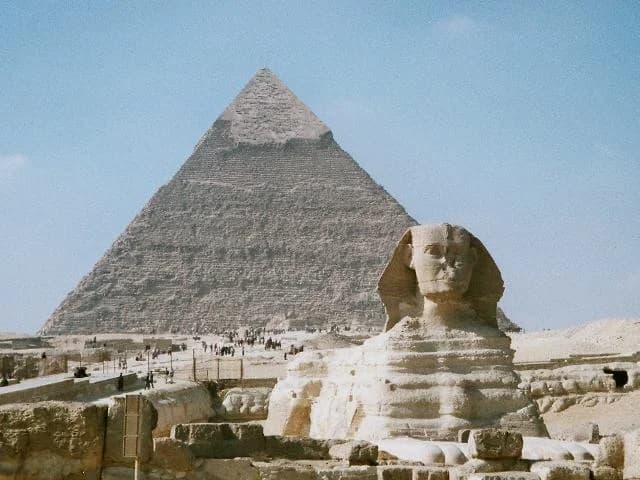
The Great Pyramid of Khufu at dawn — the last surviving Wonder of the Ancient World rising from the Giza plateau, the limestone catching the first light of the Egyptian sun, the desert stretching to the western horizon, the city of Cairo a distant presence on the eastern skyline, five thousand years of history compressed into a single, perfect geometry
The Great Pyramid of Khufu, completed around 2560 BCE during the Fourth Dynasty, stood 146.6 metres tall originally (now approximately 138.8 metres after the loss of its smooth Tura limestone casing) and remained the tallest man-made structure on Earth for 3,800 years — a record unmatched by any other building in history. Constructed from an estimated 2.3 million limestone blocks weighing between 2.5 and 80 tonnes each, the pyramid's base covers 13 acres and its sides align to the cardinal points of the compass with an accuracy within one-fifteenth of a degree — a precision that engineers still struggle to explain. The Greek historian Herodotus, writing in the 5th century BCE, recorded that 100,000 men laboured on the pyramid in three-month shifts over 20 years, though modern archaeological evidence from the recently discovered workers' village suggests a permanent skilled workforce of approximately 20,000, fed by an elaborate supply chain of bread, beer, and meat.
Giza: The Pyramids and the Sphinx
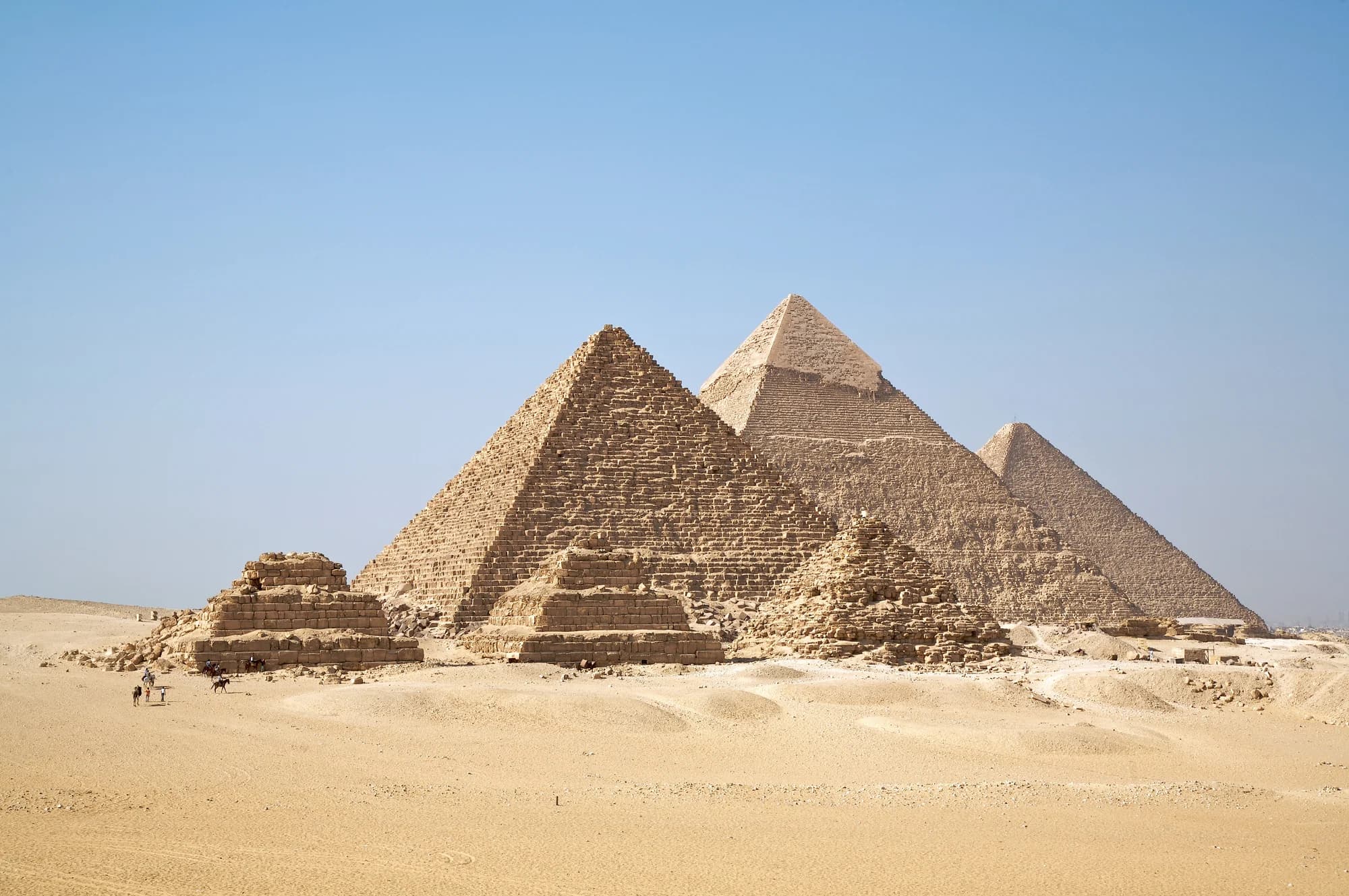
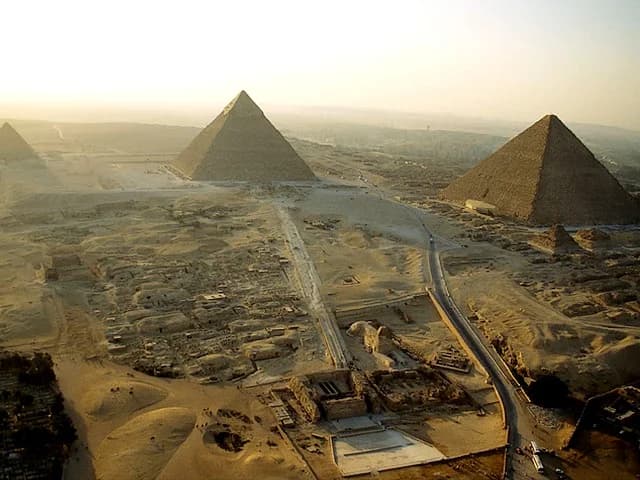
The Pyramids of Giza — the Great Pyramid of Khufu, the Pyramid of Khafre, and the Pyramid of Menkaure — are the reason travellers come to Cairo, and they do not disappoint. The Great Pyramid, 146 metres tall when completed in approximately 2560 BCE (it has lost roughly 9 metres of its original height to the removal of its limestone casing over the millennia), remained the tallest man-made structure on Earth for 3,800 years.
The essential strategy for visiting the Pyramids is to arrive at the Giza plateau when the gates open at 8 am — by 9:30 am, the tour buses from central Cairo have arrived and the site becomes a carnival of selfie sticks, camel touts, and the particular chaos of mass tourism at a world-famous monument. The morning light, low and golden, is the most flattering for photography, and the relative emptiness of the plateau in the first hour — with only the camels, the hawkers and the ancient stones for company — allows for a contemplation that the site does not otherwise permit.
The interior of the Great Pyramid — a narrow ascending corridor, the Grand Gallery (a space of such architectural drama that its 8.5-metre-high corbelled walls seem to close in on you as you climb it), and the King's Chamber, a simple granite-lined room containing the empty sarcophagus of Khufu — is claustrophobic, hot, humid, and absolutely essential for anyone who does not suffer from respiratory or mobility issues. The admission is limited to 300 tickets per day, and they sell out; book online, the moment tickets are released, or arrange for your hotel concierge to acquire them. The experience — standing in the heart of the Great Pyramid, surrounded by the seventy-ton granite blocks of the King's Chamber, breathing air that has been sealed in this space for 4,500 years — is one of the most potent encounters with the ancient world that a traveller can have.
The Grand Egyptian Museum — the GEM, a billion-dollar complex that opened its doors (partially) in 2024 and will, when complete, be the largest archaeological museum in the world — is a five-minute drive from the Pyramids. The architecture — a vast triangular form facing the pyramids across the desert, designed by Heneghan Peng architects after an international competition — is as ambitious as the collection. The star attraction, the entire contents of Tutankhamun's tomb (all 5,398 objects displayed together for the first time), includes the gold funerary mask that is, along with the Great Pyramid, the most famous object in Egypt. Book the first time slot of the day to experience the King Tut galleries in something approximating solitude.
The gold funerary mask of Tutankhamun — the lapis lazuli and carnelian inlaid in the gold, the nemes headdress striped in blue and gold, the serene face of a boy king who died at nineteen and whose tomb, by the accident of its survival, has become the most famous archaeological discovery in history
Tutankhamun's gold funerary mask, discovered by Howard Carter in 1922 in tomb KV62 in the Valley of the Kings, is crafted from 11 kilograms of solid gold and inlaid with lapis lazuli (from Badakhshan in modern Afghanistan, evidence of Bronze Age trade networks spanning over 4,000 kilometres), carnelian, turquoise, and coloured glass paste. The mask's nemes headdress bears the uraeus (rearing cobra) and vulture — symbols of the pharaoh's dominion over Lower and Upper Egypt respectively. Tutankhamun reigned from approximately 1332 to 1323 BCE, ascending the throne at around age 9 and dying at approximately 19; his tomb, uniquely among the pharaonic burials in the Valley of the Kings, was found substantially intact, its 5,398 objects now forming the centrepiece of the Grand Egyptian Museum.
“There is no there there — Gertrude Stein wrote this of Oakland. Cairo is its opposite. There is so much 'there' in Cairo that the visitor, overwhelmed, retreats to the hotel bar and tries to write a sentence that can contain it. No sentence can.”
Islamic Cairo: A Thousand Years of Architecture
Islamic Cairo — the medieval city that grew up around the Fatimid foundation of al-Qahira ("the Victorious") in 969 CE — is the greatest concentration of Islamic architecture in the world: mosques, madrasas, mausoleums, caravanserais, and hammams spanning a thousand years of architectural history, from the austere ninth-century Mosque of Ibn Tulun (the oldest mosque in Egypt surviving in its original form, a vast courtyard surrounded by arcades of pointed brick arches that predate the Gothic by two centuries) to the Ottoman mosques of the eighteenth century.
The Citadel of Saladin, built by the great Kurdish general who defeated the Crusaders and recaptured Jerusalem in 1187, crowns a spur of the Mokattam Hills and offers the definitive panorama of Cairo: the city spread beneath you in a carpet of minarets, the Nile winding through the smog, the Pyramids of Giza visible (on a clear day, which is to say from November to March, when the air is at its cleanest) on the western horizon. The Mosque of Muhammad Ali — the "Alabaster Mosque" — inside the Citadel was built in the Ottoman style between 1830 and 1848, and its central dome, flanked by two slender minarets, is the most recognisable silhouette in Islamic Cairo. The courtyard, with its arcades of alabaster columns and its central ablutions fountain, is one of the most beautiful spaces in the city, and the clock tower in the corner — a gift from King Louis-Philippe of France in 1846, in exchange for the obelisk that now stands in the Place de la Concorde in Paris — has never worked. The symbolism, of a broken clock in a working mosque, is the kind of thing that makes travel writers happy.
The Khan el-Khalili, the great bazaar of Cairo, is the economic and social heart of Islamic Cairo: a warren of narrow streets and covered alleys selling everything from gold jewellery to spices to the finest Egyptian cotton to the shisha pipes that are the essential accessory of Egyptian café culture. The bazaar dates from the fourteenth century (it was founded by the emir Jarkas al-Khalili, whose name it bears), and the experience of wandering through it — the air thick with the smell of cardamom, cumin, and the apple-scented tobacco of a thousand shisha pipes, the shopkeepers calling out invitations ("Just for looking! No buy, no problem!") in a dozen languages — is essential Cairo. The Fishawy Café, in the heart of the bazaar, has been serving coffee and tea since 1773, and its mirrored interior, its ancient waiters, and its clientele (Cairo intellectuals, foreign journalists, tourists, and the occasional Cairene who has been smoking shisha here every afternoon for forty years) make it one of the world's great cafés.
The Citadel of Saladin at sunset — the domes and minarets of the Mosque of Muhammad Ali glowing in the golden light, Cairo spread beneath like a carpet of mosques and apartment blocks and the eternal presence of the Nile, the Pyramids (if the day is clear) just visible on the western horizon, the call to prayer beginning its cascade across the city from a thousand minarets, the song of Islam in its most populous and ancient heartland
The Citadel of Saladin, constructed between 1176 and 1183 CE by Salah al-Din al-Ayyubi (Saladin), the Kurdish founder of the Ayyubid dynasty who defeated the Crusaders and recaptured Jerusalem in 1187, occupies a strategic spur of the Mokattam Hills and served as the seat of Egyptian government for nearly 700 years until the abdication of King Farouk in 1952. The Mosque of Muhammad Ali, whose Ottoman-style silhouette — a central dome flanked by two pencil minarets — dominates the Citadel, was built between 1830 and 1848 by the Albanian-born pasha who founded modern Egypt; its alabaster-clad interior and courtyard earned it the popular name 'the Alabaster Mosque.' The French clock tower in the courtyard, a gift from King Louis-Philippe in 1846 in exchange for the Luxor obelisk that now stands in the Place de la Concorde in Paris, has never functioned — a broken clock in an eternal mosque, a symbol of the asymmetrical exchange between East and West that continues to resonate.
The Egyptian Museum and the Mummies
The Egyptian Museum in Tahrir Square — the old museum, the pink neoclassical building that has been Cairo's principal repository of Pharaonic antiquities since 1902 — is, despite the transfer of the most famous artefacts to the GEM, still one of the world's great museums.
The Royal Mummy Room (separate ticket required) houses the mortal remains of the pharaohs of the New Kingdom: Ramses II (the Great, the longest-reigning and most powerful of the pharaohs, his aquiline nose and wispy hair still recognisable after 3,200 years), Seti I, Thutmose III, and the female pharaoh Hatshepsut, whose mummy was identified by a tooth (the sole surviving fragment of her body, found in a box inscribed with her name) in 2007. The experience — standing before the faces of men and women who ruled the most powerful empire of the ancient world, whose names are inscribed on monuments across Egypt and the Middle East, and who are now reduced to leathery skin and bone — is haunting. The pharaohs, who built the Pyramids to defy death, are dead. The Pyramids are not.
The Nile Cruise: Minarets and Sunset
The Nile, the longest river in the world (6,650 kilometres from its source in Lake Victoria to its delta on the Mediterranean), is the reason Egypt exists — a ribbon of water and fertility through one of the driest deserts on Earth, whose annual flood sustained Egyptian civilisation for five thousand years before the Aswan High Dam tamed it in 1970. The felucca — the traditional wooden sailing boat, its lateen sail a white triangle against the brown water and the blue sky — has been the essential transport on the Nile since antiquity, and an hour on the river at sunset, with the minarets of Islamic Cairo silhouetted against the western sky and the call to prayer echoing across the water, is the most beautiful experience Cairo offers.
For the luxury traveller, a private dahabiya — a larger, more comfortable version of the felucca, traditionally used by the Egyptian elite for Nile journeys — can be chartered for a multi-day cruise between Luxor and Aswan, the stretch of the Nile that contains the greatest concentration of Pharaonic monuments (the Valley of the Kings, Karnak, Luxor Temple, the tombs of the nobles). The boats — wooden, elegant, with private cabins and dining on deck — offer an experience of the Nile that the large cruise ships, with their hundreds of passengers and their fixed schedules, cannot approach. The Nile at dawn, the mist rising from the water, the palms on the riverbank silhouetted against the pink sky — is one of the great sights of the world.
Cairo's Rhythm
Cairo operates on a schedule that disconcerts the European traveller. The city wakes late (shops open at 10 am, offices at 9 am), takes a long lunch (1-4 pm), and comes alive in the evening. The peak hours for visiting monuments are early morning (8-10 am) and late afternoon (3-5 pm). The peak hours for eating are late — dinner starts at 9 pm and can stretch past midnight, particularly in the trendy restaurants of Zamalek and Heliopolis. The traffic is among the worst in the world; allow at least an hour for any journey across the city, and avoid travelling between 8-10 am and 4-7 pm. The metro is clean, efficient, and covers the main axes of the city; use it where possible.
Frequently Asked Questions
When is the best time to visit? October through April bring the most pleasant weather (18-28°C) and clearer skies for photography. June through September is hot (35-42°C), dusty, and physically demanding — but the sites are empty, the hotels are cheaper, and the desert light, if you can tolerate the heat, is magnificent. Ramadan is a wonderful time to visit: the city is quieter, the evenings (when the fast is broken with iftar — the meal after sunset) are festive, and the call to prayer from a thousand mosques, marking the end of the day's fast, is an experience of extraordinary power.
How many days do I need? Four full days at a minimum: one for the Pyramids and the GEM, one for Islamic Cairo (the Citadel, the mosque of Ibn Tulun, the Khan el-Khalili), one for the Egyptian Museum and Coptic Cairo, and one for a day trip — either to Saqqara and Dahshur (the Step Pyramid of Djoser, the Bent Pyramid and the Red Pyramid) or to the desert monasteries of Wadi Natrun. Five to six days allows for a more leisurely pace.
Is Cairo safe? Yes, in the sense that the security situation has been stable since 2015. The principal dangers are traffic, food safety (drink only bottled water, eat only in restaurants of good reputation, avoid raw vegetables unless you know the source), and the persistent hounding of tourists by touts. A firm "la shukran" (no thank you), repeated as often as necessary, is the essential Cairene phrase.
The Nile at sunset — a felucca gliding across the brown water with its lateen sail catching the evening breeze, the minarets of Islamic Cairo silhouetted against a sky of gold, rose, and deepening violet, the city a constant hum of traffic and prayer and twenty-two million lives, the river that created Egypt doing what it has done for millennia — flowing, silently, beautifully, indifferently, toward the sea
The Nile, at 6,650 kilometres, is the longest river in the world, flowing northward from Lake Victoria in Uganda through eleven countries before emptying into the Mediterranean Sea at the Nile Delta. Its annual inundation, which deposited nutrient-rich black silt across the floodplain for over 5,000 years, enabled the civilisation of ancient Egypt to flourish in an otherwise hyper-arid desert — the Greek historian Herodotus famously described Egypt as 'the gift of the Nile.' The felucca, with its distinctive lateen (triangular) sail, has been the primary vessel of Nile transport since Pharaonic times, depicted in tomb paintings dating to the Old Kingdom (c. 2686–2181 BCE). The Aswan High Dam, completed in 1970, ended the annual flood cycle, transforming Egyptian agriculture and ecology in ways that are still being assessed half a century later.