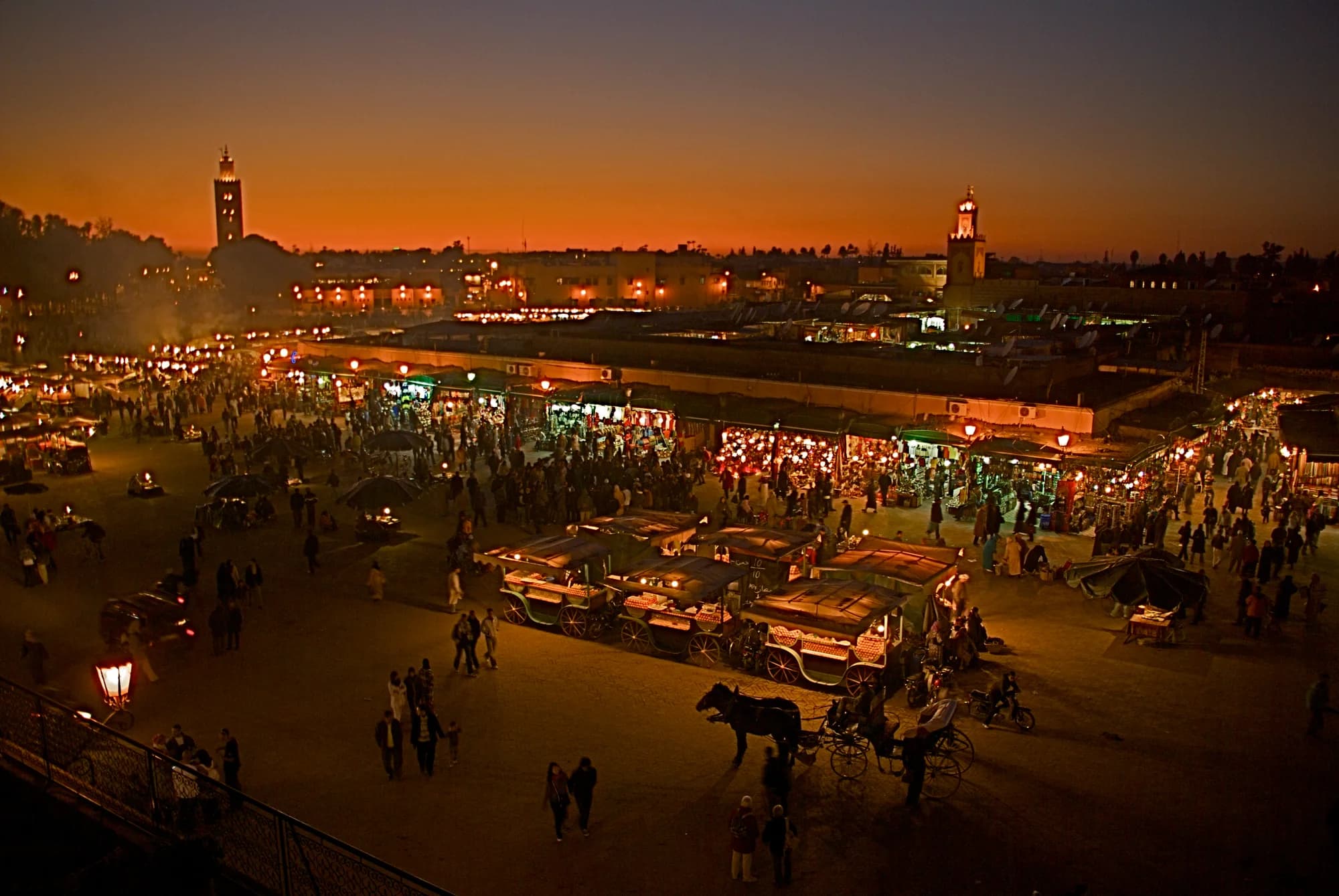
Marrakech is a city that assaults the senses in the most magnificent way. The first encounter — the Jemaa el-Fnaa, the great square at the heart of the medina, at dusk — is one of the great urban experiences on Earth: snake charmers, storytellers, orange juice vendors, smoke rising from a hundred food stalls, the call to prayer echoing from the minaret of the Koutoubia Mosque, the High Atlas Mountains a wall of snow on the southern horizon. The square, a UNESCO Masterpiece of the Oral and Intangible Heritage of Humanity, is not a tourist attraction; it is a thousand-year-old tradition that continues, every evening, to turn the centre of the city into a theatre, a circus, a restaurant, and a gathering place for the entire population of Marrakech and a good portion of the world.
Marrakech has been the capital of Moroccan luxury since the 1920s, when the French painter Jacques Majorelle created his garden — a botanical masterpiece of cobalt blue walls (the famous Majorelle Blue, a pigment so intense it seems to vibrate) and plants from five continents in the middle of the Palmeraie — and the expatriate community discovered that the light, the climate, and the particular atmosphere of a city at the edge of the desert could seduce even those who had seen everything. Yves Saint Laurent and Pierre Bergé bought the Majorelle Garden in 1980, preserving it from development, and the designer's ashes were scattered there in 2008. The garden, now open to the public, is the most visited site in Morocco, and the Musée Yves Saint Laurent next door, which opened in 2017, tells the story of the designer's creative relationship with Marrakech — a relationship that produced some of his most celebrated collections. The gift shop, stocked with objects of a quality that most museum shops cannot match, is the best in the city.
The Jemaa el-Fnaa at dusk — the square transformed into a living theatre of food stalls, storytellers, musicians, and the smoke of a hundred grills, the Koutoubia minaret illuminated against a sky of deepening indigo, the High Atlas mountains a dark presence on the southern horizon, the energy of a thousand years of tradition compressed into a single, overwhelming spectacle
The Jemaa el-Fnaa, Marrakech's central square since the city's founding by the Almoravid dynasty in 1070 CE, was inscribed by UNESCO in 2008 on the Representative List of the Intangible Cultural Heritage of Humanity — the first square in the world to receive such recognition. The square's name in Arabic translates roughly as 'assembly of the dead,' likely referring to the public executions that once took place here under various dynasties. Today it is a living theatre where halqa (storytelling circles), a tradition dating to the medieval period, features hlayqia (storytellers) reciting epic tales from the Arabian repertoire, while snake charmers, acrobats, henna artists, and the famed food stalls — some run by the same families for generations — create a nocturnal spectacle that has drawn travellers from Ibn Battuta in the 14th century to Edith Wharton and Winston Churchill in the 20th.
The Medina: A City Within a City
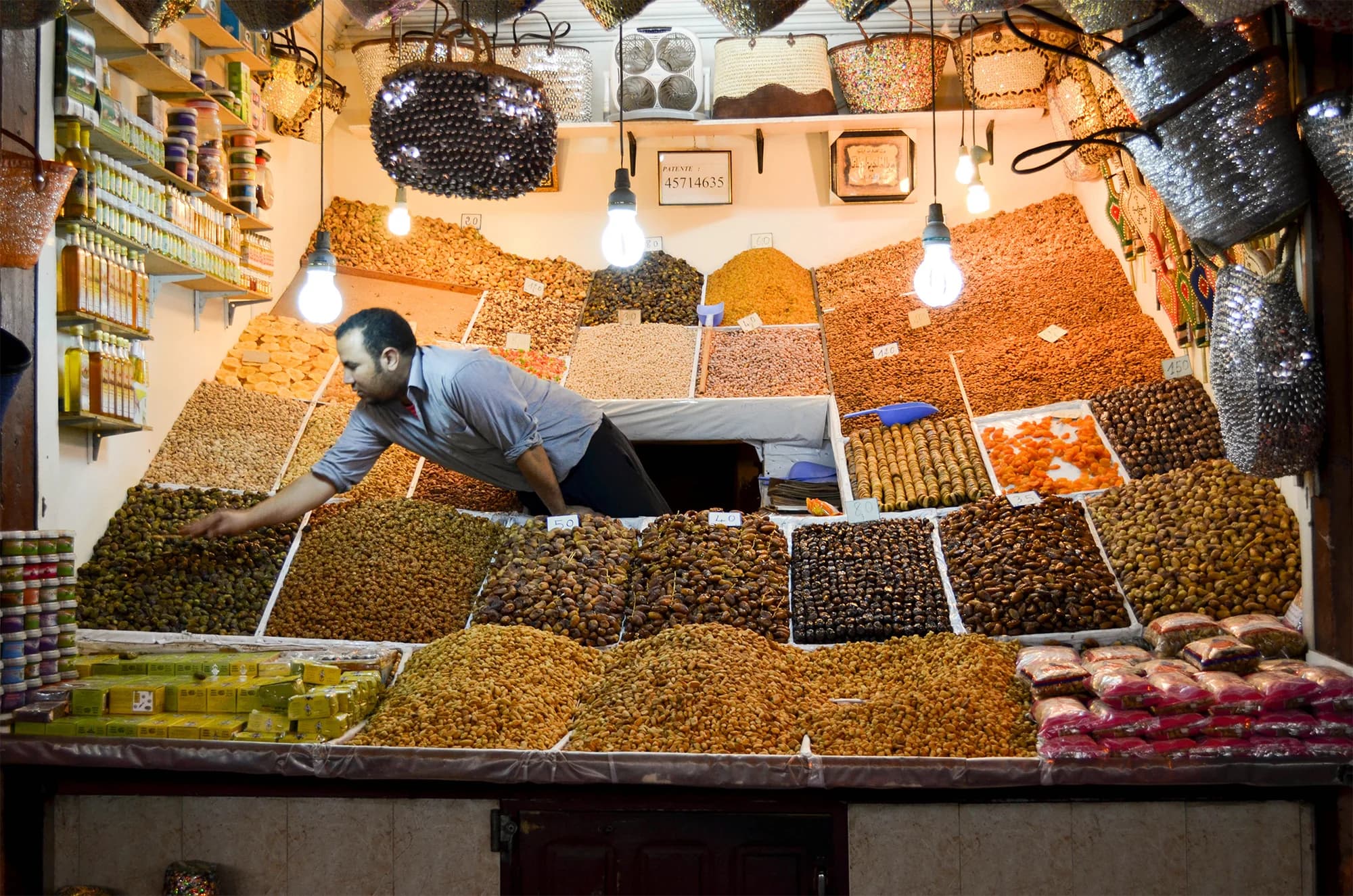
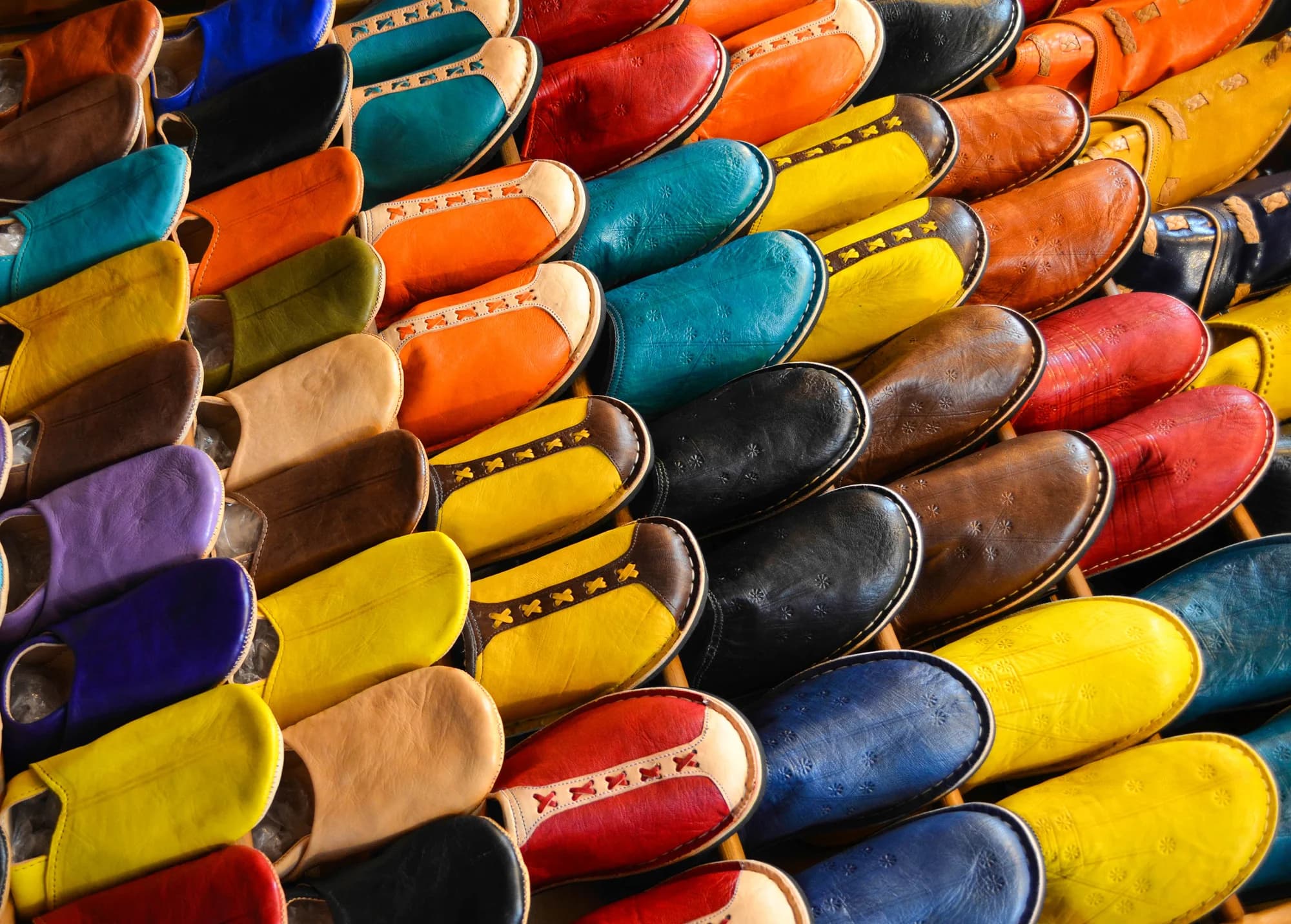
The medina of Marrakech, a UNESCO World Heritage Site, is one of the largest and most complex medieval cities in the world — a labyrinth of 2,000 streets that houses 200,000 people, and in which it is possible, and advisable, to get lost. The souks — the markets that have been the economic engine of Marrakech since the city was founded in 1070 — sell everything from spices (the pyramids of saffron, cumin, and ras el hanout that fill the air with their scent) to leather (the babouches, the pointed leather slippers that are Morocco's essential footwear) to metalwork (the lanterns of pierced brass that filter the light into patterns of a thousand stars) to carpets (the Berber rugs of the High Atlas, wool woven by women in patterns that encode the history and identity of their tribes).
The Essence of the souks is the haggling — a ritual that, for the uninitiated, can feel confrontational but is in fact a form of social engagement, a negotiation of respect and relationship as much as price. The essential rules: never accept the first price (it will be roughly double what the vendor expects to receive), remain friendly and good-humoured, and be prepared to walk away — the price will follow you. The vendor will not be offended by your bargaining. He will be offended if you do not bargain. The transaction, once completed, is sealed with a handshake and a "barakallah fik" — God bless you — that transforms a commercial exchange into a human one.
The medina's riads — the traditional courtyard houses that have been converted into boutique hotels — are the essential Marrakech accommodation. The riad, an inward-facing house organised around a central courtyard with a fountain, citrus trees, and a roof terrace, is the architectural expression of a culture that values privacy, family, and the beauty of the interior world over the public street. Many of the finest riads — La Maison Arabe, Riad El Fenn (owned by Vanessa Branson, decorated by artists from around the world), Riad Kniza — have been restored to a standard that rivals the city's palace hotels, and the experience of returning from the chaos of the medina to the cool, tiled serenity of a riad courtyard, with a glass of mint tea and the sound of the fountain, is one of the essential pleasures of travel in Morocco.
A riad courtyard at midday — the zellige tiles in patterns of green, blue, and white, the fountain at the centre filling the air with the quiet sound of water, the citrus trees casting dappled shade across the central courtyard, the intricate carved plaster of the walls and the painted cedarwood of the ceiling testifying to the centuries of craft tradition that created the Moroccan interior, the chaos of the medina a world away and a moment's walk
The riad, from the Arabic riyad ('gardens'), is the traditional Moroccan courtyard house, an architectural form that originated in the medieval Islamic city and reflects a culture that privileges interior beauty, family privacy, and the symbolic representation of paradise — the quadripartite garden with a central fountain evoking the four rivers of Jannah described in the Quran. Zellige, the geometric mosaic tilework that covers the lower walls, fountains, and stair risers of Moroccan architecture, is crafted by maâlems (master craftsmen) who cut individual pieces from glazed terracotta tiles using a sharpened hammer called a menqach, assembling patterns — typically based on eight-pointed stars — that have been passed down through guilds since the Merinid dynasty (13th–15th centuries). Carved stucco (gebs), made from a mixture of lime, marble powder, and egg white, is applied to the upper walls and arches while still wet, then intricately carved by hand with floral, geometric, and calligraphic motifs — the three decorative elements of zellige, stucco, and painted cedarwood (including the characteristic zouak ceiling patterns) forming the holy trinity of Moroccan architectural ornament.
“If you want to know the East, you must first fall in love with its silence — and in Marrakech, you must learn to find silence within the noise, beauty within the chaos, and yourself within the labyrinth.”
The Palaces and Monuments
The Bahia Palace, the nineteenth-century residence of the Grand Vizier Bou Ahmed, is the finest surviving example of Moroccan palace architecture. The palace — built over fourteen years by a vizier determined to create a residence that would outlive the dynasty whose name it bore (bahia means "brilliance") — is a sequence of courtyards, gardens, and rooms covered in zellige (mosaic tilework), stucco, and painted cedarwood, the three decorative elements that define Moroccan architecture. The harem courtyard, with its central fountain and its gallery of intricately carved cedarwood, is the most beautiful space in the palace — and the most photographed. The palace is best visited in the morning, when the light is low and the crowds are thin, and the experience of walking through its sequence of empty rooms and quiet courtyards, with the stucco glowing in the filtered light and the sound of fountains in the air, is a transport into a world that has largely vanished.
The Ben Youssef Madrasa, the largest Islamic college in North Africa, was built in the fourteenth century and rebuilt in the sixteenth by the Saadian sultan Abdallah al-Ghalib. The central courtyard — a masterpiece of zellige, carved stucco, and cedarwood, with a large central pool for ablutions — is one of the most beautiful enclosed spaces in the Islamic world, and the 132 student cells that surround it, each barely large enough for a bed and a desk, are a reminder of the asceticism that underlay the intellectual life of the medieval Islamic world. The madrasa operated until 1960, and the graffiti in some of the cells — students' names, dates, prayers — is a human connection to the centuries of young men who studied here.
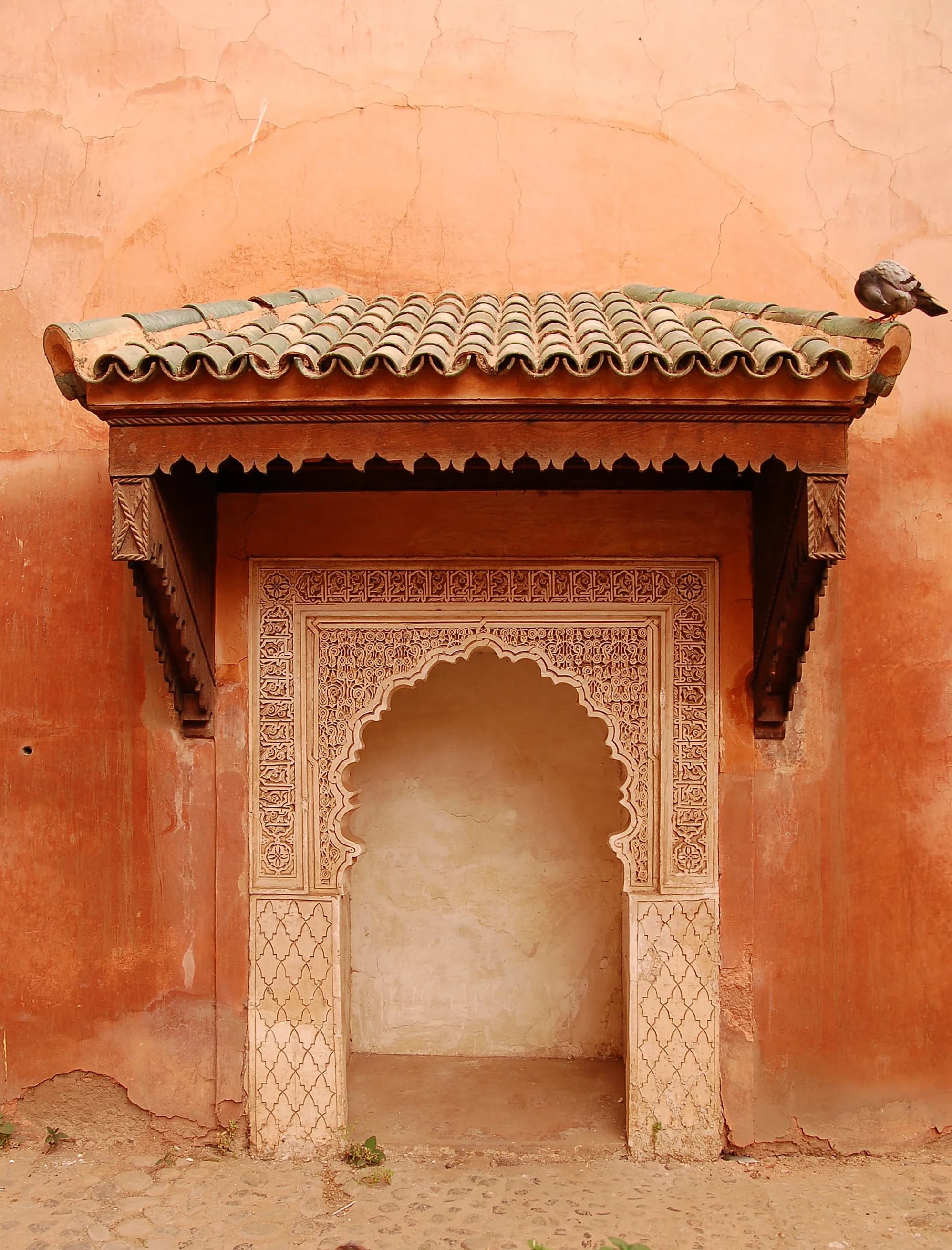
The Saadian Tombs, rediscovered in 1917 after having been walled up for two centuries (the Alaouite sultan Moulay Ismail, who wanted to erase all memory of his predecessors, sealed them in the eighteenth century, inadvertently ensuring their preservation), are the burial place of the Saadian dynasty. The Hall of Twelve Columns, where Sultan Ahmad al-Mansur and his family are interred, is a chamber of such exquisite decoration — Carrara marble columns, honeycomb muqarnas vaulting in carved stucco, zellige paneling of extraordinary refinement — that it justifies the queue, which can stretch to an hour in peak season. Go early, or go late; the tombs close at 4:45 pm, and the last hour is the quietest.
The central courtyard of the Ben Youssef Madrasa — the zellige tiles in geometric patterns of blue, green, and white, the carved stucco archways framing the student cells, the shallow ablutions pool reflecting the sky, the silence a profound counterpoint to the chaos of the souks just beyond the madrasa's walls, six centuries of Islamic scholarship compressed into a single perfect space
The Ben Youssef Madrasa, originally founded in the 14th century by the Marinid sultan Abu al-Hassan and rebuilt in 1564–65 by the Saadian sultan Abdallah al-Ghalib, was the largest Islamic college in North Africa, housing up to 900 students in 132 cells clustered around its central courtyard. The madrasa's decorative programme — zellige mosaic tilework, carved stucco with muqarnas (stalactite) vaulting, and intricately painted cedarwood ceilings — represents the apogee of Saadian architectural patronage during Morocco's golden age. The madrasa operated continuously for nearly 600 years until 1960, making it one of the longest-running educational institutions in the Islamic world, and the calligraphic frieze encircling the courtyard bears the basmala ('In the name of God, the Most Gracious, the Most Merciful') executed in Maghrebi thuluth script.
The Gardens of Marrakech
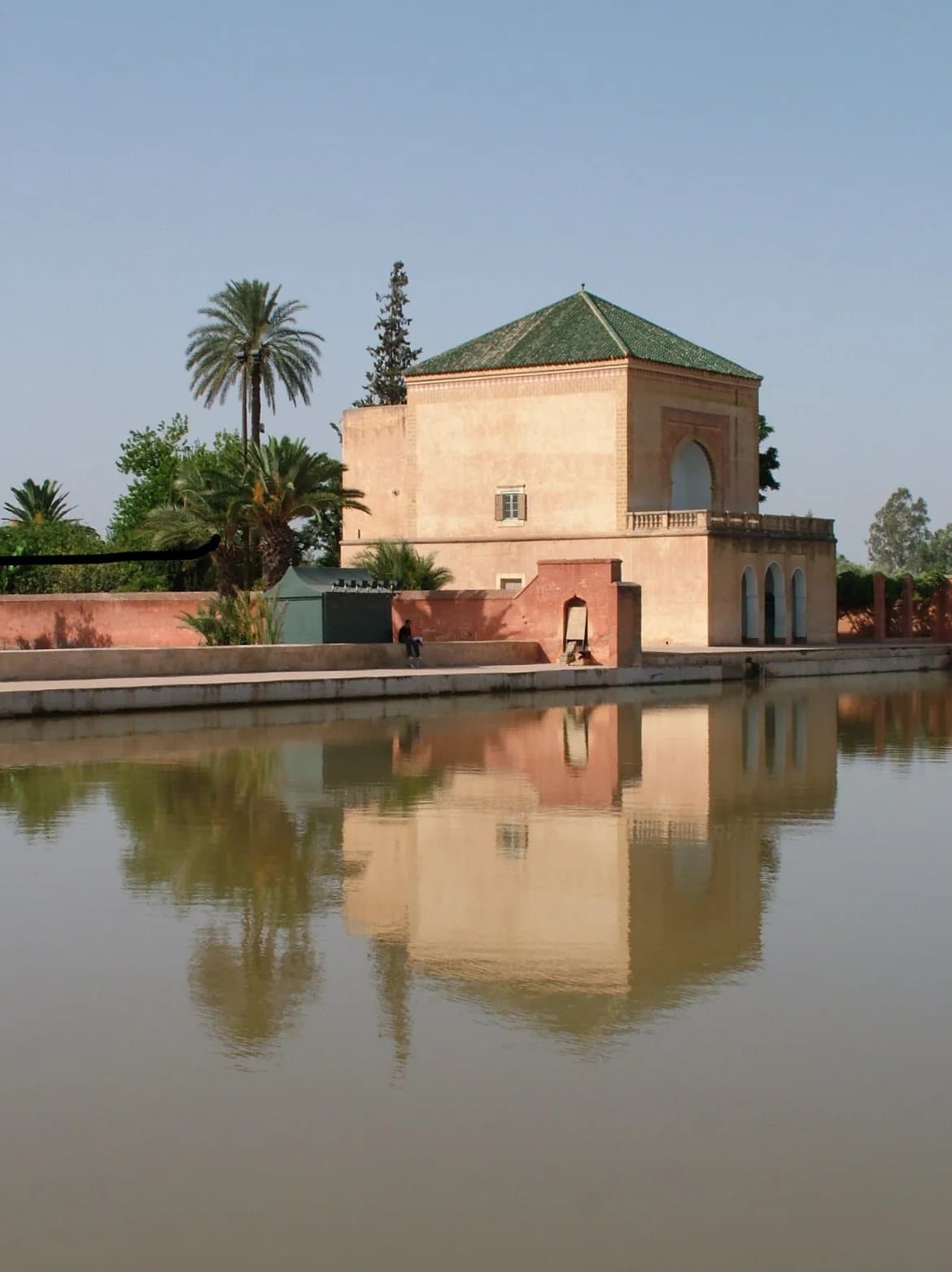
Marrakech is a garden city, and its gardens — the cultivated oases that have been an essential feature of Moroccan urban life since the Almoravid period — are sanctuaries of green and water that provide relief from the heat and dust of the medina. The Majorelle Garden, created by Jacques Majorelle over forty years from 1923 and restored by Yves Saint Laurent and Pierre Bergé, is the most famous — a botanical composition of cacti, palms, bamboo, bougainvillea, and water features, set against walls of the intense cobalt blue that Majorelle created and trademarked. The garden is at its most beautiful in the morning, when the light filters through the bamboo and the visitors are (relatively) thin, and the Islamic Art Museum of Marrakech, housed in Majorelle's former painting studio, contains a small but exquisite collection of Berber jewellery, textiles, and artefacts from the Atlas Mountains.
The Secret Garden — Le Jardin Secret — is a more recent revelation: a historic riad garden in the heart of the medina, restored and opened to the public in 2016. The garden, divided into an Islamic garden (a quadripartite layout with a central fountain, symbolising the four rivers of Paradise described in the Quran) and an exotic garden (filled with plants from around the world, including species collected by the wealthy caïds who owned the property in the nineteenth century), is a model of restoration and interpretation. The tower, the only structure in the medina that offers a rooftop view without a restaurant attached, provides a panorama of the medina and the Atlas Mountains that is worth the climb.
The Palmeraie — the palm grove on the northern edge of the city — is not a garden but a landscape: 100,000 palm trees planted by the Almoravids in the eleventh century, irrigated by a network of underground channels (khettara) of pre-Islamic origin that remain one of the marvels of desert agriculture. The Palmeraie is best explored by camel — the classic tourist experience, available from dozens of operators, and genuinely enjoyable despite the cliché — or, for those who prefer horsepower to camel power, by vintage sidecar from a company like Marrakech Insiders, whose restored Soviet Ural sidecars offer a tour of the Palmeraie that is as stylish as it is fun.
The Majorelle Garden in early morning — the cobalt blue walls, the towering cacti silhouetted against the clear Moroccan sky, the bamboo and bougainvillea creating corridors of green and magenta, the small museum of Berber arts in the painter's former studio, the garden that seduced Yves Saint Laurent and has been seducing visitors ever since Jacques Majorelle planted his first palm a century ago
The Majorelle Garden was created over forty years from 1923 by the French Orientalist painter Jacques Majorelle, who collected plants from five continents — cacti from the Americas, bamboo from Asia, palms from across the tropics — and built his studio in the centre of what became a botanical masterpiece and the most visited site in Morocco. Majorelle created and trademarked the intense cobalt blue pigment ('Majorelle Blue') that covers the walls, pots, and architectural details — a colour he derived from the deep blue of traditional Berber tiles and the luminous cobalt pigment used in Moroccan zellige. Yves Saint Laurent and Pierre Bergé purchased the garden in 1980 to save it from a planned hotel development; Saint Laurent, who credited Marrakech and the Majorelle Garden with teaching him about colour — 'the city taught me colour,' he once said — designed many of his most celebrated collections here, and after his death in 2008, his ashes were scattered in the rose garden.
The Desert Beyond: A Day Trip to the Atlas
The High Atlas Mountains, visible from every rooftop in Marrakech, rise to over 4,000 metres and are, in winter, covered in snow — an improbable sight from the palm groves and rose gardens of the city. The Ourika Valley, a ninety-minute drive from Marrakech, is the most accessible slice of the Atlas experience: a valley of Berber villages, terraced agriculture, and a river whose banks are lined with poplars and walnut trees. The Monday market at Tnine Ourika — the largest rural market in the region, where everything from livestock to electronics is traded — is one of the great socio-economic spectacles of rural Morocco. The waterfall at Setti Fatma, at the head of the valley, is a popular destination, but the real pleasure is the journey: the villages clinging to the mountainsides, the women washing clothes in the river, the terraces of wheat and barley and almond trees that have sustained the Berber communities of the Atlas for millennia.
For a more immersive experience, the Kasbah du Toubkal, a restored Berber fortress at 1,800 metres above Imlil, is one of the most extraordinary hotels in North Africa — a property that won a Responsible Tourism Award for its commitment to the local community, and whose terrace offers views of Jebel Toubkal, the highest peak in North Africa at 4,167 metres, that are worth the stomach-churning drive up the mountain. The kasbah was built by a local caïd in the nineteenth century, fell into ruin, and was restored by two British brothers in the 1990s. The result is a hotel that employs the local Berber community, serves traditional Moroccan food of exceptional quality (the tagines are cooked in the same kitchens that served the caïd), and offers hiking — guided by local Berber men who have been walking these mountains since childhood — from the doorstep. Even a single night at the Kasbah du Toubkal is an experience that redefines what travel can mean.
The Marrakech Mentality
Marrakech requires a recalibration of expectation. The medina will overwhelm you. The haggling will exhaust you. The motorbikes in the narrow streets will terrify you. And then, on the second or third day, something shifts. You learn to navigate by the minaret of the Koutoubia rather than by street names. You discover that the seemingly aggressive invitation to enter a shop is, in fact, an invitation to conversation — and that the shopkeeper, once you have established that you are not buying anything, is happy to talk about football, politics, family, and the price of saffron. You find the quiet courtyard behind the noisy street. You discover that mint tea — the sugary green tea that is Morocco's universal gesture of hospitality — is genuinely delicious. Marrakech does not change to accommodate you. You change to accommodate Marrakech. That is the experience.
Frequently Asked Questions
When is the best time to visit? March through May and September through November offer the most pleasant temperatures (20-30°C). June through August is hot (35-45°C), but the city is quieter, the hotels are cheaper, and the desert light is at its most intense. December through February is cool (10-20°C during the day, near freezing at night), with the High Atlas capped in snow — a spectacular backdrop that no other desert city can match.
How many days do I need? Four full days is the minimum: one for the medina and the souks, one for the palaces and the Ben Youssef Madrasa, one for the Majorelle Garden, the Yves Saint Laurent Museum, and the Palmeraie, and one for a day trip to the Atlas or the Agafay Desert. Five to seven days allows for a deeper immersion and a night or two in the Atlas.
What should I wear? Morocco is a conservative Muslim country, and both men and women should dress modestly. For women: shoulders covered, knees covered, nothing tight or revealing. A scarf, while not required, is useful for entering mosques (non-Muslims may not enter most mosques in Morocco, but the tin-mosques of the Atlas and some smaller shrines make exceptions). For men: long trousers and short-sleeved shirts. The Moroccan concept of hshuma (shame/disgrace) governs public behaviour; excessive displays of affection, drinking in public, and shouting in anger are all unacceptable.
Is Marrakech safe? Yes, in the sense that violent crime against tourists is extremely rare. The principle dangers are pickpocketing in the medina (particularly around the Jemaa el-Fnaa at night), motorbike snatch-thefts, and the general chaos of a medieval city with a modern population. Walk with purpose, keep your valuables in a zipped bag slung across your body, and do not flash wealth. The hustlers are persistent but harmless, and a firm "la shukran" (no thank you) will deter most of them.
The Koutoubia Mosque at sunset — the 77-metre minaret, the architectural model for the Giralda in Seville and the Hassan Tower in Rabat, rising above the palm trees and the rooftops of the medina, the High Atlas Mountains silhouetted against a sky of gold and rose, the call to prayer echoing across the city from a dozen minarets, Marrakech entering the hour of magic — the magic hour — when everything softens, everything glows, and even the most jaded traveller feels a stirring of something that might be, for want of a better word, wonder
The Koutoubia Mosque, completed around 1158 under the Almohad caliph Abd al-Mu'min, derives its name from the Arabic kutubiyyin ('booksellers'), referring to the manuscript and book traders who once clustered in the surrounding souks. Its 77-metre sandstone minaret, with its distinctive square shaft and the three golden orbs at its summit, became the architectural prototype for Almohad minarets across the empire: the Giralda of Seville (completed 1198) and the unfinished Hassan Tower in Rabat (begun 1195) are both direct descendants of the Koutoubia design. The mosque, rebuilt on its current site in the late 12th century after the discovery that the original structure was not precisely aligned with Mecca, is the largest in Marrakech and remains a functioning place of worship closed to non-Muslims, its minaret — illuminated at night and visible from virtually every rooftop in the medina — serving as the unmissable navigational landmark for which no GPS can substitute in the labyrinthine alleys of the old city.