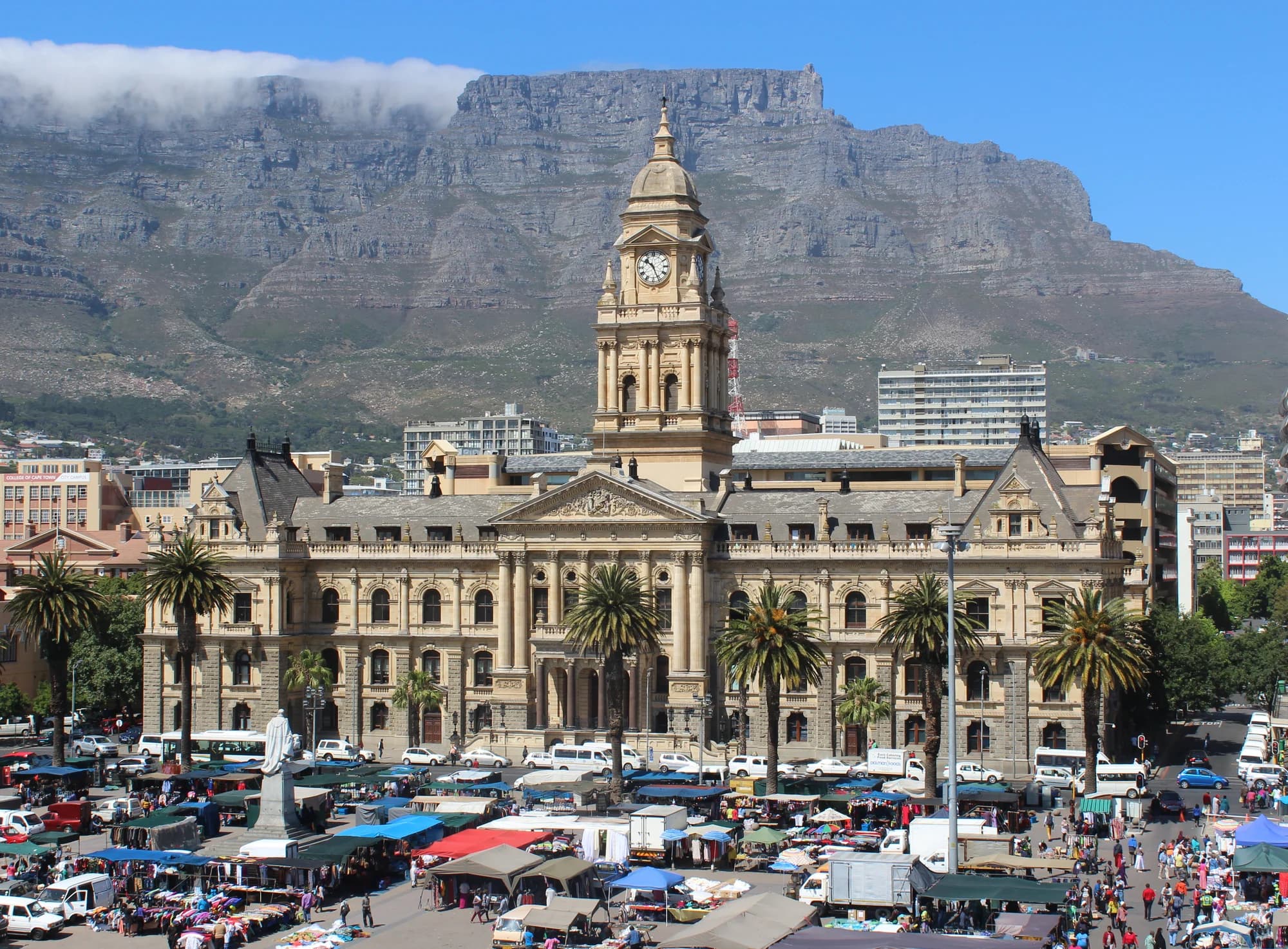
Cape Town is the most beautiful city in Africa — a statement that invites comparison with Marrakech, with Stone Town, with Lamu, and that survives all of them. The city is built on a peninsula of such extraordinary geological drama that it barely seems to belong to this planet: Table Mountain, a 1,086-metre plateau of sandstone that rises from the Atlantic coast like a fortress at the edge of the world, its summit often covered by the "tablecloth" — a layer of cloud that spills over the edge and evaporates in the hotter air below — while the Twelve Apostles ridge extends south toward Cape Point, and the Atlantic and Indian Oceans meet, in a confusion of currents and temperatures, somewhere beyond the Cape of Good Hope. No other city on Earth is dominated by its natural setting so completely. The mountain is Cape Town — its orientation point, its backdrop, its weather-maker, its soul.
South Africa is a country of staggering natural wealth and heartbreaking social complexity, and Cape Town, its most beautiful city, concentrates both qualities. The luxury traveller — arriving at the V&A Waterfront, perhaps, or at one of the vineyard hotels of Constantia — will find a city of world-class restaurants, hotel infrastructure that rivals any in the Mediterranean, and natural beauty that arguably exceeds it. The same traveller, driving ten minutes from the Waterfront to the Cape Flats (the townships where the apartheid government forcibly relocated the city's non-white population), will encounter poverty of a kind that exists, in the contemporary world, only in the cities of the Global South. Cape Town does not permit the luxury of ignorance. It demands that you see everything — the beauty and the pain, the wealth and the deprivation, the aspiration and the struggle — and that you hold them all, simultaneously, in your mind. That is the challenge, and the gift, of the Mother City.
Table Mountain from Bloubergstrand at dawn — the mountain a dark massif against the pink and gold of sunrise, the tablecloth beginning to form at the summit, the city invisible across the bay, the ocean a sheet of hammered silver, the most beautiful profile of the most beautiful mountain in Africa, and possibly the world
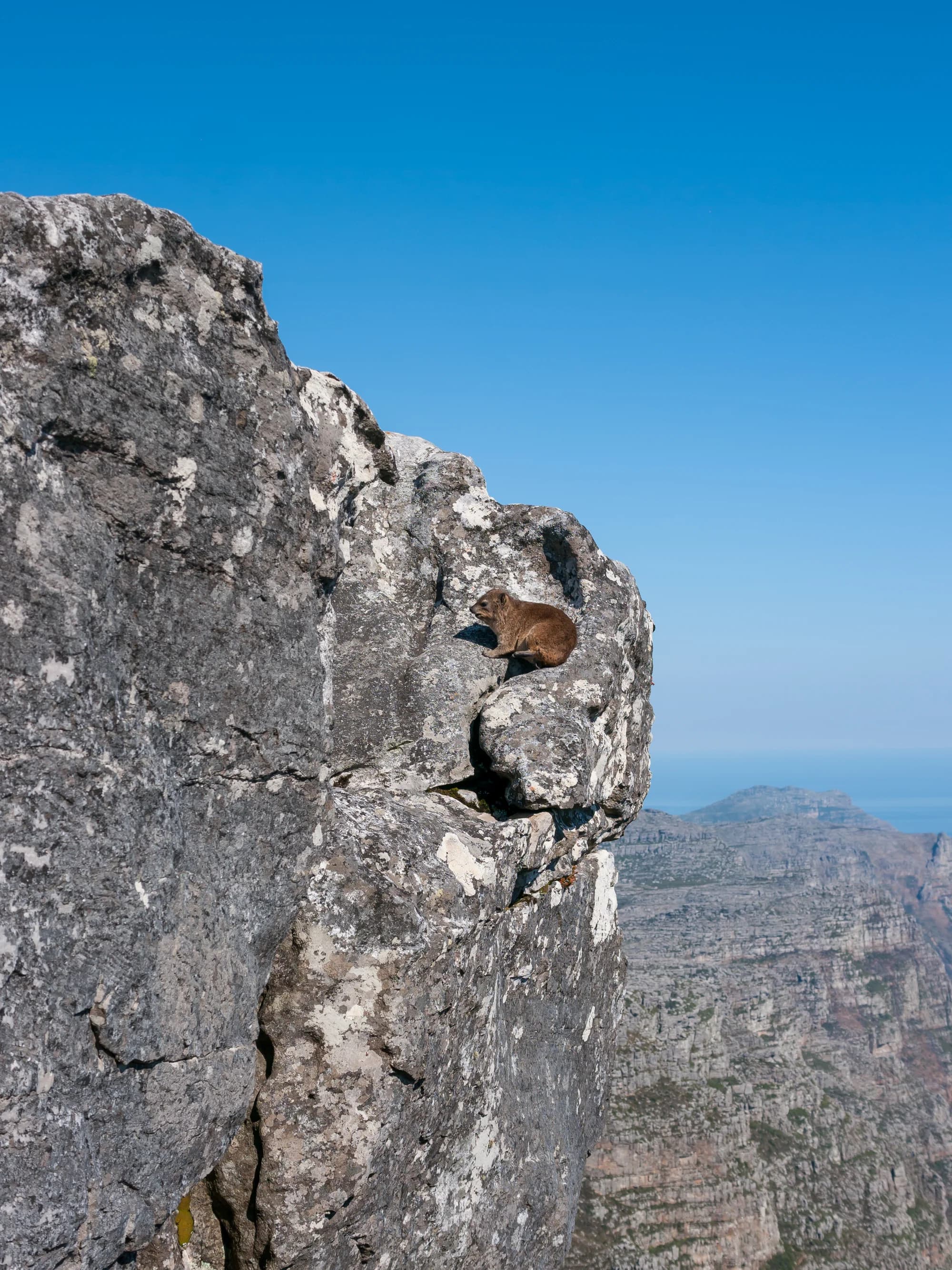
Table Mountain, named Hoerikwaggo ('mountain in the sea') by the indigenous Khoisan people, is one of the oldest mountains on Earth — its sandstone dates from the Cambrian period approximately 500 million years ago, making it roughly six times older than the Himalayas and older than the first multicellular life on land. Its flat summit plateau, spanning approximately 3 kilometres from end to end at 1,086 metres above sea level, is covered in fynbos — the Cape Floral Kingdom, the smallest and richest of the world's six floral kingdoms, containing over 2,285 plant species on the mountain alone, more than the entirety of the British Isles, with approximately 70% being endemic. The 'tablecloth' cloud formation, caused by moist Atlantic air forced up the mountain's slopes and condensing at the dew point, is a meteorological phenomenon documented by Portuguese navigators as early as the 15th century.
Table Mountain: The Sacred Height
Table Mountain — Hoerikwaggo, "the mountain in the sea," in the Khoisan language — has been sacred to the indigenous peoples of the Cape for millennia, and one look at it, rising sheer from the ocean, explains why. The mountain is one of the oldest on Earth: its sandstone dates from the Cambrian period, 500 million years ago, and the forces that shaped it — plate tectonics, glaciation, erosion — have produced a landform of such sculptural perfection that it is, even to the most determinedly secular, a religious experience.
The ascent, by the Table Mountain Aerial Cableway (which has carried more than 30 million visitors since it opened in 1929 — the new cable cars, introduced in 1997, rotate through 360 degrees, giving every passenger a complete panorama of the city, the sea, and the mountain during the five-minute journey), delivers you onto a plateau of fynbos — the Cape's unique floral kingdom, the smallest and richest on Earth, with 2,285 plant species (more than the entirety of the British Isles) found on the mountain alone, most of them endemic. The plateau is criss-crossed with paths leading to viewpoints of such staggering drama — the city at your feet, the Atlantic stretching to the horizon, the Cape of Good Hope a distant smudge to the south, Robben Island (where Nelson Mandela spent eighteen of his twenty-seven years of imprisonment) a green presence in Table Bay — that they can induce a kind of vertigo, not of the body but of the spirit. This much beauty, absorbed all at once, is a shock.
The alternative to the cableway is to walk. Platteklip Gorge — the standard route, a steep staircase of stone steps that climbs the mountain's front face — takes one to two hours and is achievable by anyone with moderate fitness. The India Venster route, more challenging and more interesting, involves scrambling up rock faces with chains and ladders, and the views — of the city, the sea, and the mountain falling away beneath you — are a reward that justifies every moment of exertion. The Skeleton Gorge route, approaching from the Kirstenbosch side, climbs through indigenous forest before emerging onto the plateau — the most beautiful and the longest ascent. All of the walking routes require a guide, or at least careful preparation, or preferably both; the mountain claims lives every year, usually of visitors who underestimated it. The weather changes in minutes. The cloud descends without warning. The mountain is not a theme park. Respect it.
The view from the summit of Table Mountain at sunset — the city a carpet of lights stretching to the dark Atlantic, the Twelve Apostles ridge extending south in silhouette, the fynbos glowing bronze in the last light, the cable car descending into the gathering dusk, the sense of standing on a sacred height, a plateau in the sky, a place that the Khoisan people called "the mountain in the sea" and that the world has not improved upon for a name
The Table Mountain Aerial Cableway, which has carried over 30 million visitors since opening in 1929, was upgraded in 1997 with Swiss-designed Rotair cars whose floors rotate 360 degrees during the five-minute journey, providing every passenger with a complete panorama of the city, the Atlantic seaboard, and the mountain. The summit plateau's network of paths and viewpoints encompasses Robben Island — the former prison island 6.9 kilometres offshore where Nelson Mandela spent 18 of his 27 years of imprisonment along with other anti-apartheid activists — visible as a green presence in Table Bay. The Twelve Apostles ridge, named by British colonial officials for the biblical apostles, extends roughly 6 kilometres southward from the main plateau, its seventeen distinctive buttresses (despite the name, there are seventeen, not twelve) carved by millions of years of erosion from the Table Mountain Sandstone formation.
“During the many years of incarceration on Robben Island, we often looked across Table Bay at the magnificent silhouette of Table Mountain... To us on Robben Island, Table Mountain was a beacon of hope. It represented the mainland to which we knew we would one day return.”
The Cape Peninsula: The Edge of Africa
The Cape Peninsula, the mountainous finger of land that extends 52 kilometres south of the city to Cape Point and the Cape of Good Hope, is one of the world's great drives — a road (Chapman's Peak Drive, carved into the mountainside above the Atlantic, one of the most spectacular engineering feats of the twentieth century) that winds between mountains and ocean, passing fishing villages (Hout Bay, Kalk Bay, Simon's Town), penguin colonies (Boulders Beach, where 3,000 African penguins have established a colony on the white sand and the granite boulders), and the fynbos vegetation that covers the peninsula like a botanical blanket of astonishing diversity.
Cape Point, the end of the Cape Peninsula, is not, despite popular belief, the southernmost point of Africa (that is Cape Agulhas, 150 kilometres east, where the Atlantic and Indian Oceans officially meet). But Cape Point is the most dramatic — the lighthouse on the highest rock, the cliffs plunging 200 metres into the ocean, the views of False Bay and the Atlantic stretching to a horizon that hides Antarctica somewhere beyond. Flying Dutchman funicular takes you to the lighthouse, but the walk — a steep but brief ascent from the car park — is more rewarding. The Cape of Good Hope, a short drive from Cape Point, is the southwestern-most point of Africa, a spit of rock and sand and the crashing of two oceans — the Atlantic cold, the Indian warm, their meeting a turbulence of currents and temperatures that created the Cape of Storms, the name that the Portuguese navigator Bartolomeu Dias gave it in 1488, before King John II, realising the route to India had been opened, renamed it the Cape of Good Hope.
Boulders Beach, near Simon's Town, is the essential stop on the Peninsula tour: a beach of white sand and enormous granite boulders on which a colony of African penguins (Spheniscus demersus, the Jackass Penguin, so called for its braying call) has established itself since 1982. The penguins, which have grown from two breeding pairs to a colony of 3,000, are unperturbed by humans, and allow approach to within a metre or two — close enough for photographs, not so close as to invite a bite (the penguins, while small and comical on land, have beaks sharp enough to draw blood and will use them). The boardwalk through the colony, with the penguins nesting beneath it and the beach of Foxy Beach beyond, is one of the most unusual wildlife experiences in Africa.
Chapman's Peak Drive at golden hour — the road a ribbon carved into the mountainside 600 metres above the Atlantic, the sea a sheet of blue and turquoise stretching to the horizon, Hout Bay a crescent of white sand in the distance, the fynbos glowing in the afternoon light, one of the most beautiful roads on the planet doing what it does best: making the driver pull over every hundred metres with an exclamation of disbelief
Chapman's Peak Drive, a 9-kilometre engineering marvel carved into the near-vertical western flank of Chapman's Peak between Hout Bay and Noordhoek, was completed in 1922 and is often described as one of the most spectacular marine drives in the world. The road was constructed using convict labour and employed a pioneering cantilevered design to anchor the roadway to the cliff face, with 114 curves tracing the contours of the mountain. Hout Bay, the fishing village visible from the drive's northern section, was named 'Wood Bay' by early Dutch settlers in 1652 for the timber they harvested from its forested slopes, and its harbour is today home to a working fishing fleet, a colony of Cape fur seals that loaf on the quayside, and the Mariner's Wharf fish market.
The Winelands: Constantia, Stellenbosch, and Franschhoek
The Cape Winelands, forty-five minutes' drive from Cape Town, produce some of the finest wines in the Southern Hemisphere, and the experience of tasting them — in the Cape Dutch manor houses, with their whitewashed gables, their thatched roofs, and their views of mountains and vineyards that seem to have been arranged by a landscape architect with immoderate ambition — is one of the world's great wine experiences.
Constantia, the oldest wine region in the Southern Hemisphere (the first vines were planted in 1685 by the Dutch governor Simon van der Stel), is fifteen minutes from the city centre, and its vineyards — Groot Constantia (the manor house, designed by Louis-Michel Thibault, is a masterpiece of Cape Dutch architecture), Klein Constantia, Buitenverwachting — produce wines (the sauvignon blanc, the chardonnay, the legendary Vin de Constance, a sweet wine that was the favourite of Napoleon, Jane Austen, and the courts of Europe in the eighteenth century) that are worth the short journey. Lunch at Buitenverwachting, on the terrace overlooking the vineyards and the Constantiaberg mountains, a glass of their sauvignon blanc in hand and a plate of freshly caught Cape salmon before you — is a deeply civilised experience.
Stellenbosch, the second-oldest town in South Africa (founded 1679), is the heart of the Winelands: a university town of oak-lined streets, Cape Dutch architecture, and more than 150 wineries within a thirty-minute radius. The town itself, with its whitewashed houses, its village museum, and its restaurants (Rust en Vrede for the tasting menu and the ox-tongue pastrami; Overture at Hidden Valley for chef Bertus Basson's seasonal cooking; the Delaire Graff Estate for the views, the art, and the Laurence Graff Signature Cabernet Sauvignon), is worth a day in itself.
Franschhoek, the "French Corner," was settled by French Huguenot refugees in the 1680s, and their influence — in the winery names (La Motte, Haute Cabrière, Dieu Donné), the cuisine (the town has one of the highest concentrations of top-tier restaurants in South Africa), and the Bastille Day celebrations — persists. The Franschhoek Wine Tram, a hop-on-hop-off tram that visits eight wineries on two routes, is a tourist experience that is genuinely enjoyable: no one has to drive, the scenery is spectacular (mountains, valleys, vineyards, the whole Franschhoek Valley spread beneath you), and the wine is excellent. The Tasting Room at Le Quartier Français (the restaurant of chef Margot Janse, one of the pioneers of South African cuisine) has closed, but the new generation of restaurants — Protégé, La Petite Colombe, Chefs Warehouse at Maison — has ensured that Franschhoek's culinary reputation survives.
The vineyards of Stellenbosch in autumn — the vines turning gold and red, the Cape Dutch manor houses white and gabled against the mountains, the Helderberg range a blue presence on the eastern horizon, a glass of cabernet sauvignon catching the afternoon light, the Winelands offering their particular combination of Dutch architecture, French wine-making tradition, and African light — a combination that exists nowhere else on Earth
Stellenbosch, founded in 1679 by the Dutch governor Simon van der Stel, is the second-oldest town in South Africa and the historic heart of the Cape Winelands, surrounded by over 150 wine estates within a 30-kilometre radius. The distinctive Cape Dutch architectural style — characterised by whitewashed walls, ornate central gables (holbol, or 'hollow-bulge,' gables), thatched roofs, and symmetrical facades — evolved during the 18th century as a uniquely South African synthesis of Dutch, German, and French Huguenot building traditions, with the Groot Constantia manor house (designed by Louis-Michel Thibault, 1791) considered its finest expression. The Constantia estate's Vin de Constance, a naturally sweet wine made from Muscat de Frontignan grapes, was the favourite of Napoleon Bonaparte (reportedly requesting it during his exile on Saint Helena), Jane Austen (who mentions it in Sense and Sensibility), and King Louis-Philippe of France.
The Food: Cape Malay, Braai, and the Sea
South African cuisine is the most diverse on the African continent — a reflection of the country's multiplicity of cultures (African, European, Asian, and the Coloured community of the Cape, which descends from the indigenous Khoisan, the enslaved peoples of Indonesia and Madagascar, and the European settlers) and its extraordinary natural larder: the Atlantic and Indian Oceans, the Karoo lamb, the game of the bushveld, the wines of the Cape.
Cape Malay cooking — the cuisine of the Cape's Muslim community, brought by enslaved Indonesians and Malays in the seventeenth and eighteenth centuries — is the Cape's most distinctive culinary tradition: fragrant, spicy, a fusion of Indonesian, Indian, and African influences that produced dishes like bobotie (spiced minced meat baked with a savoury custard, the Cape's national dish), bredie (a slow-cooked stew of lamb and the vegetable that gives it its name — tomato bredie, green bean bredie, waterblommetjie bredie), and the koeksister (a plaited doughnut, syrupy and sweet, that is the essential Cape indulgence). The Bo-Kaap — the neighbourhood of brightly coloured houses on the slopes of Signal Hill, where the Muslim community of Cape Town has lived since the nineteenth century — is the epicentre of Cape Malay food, and the Atlas Trading Company, the spice shop where the Bo-Kaap's cooks have been buying their cumin, coriander, and masala since 1946, is a pilgrimage site for anyone interested in the flavours of the Cape.
The Pot Luck Club, in the Old Biscuit Mill in Woodstock, is the restaurant that defined Cape Town's contemporary food scene — chef Luke Dale-Roberts's menu of small plates (the fish tacos with miso and chipotle; the smoked beef fillet with black pepper and truffle café au lait; the cheesecake with fresh passion fruit and meringue) served in a glass-walled room with views of Table Mountain and the city. The Test Kitchen, Dale-Roberts's more formal restaurant next door, closed in 2022, but the Pot Luck Club continues, and the combination of its food, its view, and its atmosphere (buzzy, stylish, fun) makes it the essential Cape Town dining experience. Book weeks in advance, request a table by the window, and order the tacos. Then order them again.
The Cape Town Strategy
Plan around the weather. Cape Town's Mediterranean climate produces wet winters (June to August) and dry, windy summers (December to March). The wind — the "Cape Doctor," the southeastern gale that clears the air but makes life on the mountain and the beach challenging when it blows — is the factor that most visitors underestimate. Table Mountain aerial cableway closes in high winds, and the peak summer months (December through February) can see the mountain inaccessible for days at a time. Book the cableway for your first clear day, as soon as you arrive; do not wait. The Cape of Good Hope in a southeaster is a sandblasting experience that is not enjoyable. Adjust your itinerary to the weather, not the reverse.
Frequently Asked Questions
When is the best time to visit? October through April is the dry season, with long, warm days (25-32°C) and the best chance of clear skies for Table Mountain. December through February is peak season — hot, crowded, and expensive. March and April offer the best combination of weather, light, and availability. May through September is winter: cold, wet, and beautifully green, with the lowest prices, the fewest visitors, and the mountain streams and waterfalls at their most spectacular.
Is Cape Town safe? The security situation demands attention. The city centre, the Waterfront, the Atlantic Seaboard (Sea Point to Camps Bay), and the southern suburbs are generally safe during the day, and walking in groups is possible in the most touristed areas. At night, use taxis and ride-hailing services (Uber operates reliably) even for short distances. The townships of the Cape Flats should not be visited independently; guided tours, by operators who work with the communities, are informative and safe. Exercise the same caution with valuables that you would in any major city in a developing country.
How many days do I need? Five full days is the minimum: one for Table Mountain and the city, one for the Cape Peninsula (Cape Point, Boulders Beach, Chapman's Peak Drive), one for the Winelands (Stellenbosch or Franschhoek), one for Kirstenbosch and the Constantia vineyards, and one for Robben Island (book weeks in advance; the ferry books out) and the V&A Waterfront. Seven days allows for a more leisurely pace and a day trip to the Whale Coast (Hermanus, from June to November, when the southern right whales calve in Walker Bay — some of the best land-based whale watching in the world).
The view from Signal Hill at blue hour — Table Mountain a dark massif against a sky of deepest blue, the city lights beginning to glitter in the bowl beneath, the Atlantic a vast expanse of darkness beyond, Robben Island a distant presence in Table Bay, the Mother City settling into the rhythm of a Cape Town evening — a rhythm that, for the traveller who has spent the day in its mountains, its vineyards, and its oceans, feels like the rhythm of a place that knows it is, for all its complexity, one of the most beautiful places on Earth
Signal Hill, a 350-metre peak forming the northern extremity of the Table Mountain massif, was historically used to communicate with ships anchored in Table Bay — flags were hoisted to signal approaching vessels, and a noon gun (still fired daily at midday, a tradition dating to 1806) allowed ships to calibrate their chronometers. The hill's gentle summit road leads to panoramic views that encompass the entirety of Cape Town's City Bowl, the Atlantic seaboard stretching to Sea Point and Camps Bay, and the flat summit of Table Mountain to the south. Robben Island, clearly visible 6.9 kilometres offshore, served variously as a leper colony, a mental institution, and from 1961 to 1991 as South Africa's most notorious political prison where Nelson Mandela, Walter Sisulu, and Govan Mbeki were among the anti-apartheid activists incarcerated; today it is a UNESCO World Heritage Site and museum, reached by ferry from the V&A Waterfront.