There is a moment, crossing the Harbour Bridge at dawn, when the city of Sydney reveals itself not as a postcard but as a living geography of sandstone and seawater and impossible light. The sun rises over the Pacific, strikes the white ceramic sails of the Opera House, spills across the green headlands of the Royal Botanic Garden, and turns the water of Port Jackson — all 55 square kilometres of it — into hammered silver. You understand, in that moment, why the Gadigal people of the Eora Nation called this place Warrane, and why Captain Arthur Phillip, arriving in 1788, wrote in his journal that it was "the finest harbour in the world." More than two centuries later, with a city of five million people wrapped around its coves and inlets, the verdict stands. Sydney is not merely a city on a harbour. It is a harbour that happens to contain a city, and the distinction is everything.
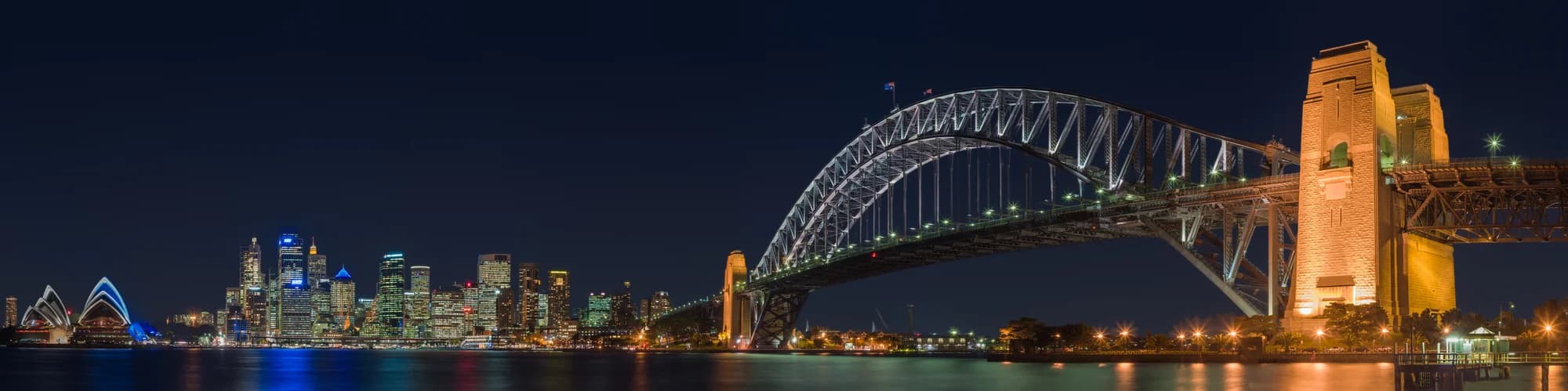
The Sydney Opera House and Harbour Bridge at dawn — Jørn Utzon's white shells glowing rose-gold in the first light, a green-and-gold ferry carving a white wake across the indigo water, the city skyline rising behind the Royal Botanic Garden
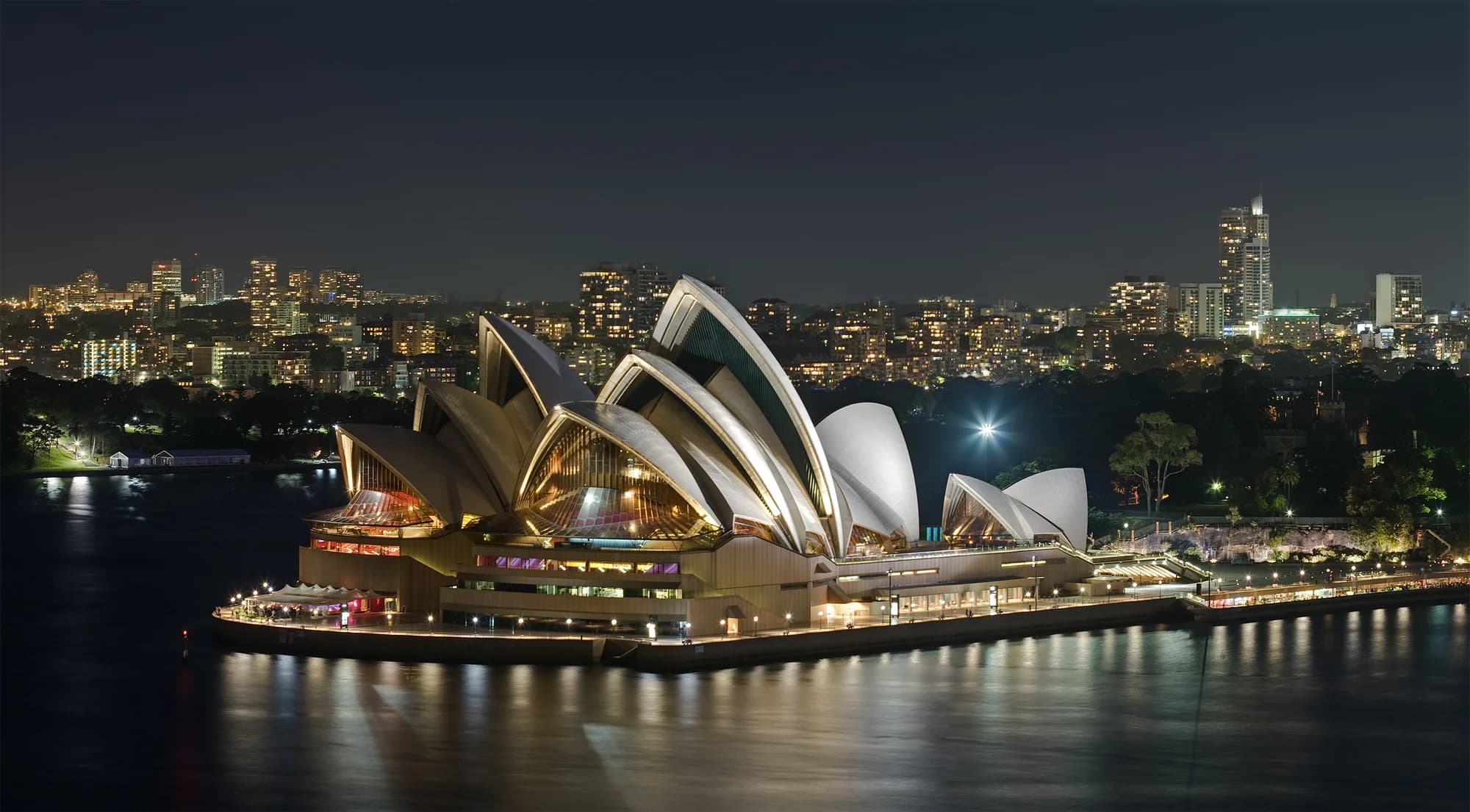
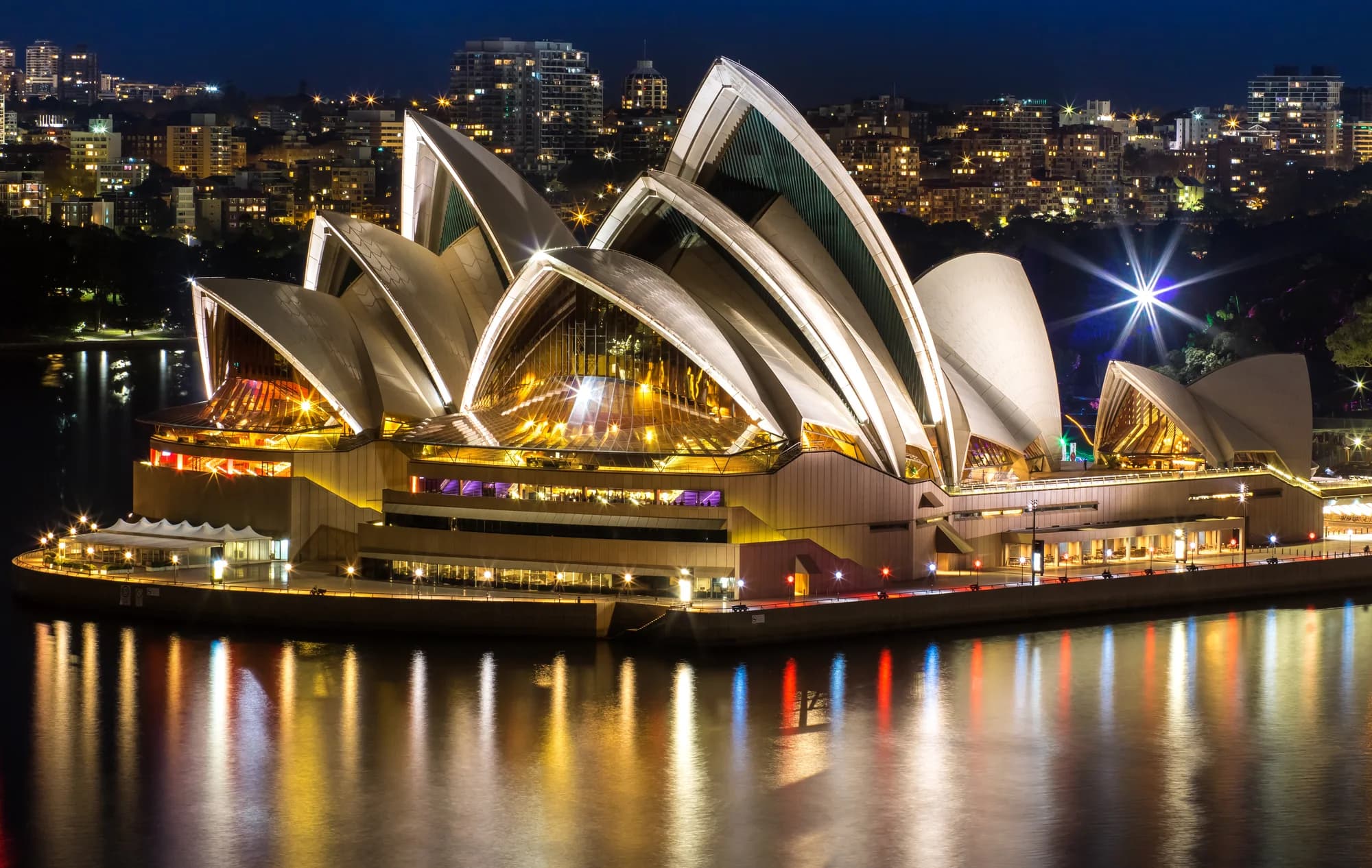
Designed by Danish architect Jørn Utzon, whose competition-winning proposal in 1957 was selected from 233 entries, the Opera House's iconic shells — actually sections of a single sphere — required revolutionary engineering that took 14 years to realise. The building was formally opened by Queen Elizabeth II on 20 October 1973 and was designated a UNESCO World Heritage Site in 2007, with UNESCO describing it as "a great architectural work of the 20th century that brings together multiple strands of creativity and innovation." Bennelong Point, where the Opera House stands, was originally a tidal island known to the Gadigal people as Tubowgule, a site of ceremony and gathering for thousands of years before European settlement.
The Opera House, completed in 1973 after a saga of engineering complexity, political controversy, and the resignation of its Danish architect Jørn Utzon — who never saw his masterpiece finished — is the most famous building of the twentieth century, and for good reason. It is not a building you visit. It is a building you experience, from every angle, at every hour. From the water, aboard the Manly ferry, the shells read as sails catching the harbour breeze. From the Botanic Garden, they are a geological formation, as ancient and inevitable as the sandstone cliffs of the Harbour. From inside, the soaring concrete ribs of the Concert Hall create an acoustics so pure that the Sydney Symphony Orchestra, performing Mahler, can reduce an audience of two thousand to breath-held silence. Even after fifty years of analysis, the Opera House retains its essential mystery: a structure that should not logically work, that violated every convention of architectural geometry, and that somehow resolved into an image so powerful it became a nation's identity.
The interior of the Sydney Opera House Concert Hall — soaring ribs of birch ply and concrete rising to the vaulted ceiling, the Grand Organ with its 10,000 pipes gleaming in warm light, a symphony orchestra tuning before a sold-out evening performance
The Concert Hall seats 2,679 people and houses the Grand Organ, the largest mechanical tracker-action organ in the world with 10,244 pipes, built by Sydney organ maker Ronald Sharp over a decade beginning in 1969 and completed in 1979, six years after the Opera House opened. The hall's soaring ceiling reaches 25 metres, and the interior's birch plywood panels — arranged in a crown-like radial pattern — were engineered to provide optimal acoustic diffusion, though the hall underwent a major AUD 150 million acoustic renovation completed in 2022 to finally resolve sound projection issues that had dogged the venue for decades. The hall was named in honour of Joan Sutherland, Australia's legendary soprano, during the venue's 40th anniversary in 2013.
The Bridge: Vertical Sydney
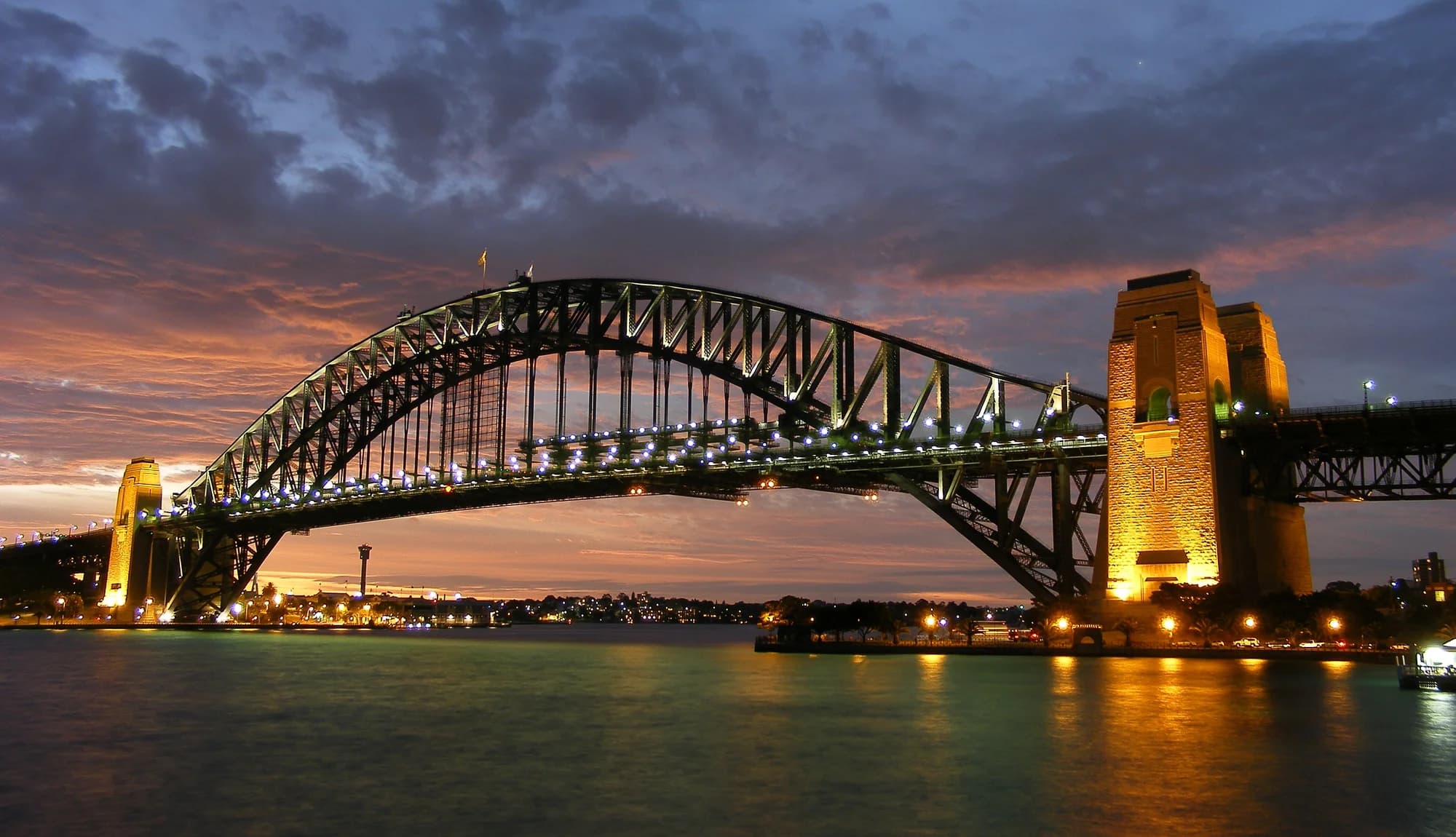
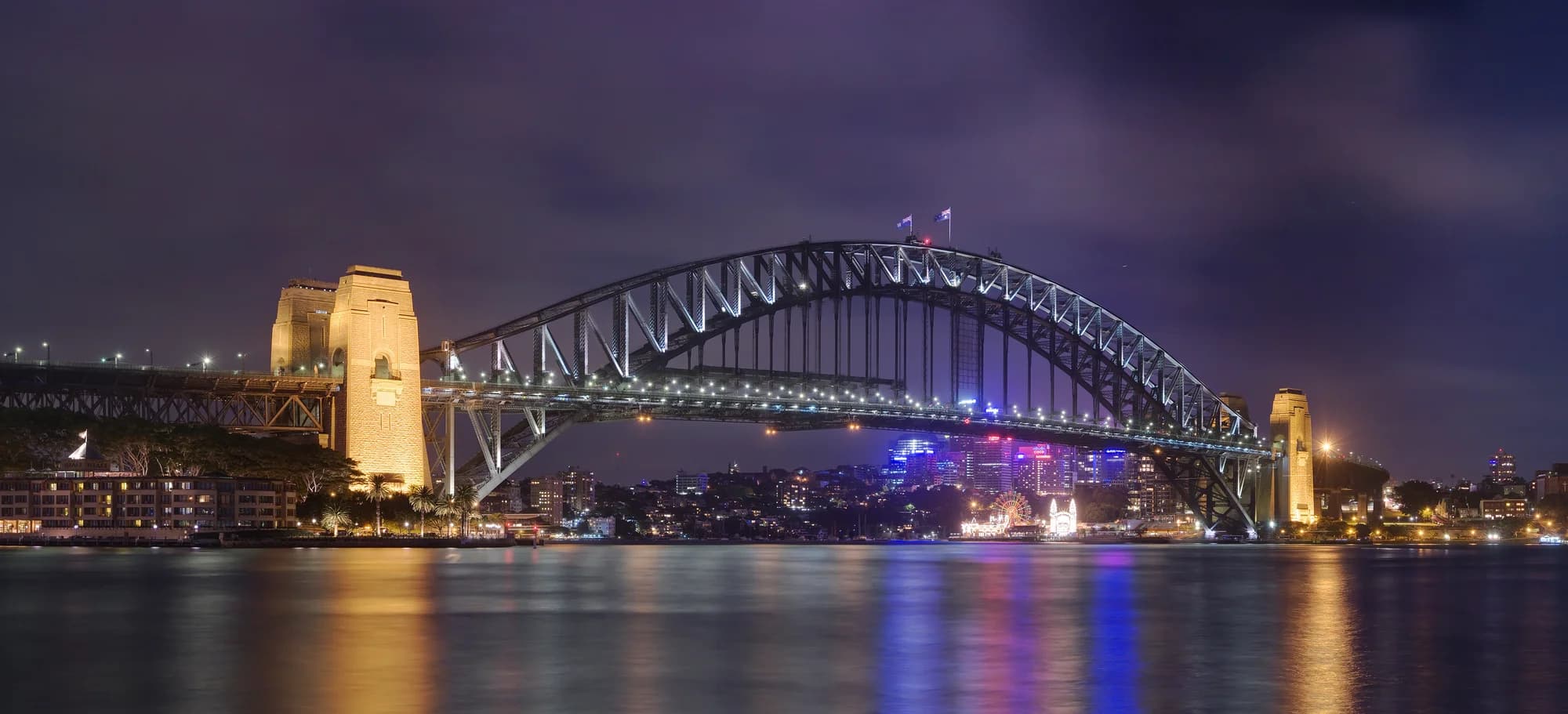
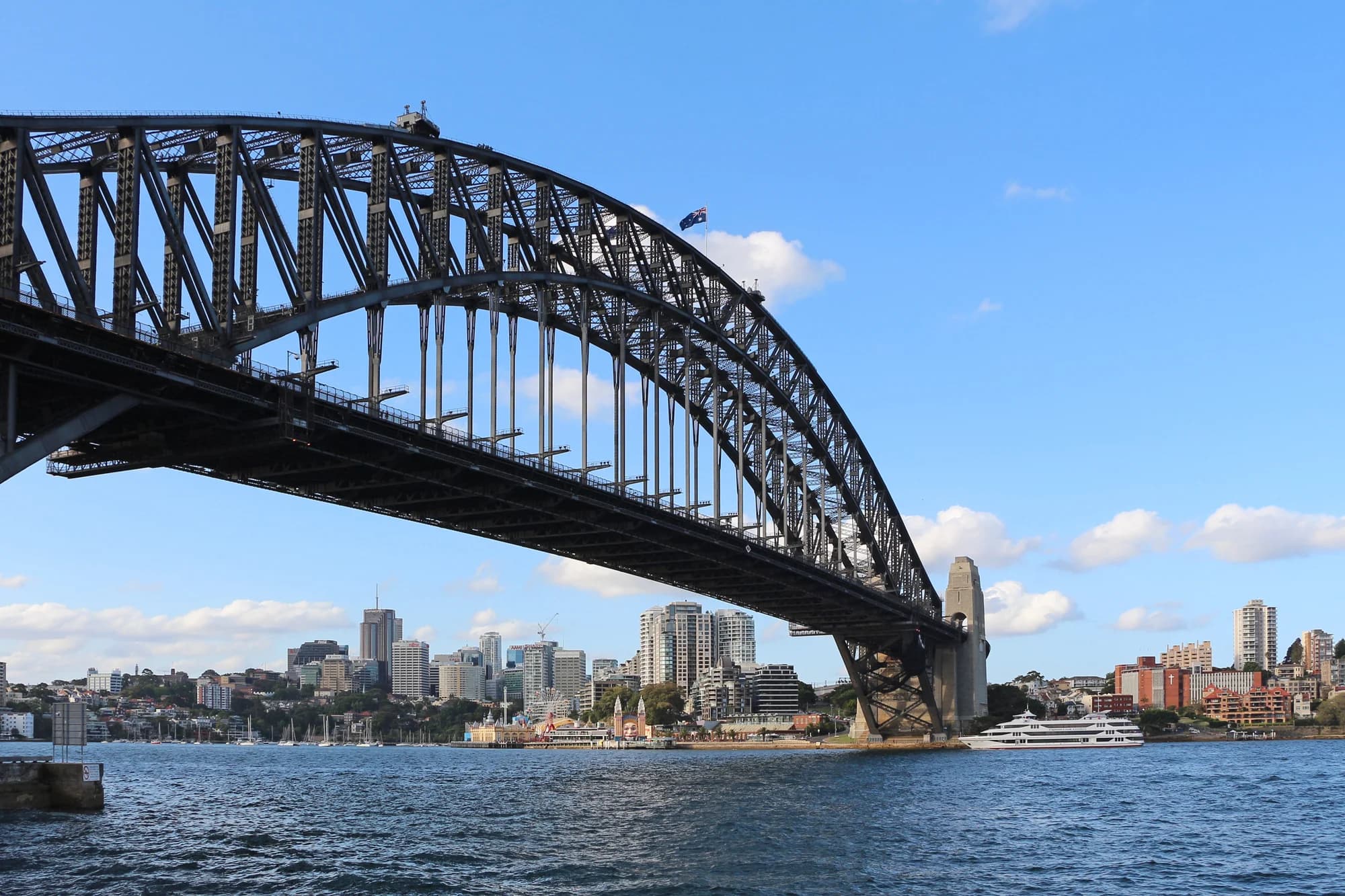
If the Opera House is the harbour's soul, the Sydney Harbour Bridge is its spine. Opened in 1932, the "Coathanger" spans 503 metres to connect the CBD with the North Shore, and for the visitor, it offers three distinct experiences. The first is the pedestrian walkway on the eastern side, accessible from the Rocks, which takes you across at bridge level with the Opera House framed perfectly between the steel arches — a forty-minute stroll that costs nothing and delivers one of the finest urban walks on Earth. The second is the Pylon Lookout, accessed from the south-eastern pylon, which includes a small museum detailing the bridge's construction and a viewing platform at 87 metres with sweeping 360-degree views. The third is the BridgeClimb: a guided ascent along the upper arch to the summit at 134 metres above the water, a three-hour experience that has drawn everyone from Prince Harry to Oprah Winfrey since its launch in 1998.
“You're standing on top of the most beautiful city on Earth, and for a moment the noise of five million people falls away. You hear only the wind and the harbour and your own heartbeat.”
The climb at dawn is the one to book. The predawn check-in at the BridgeClimb base in the Rocks, the breathalyser test and safety briefing, the suiting-up in the signature grey-and-blue climb suit — every step of the ritual builds anticipation. Then you're on the catwalk, climbing past the road deck where early traffic hums beneath your feet, and then you're on the arch itself, the steel growing narrower, the city falling away, the light beginning to seep over the Pacific horizon. When you reach the summit and the sun breaks over the water, striking the Opera House far below, the Harbour filling with the first ferries of the day, you are standing on the highest point of the most beautiful harbour city on Earth, and you have earned the view with your own legs.
Climbers on the upper arch of the Sydney Harbour Bridge at sunrise — the Opera House below, the CBD towers catching the golden light, the Pacific Ocean stretching to the eastern horizon, the climbers' grey suits silhouetted against the steel latticework
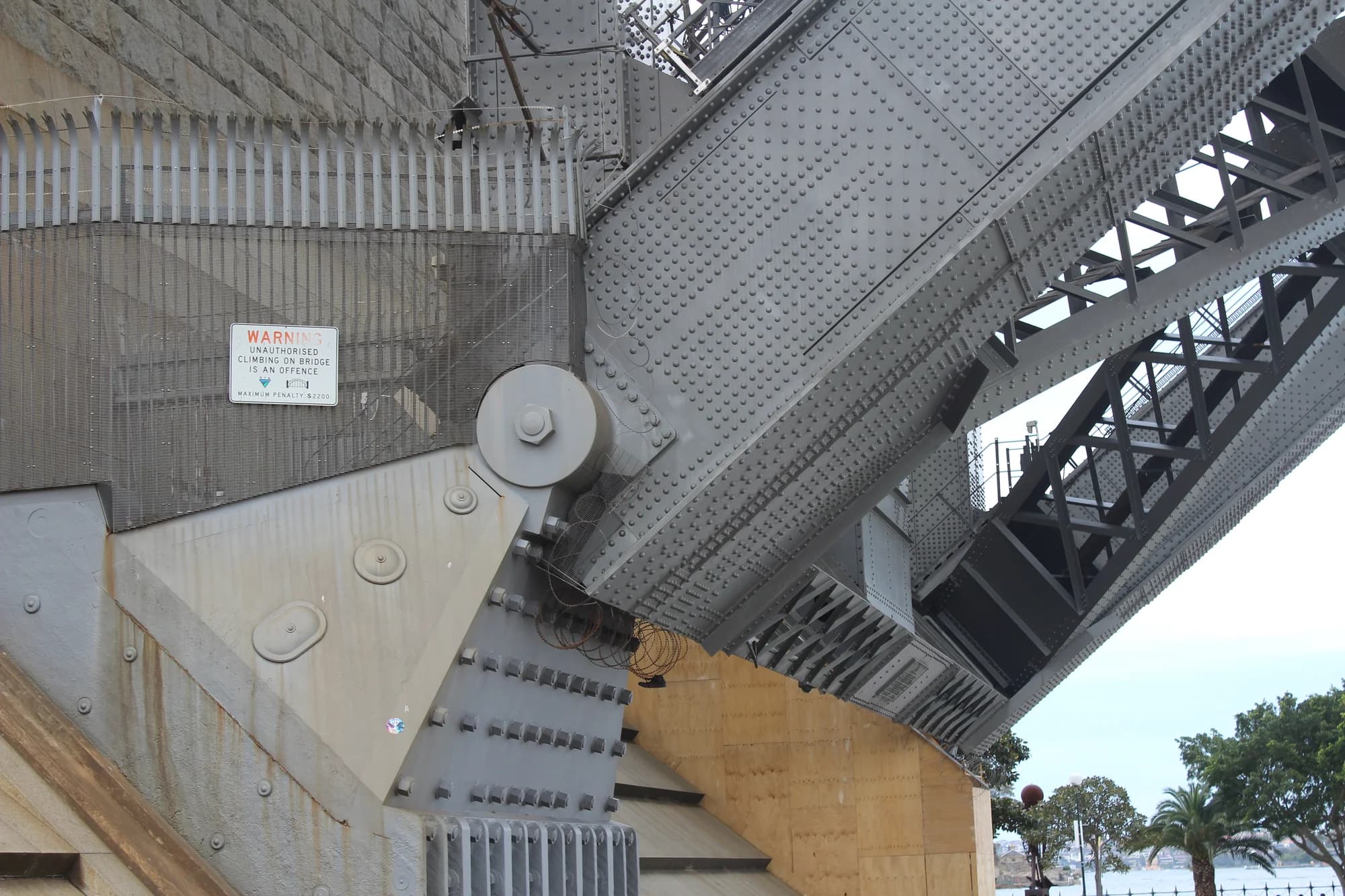
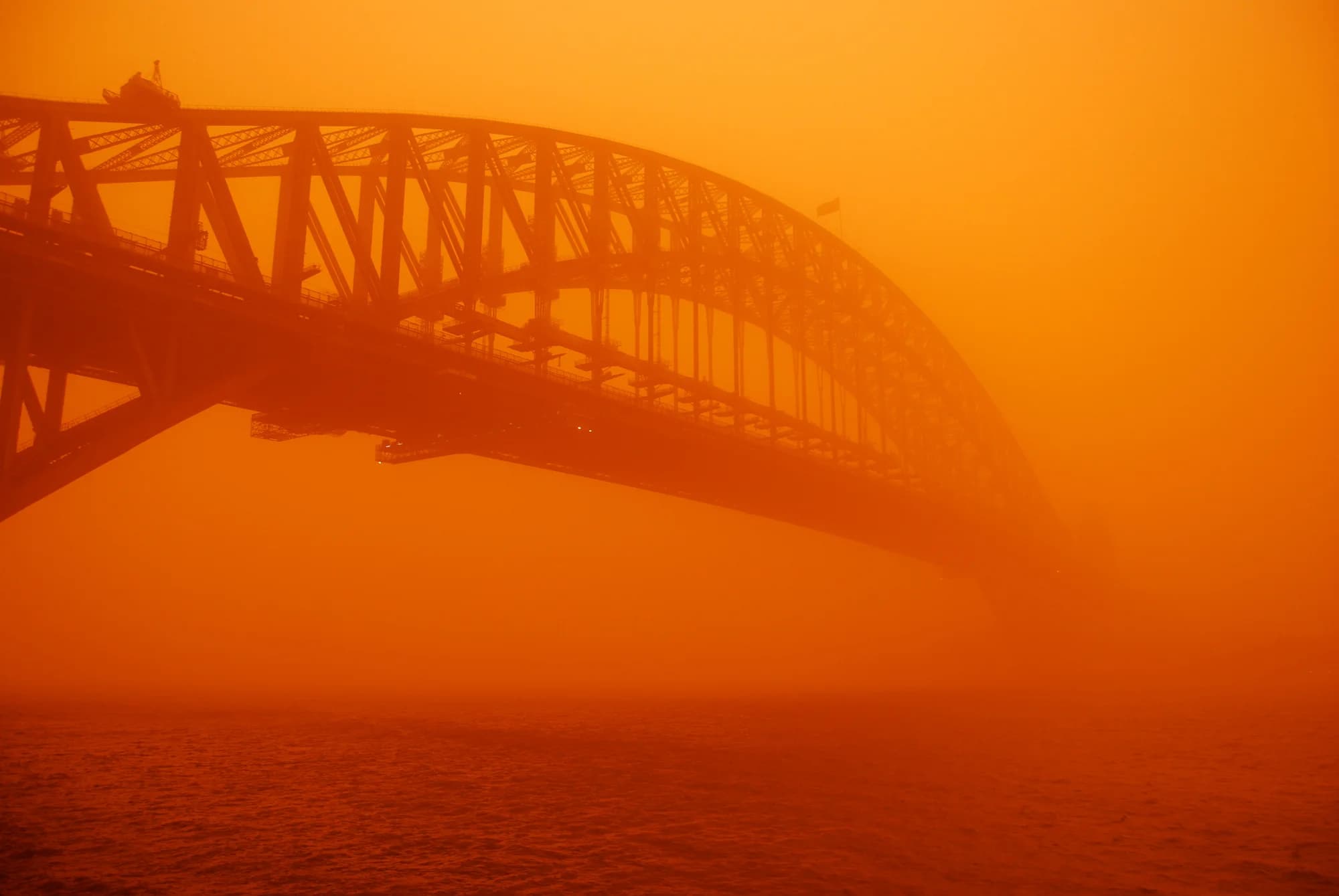
The Sydney Harbour Bridge was opened on 19 March 1932 by Premier Jack Lang, though the ribbon was famously cut by Francis de Groot, a member of the paramilitary New Guard, who rode forward on horseback and slashed it with his sword in protest. The bridge employed 1,400 workers during its eight-year construction, and its four steel arches — each weighing 38,000 tonnes — are held together by six million hand-driven rivets, the largest of which measure nearly 40 centimetres. The BridgeClimb experience, launched by entrepreneur Paul Cave in 1998 after nearly a decade securing permissions and designing safety systems, follows catwalks originally used by maintenance workers, and has since welcomed over four million climbers including Prince Harry, Oprah Winfrey, and Olympic athletes during the 2000 Sydney Games.
Coastal Sydney: Bondi to Bronte
Sydney's eastern suburbs are defined by a ribbon of coastal cliffs, beaches, and rock pools. The Bondi to Bronte coastal walk, which traces the sandstone headlands between Australia's most famous beach and its quieter neighbour 2.5 kilometres south, is the essential Sydney walk. It takes about ninety minutes if you walk it without stopping — but you will stop. You will stop at the Aboriginal rock carvings at Marks Park, where the Cadigal people etched whales and kangaroos into the sandstone two thousand years ago. You will stop at Tamarama, the small but ferocious beach known locally as "Glamarama" for its beautiful crowd, to watch surfers navigate the notoriously powerful rip. You will stop at the Bronte Baths, a saltwater pool cut into the rock shelf that fills and empties with the tide, where locals do their morning laps while waves explode against the pool wall.
The Bondi to Bronte coastal walk at mid-morning — the turquoise Pacific Ocean stretching to the horizon, surfers riding the break at Tamarama, the sandstone path winding along the cliff top with the Bondi Icebergs pool visible in the distance, its lap swimmers oblivious to the drama of the sea beyond the wall
This 2.5-kilometre cliff-top walk traces Hawkesbury sandstone platforms carved by the Tasman Sea over tens of millions of years, passing Aboriginal rock carvings at Marks Park created by the Cadigal people of the Eora Nation — engravings of whales, kangaroos, and human figures dated to approximately 2,000 years ago that are among the finest surviving examples of Sydney rock art. The walk was officially established as a public reserve in the 1930s as part of a state government initiative to guarantee coastal access for all Sydneysiders, and Tamarama Beach — the tiny 80-metre cove between Bondi and Bronte — is known for the most dangerous rip current on Sydney's eastern beaches, with its powerful undertow earning it the nickname "Glamarama" among surfers who brave its notoriously unpredictable breaks.
Bondi Beach itself deserves the reverence it receives. The kilometre-long crescent of golden sand draws three million visitors annually, and the scene on a summer Saturday — surf lifesavers in blue rashies, backpackers cooking sausages on the public barbecues, yoga classes on the grass, Brazilian tourists photographing the Icebergs pool from every conceivable angle — is a portrait of Australian beach culture in all its sunburnt, egalitarian glory. The Icebergs Club, founded in 1929 to allow serious winter swimmers to earn their name, offers the best post-walk brunch in Sydney. The dining room's floor-to-ceiling glass frames the pool and the Pacific beyond. Order the brioche French toast with lemon curd and watch the waves break against the pool wall while someone else does the laps.
The Bondi Icebergs pool at midday — lap swimmers in lanes of electric blue, a wave exploding against the far wall in a plume of white foam, the golden sand of Bondi Beach curving away to the south, Bondi's famous graffiti wall visible on the sea wall beyond
The Bondi Icebergs Winter Swimming Club was founded in 1929 by a group of local lifeguards who wanted to maintain their fitness through the colder months — to earn membership, swimmers must compete in at least three of the club's Sunday races for five consecutive winters, a tradition that continues unbroken today with over 700 members. The 50-metre saltwater pool, maintained at the southern end of Bondi Beach below the sandstone cliffs, is refilled twice daily by the rising tide, and the adjoining smaller children's pool and toddler's wading area were added in later decades to create one of the most photographed swimming complexes in the Southern Hemisphere. The concrete sea wall separating the pool from the Pacific was rebuilt in the 1960s after a series of storms, and the famous post-lap ritual of eggs Benedict with a flat white in the upstairs dining room — with floor-to-ceiling glass framing the pool against the ocean — has been a Sydney institution since the clubhouse renovation of 2002.
The Rocks: Sydney's Origin Story
Beneath the southern approach of the Harbour Bridge lies the Rocks, the cobblestone precinct where European Sydney was born. This was the convict city: a squalid, violent, alcohol-soaked settlement of ex-convicts and sailors that, by the 1820s, had become a dense neighbourhood of stone terraces, narrow lanes, and waterfront pubs. The bubonic plague of 1900 nearly erased it; the public housing schemes of the 1960s came close again. Preservation prevailed, and today the Rocks is a gentrified but still atmospheric district of galleries, restaurants, and history.
The cobblestone laneways of the Rocks at dusk — the sandstone terraces glowing amber in the lamplight, the Harbour Bridge arching overhead, a busker playing a didgeridoo in Argyle Cut, the Fort Denison light blinking in the harbour beyond
The Rocks was established as Sydney's first European settlement with the arrival of the First Fleet in 1788, though the surviving sandstone warehouses and terraces — including Cadman's Cottage, Sydney's oldest surviving residential building, completed in 1816 — date primarily from the 1830s and 1840s when the area became the city's maritime quarter. The Argyle Cut, carved through the sandstone ridge by convict labour beginning in 1843 using hand tools, explosives, and sheer endurance, took over two decades to complete and remained one of the largest engineering works in the colony. The entire neighbourhood was saved from demolition in the 1970s by the Builders Labourers Federation, which imposed "green bans" — refusing to work on projects that would destroy heritage — a landmark moment in Australian preservation history that led to the area's transformation into the cultural and dining precinct it remains today.
The Rocks Discovery Museum, tucked into a restored sandstone warehouse on Kendall Lane, tells the layered story of the district — from the Cadigal people to the convict era to the union-led preservation battles of the 1970s. It is small, free, and superb, and it provides the context that transforms a stroll through the Rocks from a shopping trip into an encounter with Australia's foundational story. The weekend markets, filling the lanes along George Street and Playfair Street, are the best place in Sydney to find genuinely local crafts — Aboriginal art from the Northern Territory, hand-spun merino wool, leather goods made in workshops you can visit in the inner west — rather than the souvenir kitsch that dominates Circular Quay.
Argyle Cut at Golden Hour
The Argyle Cut, a sandstone tunnel carved through the ridge of the Rocks by convict labour in the 1840s, is at its most photogenic during the golden hour before sunset, when the western light slants through the tunnel and illuminates the chisel marks left by men who were serving seven-year sentences for stealing bread. Position yourself at the eastern entrance for a shot that captures both the tunnel and the Bridge arching overhead.
Harbour Life: Ferries and Islands
The best way to experience Sydney is from the water, and the city's ferry network — the largest and most scenic in the Southern Hemisphere — makes this accessible. The Manly ferry from Circular Quay is the essential crossing: a thirty-minute journey that departs every half hour, traversing the full width of the Harbour from the CBD to the Pacific entrance. You pass the Opera House at close range, cross the main shipping channel where container vessels from Shanghai and San Francisco wait for their berths, glide past the naval base at Garden Island where Australian warships are berthed, and enter the narrow entrance between North and South Head, where the Harbour meets the Pacific.
The Manly ferry crossing Sydney Harbour — the green-and-gold Freshwater-class ferry cutting through cobalt water, the Opera House and Harbour Bridge framed in the background, passengers lining the bow rail into a stiff southerly breeze, seagulls hovering in the ferry's slipstream
The Manly ferry service began in 1855 when entrepreneur Henry Gilbert Smith, who founded the settlement of Manly, launched the first paddle steamer to connect the beachside village to Circular Quay — a journey that took 40 minutes in the days before diesel engines. The current Freshwater-class ferries — MV Freshwater, MV Collaroy, and MV Queenscliff — were introduced in the 1980s, named after Northern Beaches landmarks, and each can carry up to 1,100 passengers across a 6-kilometre route that passes Garden Island Naval Base, established in the 1880s as Australia's primary warship repair facility. The ferry route also crosses the deepest part of Sydney Harbour, where the natural shipping channel plunges to 45 metres — deep enough to accommodate the largest cruise liners and container vessels that dock at Port Jackson.
Manly itself is a beach town with a split personality: the harbour side is sheltered, calm, and lined with restaurants and ferry docks; the ocean side, a seven-minute walk across the isthmus via the Corso, is a surf beach of rolling Pacific swell patrolled by the Manly Life Saving Club. The walk from Manly to Shelly Beach, a paved path winding through a littoral rainforest reserve, takes twenty minutes and ends at a sheltered cove with some of the best snorkelling in metropolitan Sydney — giant cuttlefish, blue gropers, and wobbegong sharks inhabit the protected Cabbage Tree Bay Aquatic Reserve.
Seaplane to Cottage Point Inn
For the ultimate Sydney dining experience, book a seaplane from Rose Bay to Cottage Point Inn. The twenty-minute flight traces the coastline past the Harbour Bridge, the Opera House, and the sandstone cliffs of the Ku-ring-gai Chase National Park before landing on the Hawkesbury River at a secluded waterfront restaurant accessible only by boat or plane. The restaurant serves a degustation menu that changes daily based on what the local fishermen and foragers deliver. The seaplane operator, Sydney Seaplanes, offers a lunch package that includes the return flight and a four-course meal. Book months in advance — there are only a handful of tables, and the experience has become one of Sydney's most sought-after dining reservations.
The Northern Beaches
Beyond Manly stretches a chain of beaches — Curl Curl, Dee Why, Narrabeen, Mona Vale, Newport, Avalon, Whale Beach, Palm Beach — that collectively form the Northern Beaches, a 30-kilometre stretch of golden sand, surf breaks, and coastal villages that feels, in places, as remote from the Sydney CBD as the Amalfi Coast does from Naples. Palm Beach, at the northernmost tip of the peninsula, is where Sydney goes to exhale. The isthmus between Pittwater and the Pacific is so narrow that from the Barrenjoey Lighthouse, reached by a steep twenty-minute hike, you can see both bodies of water simultaneously — the calm, sheltered waters of Pittwater on one side, the booming Pacific surf on the other.
The view from Barrenjoey Lighthouse at Palm Beach — Pittwater's calm blue waters dotted with sailboats on the left, the Pacific Ocean's rolling surf on the right, the narrow isthmus of the peninsula stretching south toward the towers of the CBD visible as a distant shimmer on the horizon
Barrenjoey Lighthouse, completed in 1881 from locally quarried Hawkesbury sandstone, stands 113 metres above sea level on the northernmost headland of the Sydney peninsula and was designed by colonial architect James Barnet, who oversaw the construction of more than 20 lighthouses along the New South Wales coast during his tenure as Colonial Architect. The lighthouse's original kerosene lamp — maintained by a succession of lightkeepers and their families who lived in the adjacent sandstone cottages — guided vessels into Broken Bay for over 90 years until full electrification in 1972, and the site was added to the New South Wales State Heritage Register in 1999. The narrow isthmus below, known as the Palm Beach tombolo, is just 120 metres wide at its narrowest point, creating the rare geographic phenomenon where the calm tidal estuary of Pittwater sits mere steps from the booming swell of the Pacific.
Taronga Zoo: Animals with a View
Taronga Zoo occupies a 28-hectare site on the northern shore of the Harbour, and its setting is as extraordinary as its collection. The giraffes, uniquely among the world's zoo giraffes, have the Sydney Opera House and Harbour Bridge as the backdrop to their enclosure — a surreal juxtaposition that perfectly captures Sydney's refusal to separate the natural from the urban. Opened in 1916, the zoo houses over 4,000 animals across 350 species, and its focus on conservation and education is genuine. The Australian Walkabout exhibit, where kangaroos and wallabies roam freely among visitors, is the best introduction to the continent's unique fauna for international visitors. The seal show, performed with the Harbour as its backdrop, is a theatrical spectacle that would work even without the animals — with them, it is genuinely delightful.
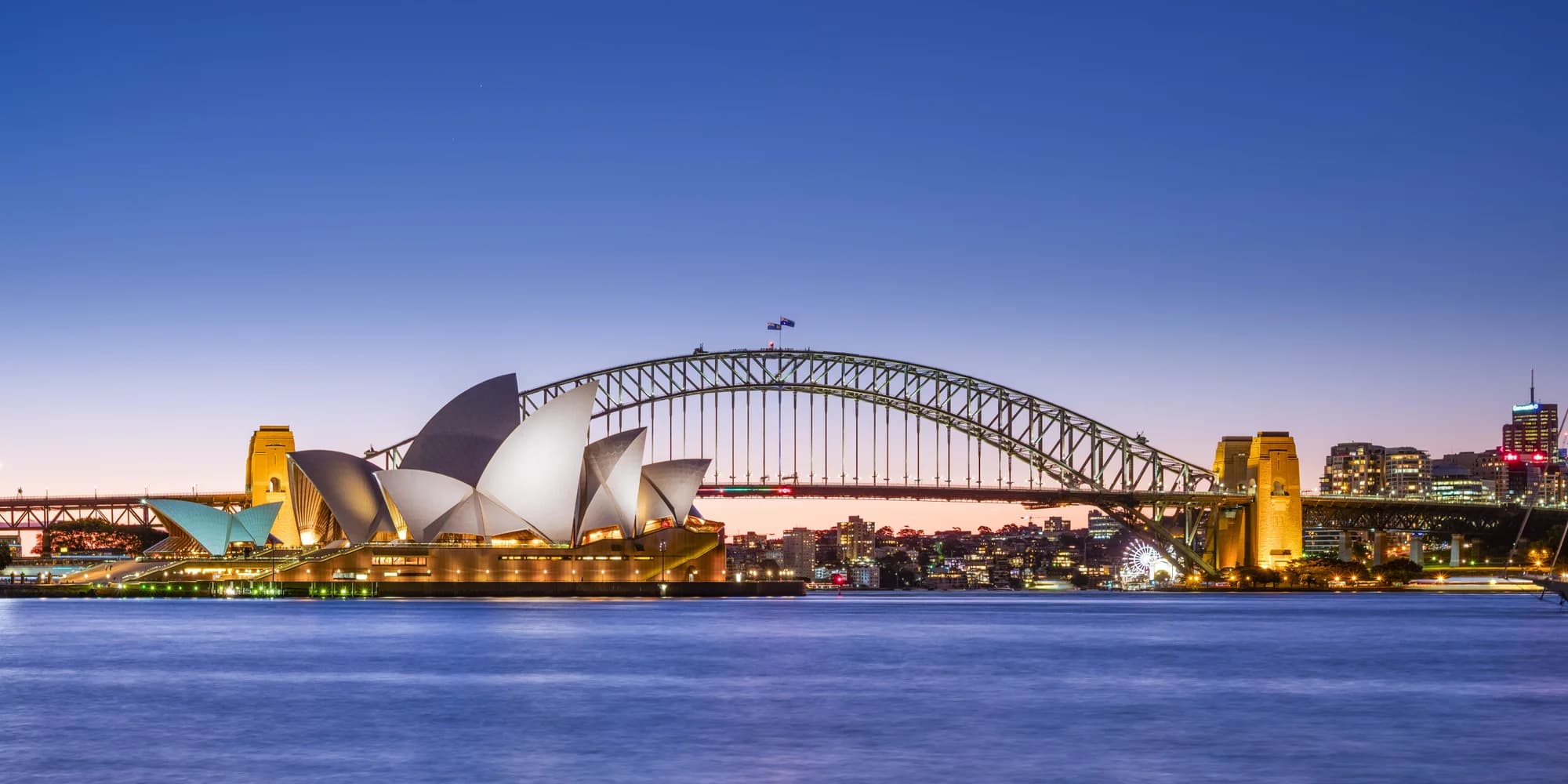
The giraffe enclosure at Taronga Zoo — two reticulated giraffes at their feeding station, the Sydney Opera House and Harbour Bridge perfectly framed behind them across the blue water of Port Jackson, a keeper in khaki explaining the zoo's breeding programme to a rapt group of visitors
Taronga Zoo opened on its current 28-hectare site on the northern shore of Sydney Harbour in October 1916, relocating from its original Moore Park location where it had operated since 1884, after the New South Wales government granted the land with the vision of creating a zoological garden with breathtaking views. The giraffe enclosure, positioned on the zoo's highest point at the crest of the hill, became the subject of its famous Opera House backdrop photograph in the 1970s when a keeper noticed the animals could be perfectly framed against the harbour skyline — an image that has since become one of the most shared on social media globally. Taronga's conservation credentials are genuine: the zoo participates in over 70 international breeding programmes and in 2020 successfully bred the first two platypuses in captivity in nearly two decades, a breakthrough for the species' conservation that made headlines worldwide.
Beyond the Harbour: Blue Mountains and Hunter Valley
Sydney rewards the day-tripper. The Blue Mountains, two hours west by train or car, are a World Heritage-listed wilderness of eucalyptus forests, sandstone cliffs, and waterfalls, named for the blue haze created by the oil droplets released from the vast stands of eucalypts. The Three Sisters rock formation at Echo Point in Katoomba is the iconic view, but it is the walking tracks — the National Pass, the Grand Canyon Track, the trail to Wentworth Falls — that reward the visitor willing to lace up boots. The Scenic Railway at Katoomba, the steepest passenger railway in the world with a 52-degree incline, plunges you into the Jamison Valley through a tunnel of tree ferns.
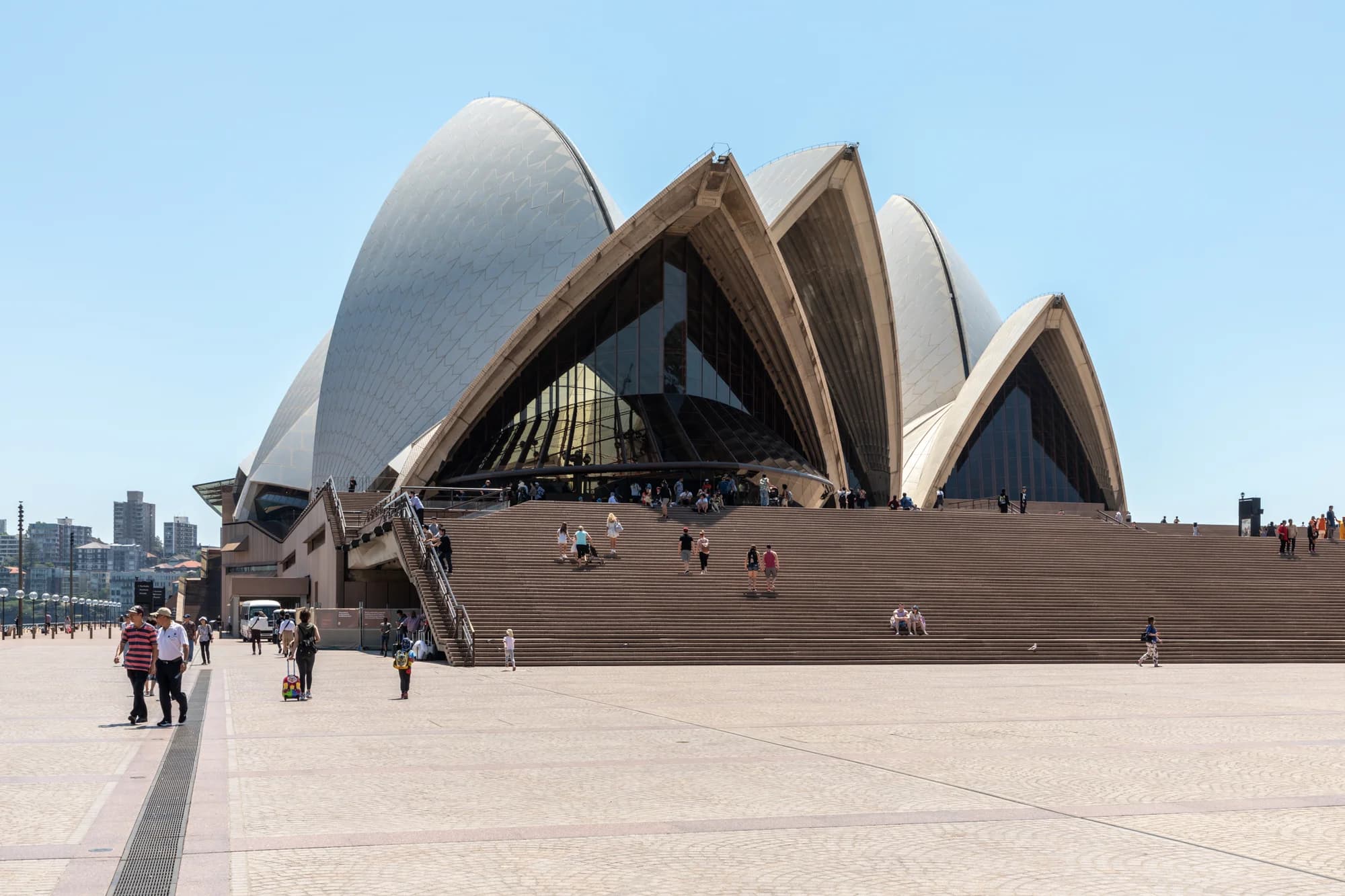
The Three Sisters at Echo Point, Katoomba — the sandstone pillars glowing orange in the late afternoon light, the blue haze of eucalyptus oil rising from the Jamison Valley below, the escarpment stretching away to the north in a series of diminishing blue ridges
The Three Sisters — named Meehni, Wimlah, and Gunnedoo — are sandstone pillars standing 922, 918, and 906 metres above sea level within the Blue Mountains National Park, which was inscribed as a UNESCO World Heritage Site in 2000 as part of the Greater Blue Mountains Area covering 10,300 square kilometres. According to the Gundungurra Aboriginal legend, the three sisters were turned to stone by a witch doctor to protect them during a tribal battle, and he was killed before he could reverse the spell — leaving them as sentinels for eternity. The surrounding Jamison Valley was carved over 250 million years by the erosion of Triassic sandstone, and the eponymous blue haze that gives the mountains their name is created by fine oil droplets released from the vast stands of eucalypts, which scatter short-wave light rays and create the ethereal azure mist that so captivated early European explorers like Gregory Blaxland, William Lawson, and William Charles Wentworth, who first crossed the range in 1813.
In the opposite direction, two hours north of the city, the Hunter Valley is Australia's oldest wine region, and while it lacks the scenic drama of the Barossa or Margaret River, it compensates with accessibility and a concentration of excellent semillon and shiraz producers. Tyrrell's, established in 1858, still makes some of the Hunter's finest wines, and the private tasting in their barrel room is an education in the region's winemaking history. Brokenwood's Graveyard Shiraz is legendary, and the tasting room — a sleek, contemporary space overlooking the vines — exemplifies the Hunter's evolution from rustic cellar door to polished wine tourism destination.
Indigenous Sydney
The story of Sydney did not begin with the First Fleet. For at least 65,000 years, the Gadigal, Wangal, Burramattagal, and other clans of the Eora Nation lived on and cared for the lands and waters of what is now the Sydney basin. The most accessible way for visitors to engage with this living culture is through the Royal Botanic Garden's Aboriginal Heritage Tour, a ninety-minute walk led by an Indigenous guide who explains the traditional uses of the plants in the garden, the seasonal calendar that governed Gadigal life, and the rock engravings and shell middens that survive within the city's boundaries. In the Rocks, the rocks themselves tell the story — the sandstone ledges of Dawes Point, visible at low tide, bear grooves worn by generations of Aboriginal women sharpening fishing hooks.
“Sydney was always a meeting place. The Gadigal called it Warrane, and it was where the clans gathered to trade, to feast, to resolve disputes. When you look at the Opera House and the Bridge and the ferries, you are looking at the latest layer of a very old story.”
Frequently Asked Questions
How many days should I spend in Sydney? Four days minimum, five to seven ideal. Day one covers the city centre: the Opera House (book a tour inside), the Royal Botanic Garden, Circular Quay, and the Rocks, with a sunset ferry to Manly for dinner. Day two tackles the coastal walk from Bondi to Bronte, with lunch at the Icebergs and an afternoon at Bondi Beach. Day three takes you across the Bridge — ideally via the BridgeClimb at dawn — to Taronga Zoo and the Northern Beaches. Day four is for culture: the Art Gallery of New South Wales and its new Sydney Modern extension, the Australian Museum, and a performance at the Opera House in the evening. With additional days, add a Blue Mountains day trip and a Hunter Valley wine day trip.
When is the best time to visit? October to November (spring) and March to April (autumn) offer the best balance of warm weather, manageable crowds, and lower accommodation rates. December to February is summer — glorious beach weather but peak tourist season, with hotel rates at their highest and the beaches crowded. The Opera House and BridgeClimb book out weeks in advance during this period. June to August is winter, with daytime temperatures around 16-18°C — cool but pleasant for city exploration, with the added benefit of whale migration season (humpbacks and southern right whales pass close to the coast). Vivid Sydney, the festival of light installations and music, runs for three weeks in May and June and transforms the city.
Is Sydney expensive? Yes — consistently ranked among the world's ten most expensive cities. A meal at Quay or Bennelong, the Opera House's two flagship restaurants, will easily run to AUD 250-350 per person for the tasting menu with wine pairing. The BridgeClimb is AUD 300-400 depending on the time slot. Hotel rooms in the CBD or at Circular Quay during peak season start at AUD 400 per night and rise steeply from there. That said, Sydney's greatest assets — the beaches, the coastal walks, the ferry rides, the Botanic Garden, the Rocks markets, the Royal National Park — are either free or cost no more than a ferry ticket. A day built around the Bondi to Bronte walk, a swim at the Icebergs pool (AUD 9 entry), fish and chips on the beach, and a sunset ferry ride will cost you less than AUD 50 and give you a more authentic Sydney experience than any monument.
What is the best neighbourhood to stay in? Circular Quay and the Rocks put you at the centre of the tourist Sydney, walking distance from the Opera House, the Bridge, and the ferries, but they skew toward international chain hotels and elevated prices. Surry Hills, immediately south of the CBD, is Sydney's best dining neighbourhood — Crown Street and its tributaries are dense with excellent restaurants, wine bars, and cafes — and offers a more local, creative energy while remaining a fifteen-minute walk from the Harbour. Bondi Beach, thirty minutes by bus from the city, provides the beach lifestyle but sacrifices centrality. For those who want luxury with harbour views, the Park Hyatt in the Rocks, tucked directly beneath the Bridge, is the city's finest hotel, with rooms that frame the Opera House across the water.
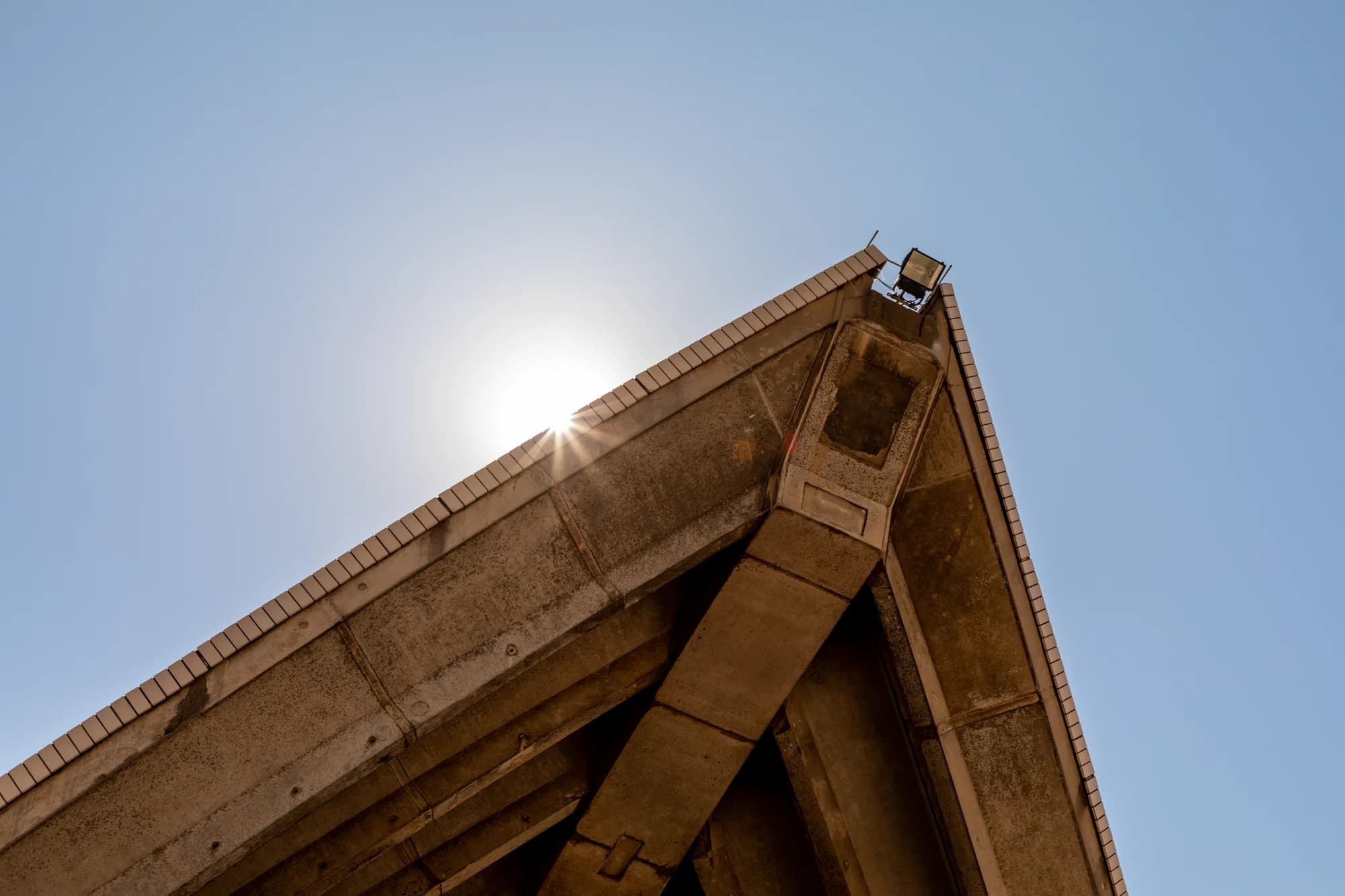
The Sydney skyline at dusk from the Royal Botanic Garden — the Opera House's sails illuminated white against a violet sky, the Harbour Bridge's arch traced in navigation lights, the CBD towers reflecting the last amber light of sunset, a flock of sulphur-crested cockatoos settling into the fig trees of the Garden, the harbour water darkening to ink
The Royal Botanic Garden was established in 1816 by Governor Lachlan Macquarie on the site of the First Fleet's failed farm at Farm Cove, making it Australia's oldest scientific institution and a living repository of 7,500 plant species across 30 hectares of harbourside land. The majestic Moreton Bay fig trees that line the waterfront were planted in the 1840s and remain among the most beloved natural landmarks in the city, their massive buttressed roots and spreading canopies home to generations of sulphur-crested cockatoos, rainbow lorikeets, and flying foxes. From Mrs Macquarie's Chair — a sandstone bench carved by convicts in 1810 for Governor Macquarie's wife Elizabeth, who loved to watch ships entering the harbour — the view across Farm Cove to the Opera House and Bridge has been described as the most photographed cityscape in the Southern Hemisphere, a panorama that has graced the opening sequences of countless films and the covers of guidebooks for two centuries.