Mexico City — Ciudad de México, CDMX — is the largest city in North America, the oldest capital in the Western Hemisphere, and, for the traveller who arrives with an open mind and a tolerance for chaos, one of the most thrilling urban experiences on the planet. The city was founded in 1325 by the Mexica people on an island in Lake Texcoco — the place where, according to legend, an eagle landed on a cactus devouring a serpent, the sign that the wandering tribe had reached its destined home — and the city they built, Tenochtitlan, was one of the wonders of the pre-Columbian world: a Venice of causeways and floating gardens, its central temple the Templo Mayor, whose ruins can still be seen in the heart of the Historic Centre. Hernán Cortés and his conquistadors destroyed Tenochtitlan in 1521, filled in the lake, and built the colonial capital of New Spain on its ruins — a decision that explains the city's most persistent problem (the sinking: the cathedral, the Palacio de Bellas Artes, the monuments of the colonial city are sinking, visibly, into the dried lakebed) and its most extraordinary feature (the palimpsest: everywhere in Mexico City, the pre-Columbian is visible beneath the colonial, the colonial beneath the modern, the modern beneath the contemporary — a city of 700 years of continuous urbanism, the deepest archaeological profile of any capital in the Americas).
The luxury Mexico City experience is not centred on a single neighbourhood or a single asset. It is distributed across the city, in the museums (the Museo Nacional de Antropología — the greatest archaeological museum in the Americas — the Frida Kahlo Museum, the Soumaya, the Jumex), the restaurants (Pujol, Quintonil, Contramar, Máximo Bistrot — the constellation of Mexican fine dining that has made the capital one of the most exciting food cities in the world), the hotels (the Four Seasons on Reforma, the St. Regis, Las Alcobas in Polanco), and the street life (the markets, the cantinas, the taco stands, the endless, irresistible theatre of the street) that is the city's essential texture. Mexico City is not an easy city. It does not offer itself to the traveller for easy consumption. It demands engagement. It rewards it.
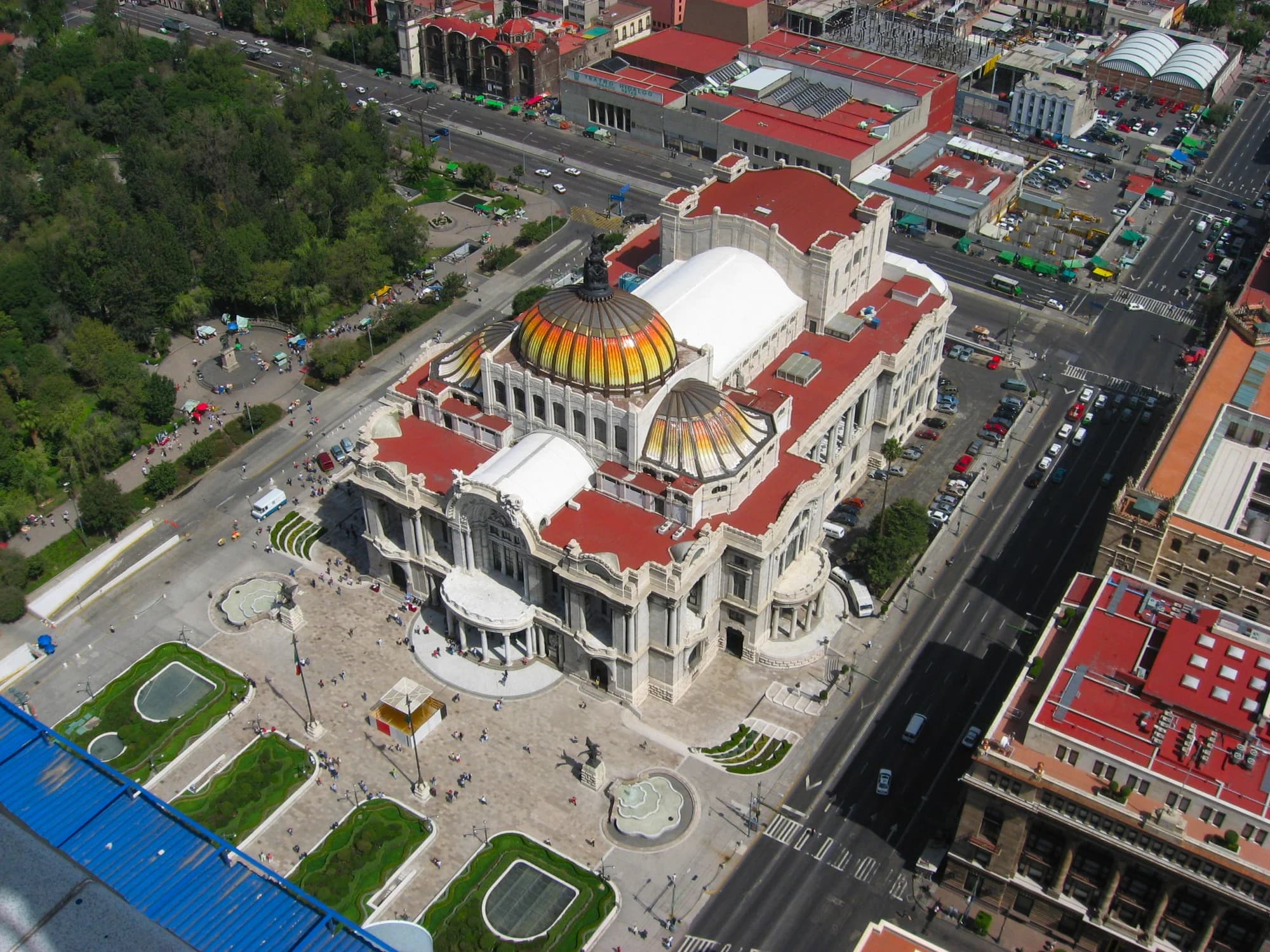
The Palacio de Bellas Artes at golden hour — the Art Nouveau and Art Deco masterpiece of Italian marble and Mexican fantasy glowing in the last light, the Torre Latinoamericana (the skyscraper that survived the 1985 earthquake) rising behind, the Alameda Central — the oldest public park in the Americas — a green carpet in the foreground, the chaotic, beautiful, impossible centre of one of the world's great cities doing what it does best: being magnificent
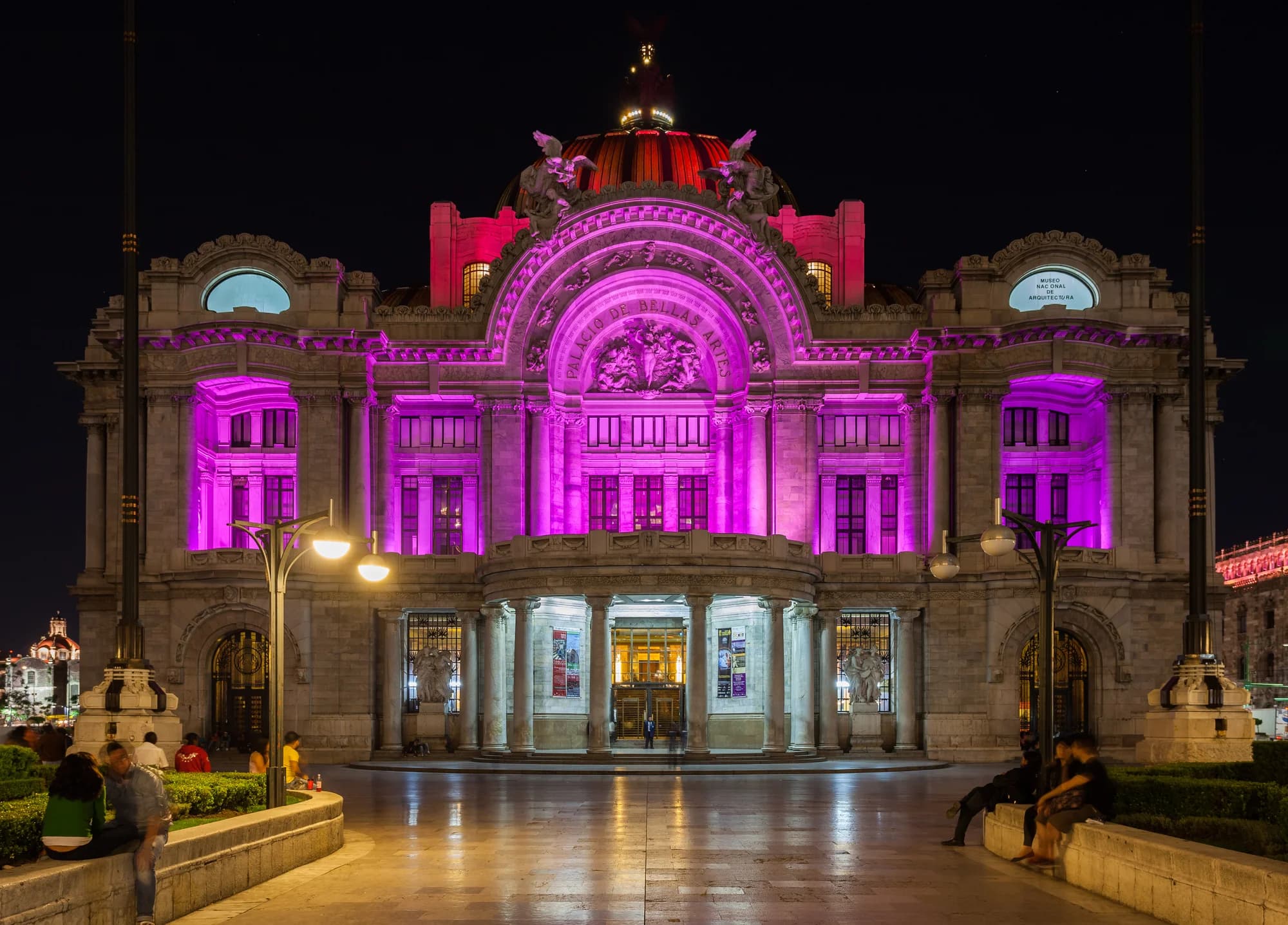
Construction of the Palacio de Bellas Artes began in 1904 under Italian architect Adamo Boari, was suspended during the Mexican Revolution (1910–1920), and was finally completed in 1934 by Mexican architect Federico Mariscal. Its hybrid style reflects this interrupted timeline: a white Carrara marble Art Nouveau exterior wraps a spectacular Art Deco interior. The theatre's stage curtain—a folding panel of Tiffany stained glass depicting the volcanoes Popocatépetl and Iztaccíhuatl—is the only one of its kind in any opera house in the world.
The Centro Histórico: 700 Years of Cities
The Centro Histórico — the historic centre, a UNESCO World Heritage Site of 668 blocks — is the largest colonial city centre in the Americas and one of the most complex urban artefacts in the world. Its central square — the Zócalo, formally the Plaza de la Constitución, one of the largest public squares on the planet — is the symbolic heart of Mexico: the Templo Mayor (the excavated ruins of the Mexica great temple) on one side, the Catedral Metropolitana (the largest cathedral in the Americas, built over 250 years in a riot of Baroque, Neoclassical, and the distinctive Churrigueresque style of Mexican decorative exuberance) on another, the Palacio Nacional (containing Diego Rivera's murals of Mexican history — a cycle of frescoes that tells the story of the country from the Aztecs to the Revolution, painted between 1929 and 1935 by the greatest of the Mexican muralists, and one of the great works of public art of the twentieth century) on a third. The Zócalo, at any hour of the day or night, is a theatre: protests, ceremonies, the raising and lowering of the enormous Mexican flag (the bandera monumental, 50 by 28.6 metres, one of the largest flags in the world), the bustle of the commercial streets that surround the square, the sense — permanent and thrilling — of being at the centre of a nation.
The Templo Mayor, excavated since 1978 (when electrical workers digging beneath the street discovered the colossal stone disc of Coyolxauhqui, the dismembered moon goddess, a discovery that transformed the understanding of Tenochtitlan and led to the demolition of several colonial buildings to expose the temple precinct), is the essential archaeological site: the ruins of the twin temples of Huitzilopochtli (the god of war) and Tlaloc (the god of rain) — layers of construction spanning the entire history of Tenochtitlan, from its foundation in 1325 to the Spanish conquest in 1521. The museum (the Museo del Templo Mayor, an eight-room journey through the objects — the Coyolxauhqui stone, the eagle warrior, the masks, the ceramics, the obsidian knives — excavated from the temple precinct) is one of the finest archaeological museums in the world, and the experience of standing in the ruins of the Mexica empire's holiest site, with the cathedral of the conquistadors looming above and the Zócalo's contemporary chaos all around, is a confrontation with the deep history of the continent that no book can replicate.
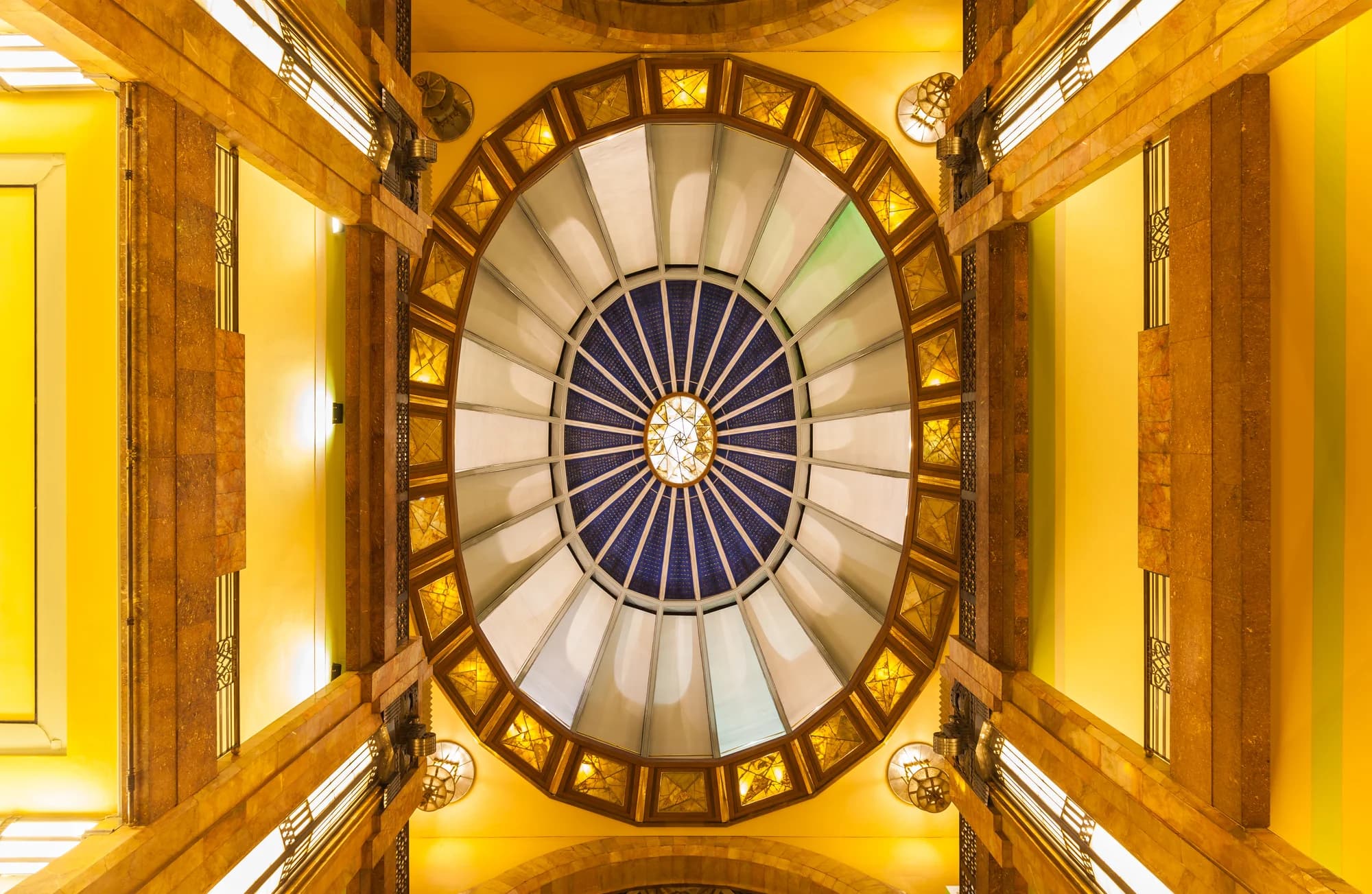
The Gran Hotel Ciudad de México, on the Zócalo's southwestern corner, is a Belle Époque masterpiece: a Tiffany stained-glass ceiling (the largest in any hotel in the world, a canopy of 20,000 pieces of glass in the Art Nouveau style), a lobby of wrought-iron balconies and gilded elevators (the original Otis elevators, installed in 1908, still working, still beautiful), and — if you book a room with a view — perhaps the most dramatic hotel-room prospect in the Americas: the Zócalo at dawn, the flag rising in the square, the cathedral glowing in the first light, the city waking to the sound of bells and traffic and the particular energy of the largest city in the hemisphere beginning another day.
The Templo Mayor — the excavated ruins of the Mexica great temple, the layers of construction (seven major building phases spanning 200 years) visible in the walls, the cathedral of the conquistadors rising behind, the modern city an omnipresent hum beyond the site's walls, the sense of deep time — seven centuries of continuous urbanism — as palpable as the stones, which were laid by hands that have been dust for half a millennium
The Templo Mayor was the absolute centre of the Mexica universe—twin shrines crowning a stepped pyramid dedicated to Huitzilopochtli, god of war, and Tlaloc, god of rain, rebuilt seven times over two centuries of Aztec rule (1325–1521). Rediscovered in 1978 when electrical workers unearthed the 3.25-metre stone disc of Coyolxauhqui, the dismembered moon goddess, the site forced the demolition of colonial buildings to expose the sacred precinct. The adjoining museum, designed by Pedro Ramírez Vázquez and opened in 1987, houses over 7,000 objects excavated from the temple complex.
“When the conquistadors saw Tenochtitlan, rising from its lake like a vision of enchantment, they asked if they were dreaming. We ask the same question now. The answer — then and now — is yes, we are dreaming, and the dream is Mexico.”
Chapultepec: The Museum Axis
The Bosque de Chapultepec — Chapultepec Forest, at 686 hectares one of the largest urban parks in the western hemisphere, the "lungs of Mexico City" — is the green centre of the capital, and its eastern entrance is the Museo Nacional de Antropología, the greatest archaeological museum in the Americas and arguably the finest museum of pre-Columbian civilisations anywhere in the world. The building — a monumental courtyard (the Patio Central, an open space dominated by the "Paraguas," the Umbrella, a 40-metre-high canopy of concrete and bronze that is one of the most iconic architectural features in Mexico, a fountain cascading from its peak) surrounded by 23 exhibition halls on two floors — is a masterpiece of mid-century Mexican modernism, designed by the architect Pedro Ramírez Vázquez (who also designed the Estadio Azteca and the Basilica of Guadalupe, the three monuments that define Mexico City's architectural patrimony) and opened in 1964.
The collection — the Stone of the Sun, the Aztec Calendar Stone (the most famous artifact in Mexico, a 24-tonne basalt disc that depicts the five eras of Aztec cosmology, and that was not a calendar but a cuauhxicalli — a vessel for the hearts of sacrificial victims), the colossal Olmec heads (three tonnes of basalt, the faces of unknown rulers from the Gulf Coast, carved 3,000 years ago by Mesoamerica's first great civilisation), the reconstruction of the Temple of the Feathered Serpent at Teotihuacan (the original in vivid colour: red, the plaza of a thousand columns at Tula, the lord of the underworld, the god of rain, each one an encounter with a civilisation that existed, flourished, and fell while Europe was still in the Dark Ages) — is overwhelming, in the best sense. The museum requires a full morning, and even then, the best strategy is to choose three or four halls for close attention rather than attempting to see everything. Priorities: the Aztecs (Sala Mexica — the most dramatic, the iconic objects that define the popular image of pre-Columbian Mexico), the Mayas (Sala Maya — Palenque's Pakal, the jade mask, the stelae of Yaxchilán), and the introduction to anthropology (Sala de Introducción a la Antropología).
The Museo Soumaya and the Museo Jumex, in the Nuevo Polanco district, form a museum axis of spectacular contemporary architecture. Soumaya — the private museum of Carlos Slim, the richest man in Mexico, housed in a cloud of hexagonal aluminium that twists upward from the ground like a sculpture — contains a collection of 66,000 works spanning European and Mexican art, with particular strengths in Rodin (the largest collection outside France: the Burghers of Calais, the Thinker, the Gates of Hell, casts and studies and the plaster originals from which the bronzes were taken) and the European Old Masters. The building — designed by Fernando Romero, Slim's son-in-law and a protégé of Rem Koolhaas — is free (admission is a gift of the Slim Foundation) and the experience of ascending its internal ramp, the collection unfolding in a continuous spiral from the ground floor to the roof, is as architectural as it is artistic.
Jumex — the Fundación Jumex Arte Contemporáneo, the collection of Eugenio López Alonso (the Jumex juice fortune), housed in a travertine-clad wedge designed by David Chipperfield — is Mexico's leading contemporary art museum, with a collection of Warhol, Koons, Hirst, and the Mexican contemporary artists (Gabriel Orozco, Damián Ortega, Abraham Cruzvillegas) who have made Mexico City one of the most important nodes in the global contemporary art network. The two museums, separated by a plaza, visited in a single afternoon, offer a compressed history of art from the fifteenth century to the present.
The Patio Central of the Museo Nacional de Antropología — the Paraguas, the iconic concrete-and-bronze canopy, suspended above the courtyard, the fountain cascading from its peak, the exhibition halls extending in every direction, the sound of water and the murmur of visitors filling the space, the most beautiful museum courtyard in the Americas and one of the most beautiful museum spaces in the world, a monument to the civilisation that built it and the civilisation it commemorates
The Museo Nacional de Antropología, opened in 1964, is Pedro Ramírez Vázquez's masterpiece of mid-century Mexican modernism—a complex of 79,700 square metres whose 23 exhibition halls ring a central courtyard dominated by the 'Paraguas' (Umbrella), a single concrete column supporting a 40-by-45-metre canopy. The bronze relief wrapping the column, sculpted by José Chávez Morado, narrates the four great epochs of Mexican history. Ramírez Vázquez deliberately routed all visitors through the open patio to access each hall, ensuring no one experiences the collection without first passing through this luminous, water-shepherded space.
The Food: Pujol, Street Tacos, and the Mexican Culinary Renaissance
Mexican cuisine — the only cuisine designated a UNESCO Intangible Cultural Heritage of Humanity — is, alongside the cuisines of France, Japan, China, and India, one of the world's great culinary traditions, and Mexico City is its capital. The range — from the taco stands on the street corners of every neighbourhood, serving al pastor (pork marinated in achiote and chilli, cooked on a vertical spit — the Mexican inheritance of the Lebanese immigrants who brought shawarma to Mexico in the early twentieth century and created, in the encounter between Middle Eastern technique and Mexican ingredients, one of the world's great street foods) of a quality that would command a Michelin star in a restaurant, to the tasting menus of Pujol and Quintonil (two of the finest restaurants in Latin America, both in the list of the World's 50 Best, both telling the story of Mexican ingredients — the corn, the chilli, the avocado, the tomato, the cacao, the vanilla, all of them Mexican domesticates, gifts of Mexico to the world — through the sensibility of chefs who trained in the world's best kitchens and chose to return to Mexico to build a culinary language that is at once deeply traditional and radically contemporary) — is staggering.
Pujol, in Polanco, is the most famous restaurant in Mexico and one of the most celebrated in the world. Chef Enrique Olvera's tasting menu — the famous "mole madre, mole nuevo" (a dish of two moles: the madre, aged for over 3,000 days, a dark, complex, endlessly evolving presence on the plate; and the nuevo, fresh- and bright and herbaceous, the same recipe but alive with newness — the contrast between them a meditation on time, memory, and the Mexican kitchen), the baby corn with chicatana ant mayonnaise and coffee, the stone crab with chilli and lime, the lamb barbacoa — is a tour of the Mexican culinary imagination, and the room, a converted mid-century house of minimalist Japanese-inflected design, is the perfect setting for a meal that rewrites the visitor's understanding of Mexican food. Book two months in advance, at the moment reservations open, and treat the evening as a cultural experience — a three-hour performance that is as intelligent, as surprising, and as satisfying as any theatrical performance in the city.
Contramar, in the Roma neighbourhood, is the essential lunch: chef Gabriela Cámara's restaurant of seafood, natural wines, and the most famous dish in the city — the pescado a la talla, a whole fish (usually red snapper) butterflied, grilled, and painted half with red chilli adobo and half with green parsley aioli, the two sauces meeting at the spine in a composition as beautiful as it is delicious. The tuna tostada, the fig tart, the people-watching (Contramar is the lunch canteen of Mexico City's creative elite, and the dining room is a theatre of the city's artistic, intellectual, and political life) — all of them essential, all of them justification for a lunch that extends into the late afternoon and becomes the centrepiece of a day in the Roma-Condesa corridor, the most vibrant neighbourhood of the contemporary city.
The street taco is the essential Mexico City food experience, and the question of where to find the best is a matter of passionate local debate. El Vilsito, in Narvarte, is an auto-repair shop by day and the best al pastor in the city by night (and the subject of a Chef's Table episode that brought it to the world's attention — the lines, longer now, are still worth the wait). Taquería Los Cocuyos, in the Centro Histórico, is a hole-in-the-wall of 50 years' standing whose suadero (beef brisket), lengua (tongue), and cabeza (head) tacos are the essential late-night meal. Expendio de Maíz, in the Roma, is not a taquería but a restaurant dedicated to the corn of Mexico — the 59 indigenous varieties, the nixtamalization process that releases the niacin and transforms a nutritionally incomplete grain into the staff of Mesoamerican civilisation — and the experience of eating handmade tortillas, quesadillas, and tlacoyos in a space that treats corn with the reverence that a Burgundian vigneron treats pinot noir, is a revelation.
Navigating Mexico City
Mexico City is vast (22 million in the metropolitan area, the sixth-largest urban agglomeration on the planet), and traffic is among the worst in the world. Plan to visit one or two colonias (neighbourhoods) per day, and travel between them by Uber (the safest, most reliable option — the Beat and Didi apps are also popular, but Uber is the standard for visitors) rather than by taxi. The Metro, the most heavily used rapid transit in the Americas, is efficient, crowded, and occasionally unsafe — use it only for short journeys during daylight, keep your valuables secured, and avoid it at night. The Ecobici, the public bicycle-sharing system, is an excellent way to explore the Roma, Condesa, and Polanco neighbourhoods, which have dedicated cycle lanes. Walk where possible. But also: accept that Mexico City cannot be comprehensively seen. Choose, savour, return another year.
Frequently Asked Questions
When is the best time to visit? October through May is the dry season, with warm days (20-27°C) and cool nights. December through February is the coolest period — the jacaranda trees bloom in March, and the city turns purple. June through September is the rainy season: afternoon downpours, cooler temperatures, cleaner air, and fewer tourists. The Day of the Dead (Día de Muertos, November 1-2) is the most vivid cultural experience in Mexico, and Mexico City's celebrations — the parades, the ofrendas (altars) in the Zócalo, the cemeteries where families spend the night with their dead — are among the most extraordinary in the country.
How many days do I need? Four full days is the minimum: one for the Centro Histórico (the Zócalo, the Templo Mayor, the cathedral, the Palacio Nacional and Rivera's murals), one for Chapultepec (the Museo Nacional de Antropología), one for the museums of the south (Frida Kahlo, the canals of Xochimilco, the floating gardens of the Aztecs, and the Mercado de Coyoacán), and one for the art and food of Polanco (the Soumaya, the Jumex, lunch at Pujol or Quintonil). Five to six days allows for Teotihuacan (the Pyramids of the Sun and the Moon, the Avenue of the Dead — a full day trip to the greatest pre-Columbian city in the Americas, site of the most beautiful pyramids on the continent and the murals that tell the story of a civilisation that flourished while Rome was falling and vanished, somehow, leaving its gods and its calendar to the Aztecs who inherited them).
Is Mexico City safe? The question is reasonable and the answer nuanced. The tourist districts — the Centro Histórico, Roma, Condesa, Polanco, Coyoacán — are generally safe during the day and into the evening, and walking in these areas, with the urban awareness that any large city requires, is a pleasure. Wealth-flaunting (visible jewellery, expensive watches, cameras of obvious value) is inadvisable anywhere. The "express kidnapping" (a taxi driver who picks up a passenger and forces them to withdraw money from ATMs) is a risk; use ride-hailing services, not street taxis, and do not hail them from the street. The city's reputation for danger is real and also, for the traveller who exercises caution, exaggerated. Mexico City is not more dangerous than other large cities in the Americas. But it is not a small town in Switzerland, either.
The view from the Torre Latinoamericana at sunset — Mexico City spread in every direction to the horizon, the Zócalo a bright square at the centre of the grid, the mountains that ring the Valley of Mexico dark silhouettes against the western sky, the volcanoes Popocatépetl and Iztaccíhuatl (the mountain and the white woman, the lovers of Aztec legend, asleep in each other's arms for eternity) visible on the eastern horizon on a clear day, visible, and the largest city in North America humming, glittering, breathing beneath you, the sound of 22 million lives rising sweetly through the evening air, the most beautiful and the most difficult, the most thrilling and the most exhausting, the most overwhelming and the most irresistible city in the Americas doing what it has done for 700 years — being alive, and asking you to be alive with it
Completed in 1956 to a height of 182 metres (44 storeys), the Torre Latinoamericana was Latin America's tallest building for nearly two decades and the world's first major skyscraper built successfully on highly seismic lakebed soil—its 361 concrete piles driven 33 metres to bedrock. It famously survived both the 7.9-magnitude earthquake of 1957 and the devastating 8.1-magnitude quake of 1985 without structural damage, an achievement recognised by a silver plaque in the lobby and cited in engineering textbooks worldwide. Architect Augusto H. Álvarez clad the steel-frame tower in glass and aluminium, and its 44th-floor observation deck remains the definitive panorama of the Valley of Mexico.