Edinburgh is not a city that reveals itself all at once. It is a city that unfolds in layers — geological, historical, literary — each one demanding attention before the next presents itself. Standing on the ramparts of Edinburgh Castle on a clear spring morning, with the Firth of Forth glittering to the north and the Pentland Hills rolling away to the south, you begin to understand why Robert Louis Stevenson called it "a city of dreaming spires and precipitous streets." The comparison to Athens — the "Athens of the North" — is not merely architectural, though the Greek Revival columns of Calton Hill's unfinished National Monument make the case rather literally. It is about a certain cast of light, a particular relationship between stone and sky, and the persistent sense that here, more than almost anywhere else in Britain, ideas have mattered.
The city's topography is its destiny. Edinburgh is built on seven hills — like Rome, like Lisbon — and the most dramatic of these is the volcanic plug on which the Castle sits, a slab of basalt extruded 340 million years ago and worn into a crag by the glaciers of the last Ice Age. The Royal Mile, the spine of the Old Town, runs eastward from the Castle esplanade down the ridge of this ancient volcano, a single street that is actually a succession of streets — Castlehill, Lawnmarket, High Street, Canongate — descending gently to the Palace of Holyroodhouse, the Queen's official Scottish residence, at the foot. The Mile is not a straight line but a subtle curve, and along it the city's history is written in stone: the sixteenth-century townhouses of the nobility, their crow-stepped gables jostling for space; the hidden courtyards and wynds that peel off at right angles, each one a dark invitation; St Giles' Cathedral, its crown spire the defining punctuation mark of the skyline.
Edinburgh Castle at the blue hour, floodlit and silhouetted against a violet sky, its ramparts rising from the dark volcanic crag
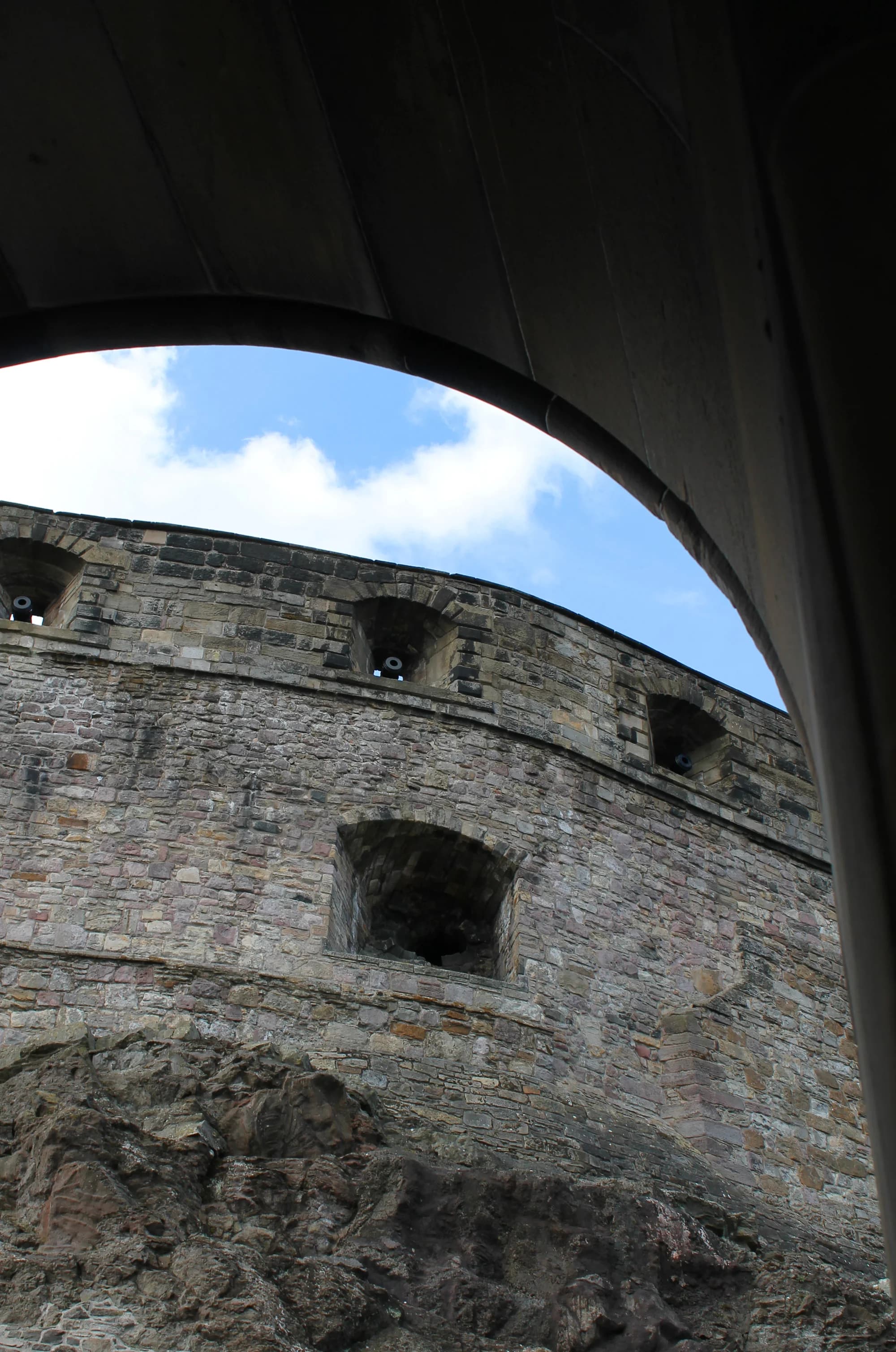
Edinburgh Castle sits atop Castle Rock, a volcanic plug formed 340 million years ago and shaped into a crag-and-tail wedge by glacial erosion during the last Ice Age. The oldest structure on the site — St Margaret's Chapel, built around 1130 by King David I — is the oldest surviving building in Edinburgh, and the castle itself has been besieged 26 times across its history, more than any other fortress in Britain. The Honours of Scotland, the nation's crown jewels dating from the 15th and 16th centuries, were hidden here from Cromwell's army in 1651 and forgotten for over a century until rediscovered by Sir Walter Scott in 1818.
The closes and wynds of the Old Town are the city's circulatory system, and to ignore them is to miss the point entirely. These narrow alleyways — some barely wide enough for two people to pass — run between the tenement buildings of the Royal Mile, plunging steeply toward the Grassmarket and the Cowgate. Their names are a kind of poem: Mary King's Close, Advocate's Close, Fleshmarket Close, World's End Close (so named because for centuries the gate at the Netherbow Port marked the boundary of the city — beyond it lay the separate burgh of the Canongate, and to Edinburgh's inhabitants, leaving the city walls felt like departing the known world).
Take Advocate's Close, one of the finest. It slopes down from the Royal Mile with a view of the Scott Monument framed perfectly at its foot, a vista that has been photographed a million times and still delivers. Or Mary King's Close, buried beneath the Royal Exchange and now a museum, where costumed guides lead you through the subterranean warren of seventeenth-century houses and tell you about the plague victims who were walled up inside — a story that is almost certainly apocryphal but that sends a genuine chill down the spine.
“This is a city of shifting light, of changing skies, of sudden vistas. A city so beautiful it breaks the heart again and again”
Arthur's Seat, the extinct volcano that dominates Holyrood Park, is the city's wild lung. The hike to the summit — 251 metres, achievable in about forty-five minutes from the Palace — is not arduous, but it rewards disproportionately. From the top, Edinburgh spreads beneath you like an Ordnance Survey map made real: the Old Town's serrated skyline, the New Town's perfect Georgian grid, the silver ribbon of the Forth, the green shoulder of Fife beyond. On a clear day you can see the Highlands glimmering on the northern horizon. The summit itself feels genuinely remote, considering you are twenty minutes' walk from a Tesco Express — a windswept hump of grass and stone where ravens wheel and the city's noise falls away to a distant hum. Go at sunrise, when the light turns the Castle gold and the only other people on the path are dedicated runners and people walking off the night before.
The Georgian New Town, laid out from 1767 onward by the 26-year-old architect James Craig, is one of the great achievements of Enlightenment urban planning. Craig's grid — three principal streets (Princes Street, George Street, Queen Street) running parallel, intersected by elegant crescents and circuses — was a rebuke to the chaos of the Old Town: rational, classical, bathed in light. George Street, in particular, has become the city's spine of quiet luxury. The Assembly Rooms, where Sir Walter Scott declared his authorship of the Waverley Novels; the Dome, originally the headquarters of the Commercial Bank of Scotland and now a bar with a ceiling to rival any in London; the independent galleries and cashmere shops; and at its eastern end, St Andrew Square, where the Melville Monument — a Doric column topped by a statue of Henry Dundas — has become the focus of a long-overdue reckoning with the city's role in the slave trade.
Edinburgh's food scene has undergone a revolution in the past two decades. This is now a city where you can eat extraordinarily well at every level. Tom Kitchin's eponymous restaurant in Leith, The Kitchin, holds a Michelin star and a reputation as one of Scotland's most important restaurants — "From Nature to Plate" is the philosophy, and the ingredients (hand-dived scallops from Orkney, venison from the Highlands, foraged sea herbs) are treated with a reverence that borders on sacramental. Restaurant Martin Wishart, also in Leith, offers a more classical French approach, with a tasting menu that is a masterclass in technique. But Edinburgh's gastronomic pleasures extend far beyond the starred dining rooms. The city has developed a thriving natural wine and small-plates culture: Timberyard, in a converted Victorian warehouse, serves food that is inventive without being intimidating; Noto, on Thistle Street, channels the precision of a Tokyo listening bar through Scottish produce; and The Palmerston, in the west end, has become the city's most reliable neighbourhood restaurant, its sourdough and pastries baked through the night in the basement bakery.
A close in the Old Town at twilight, warm light spilling from a basement pub, cobblestones wet with recent rain
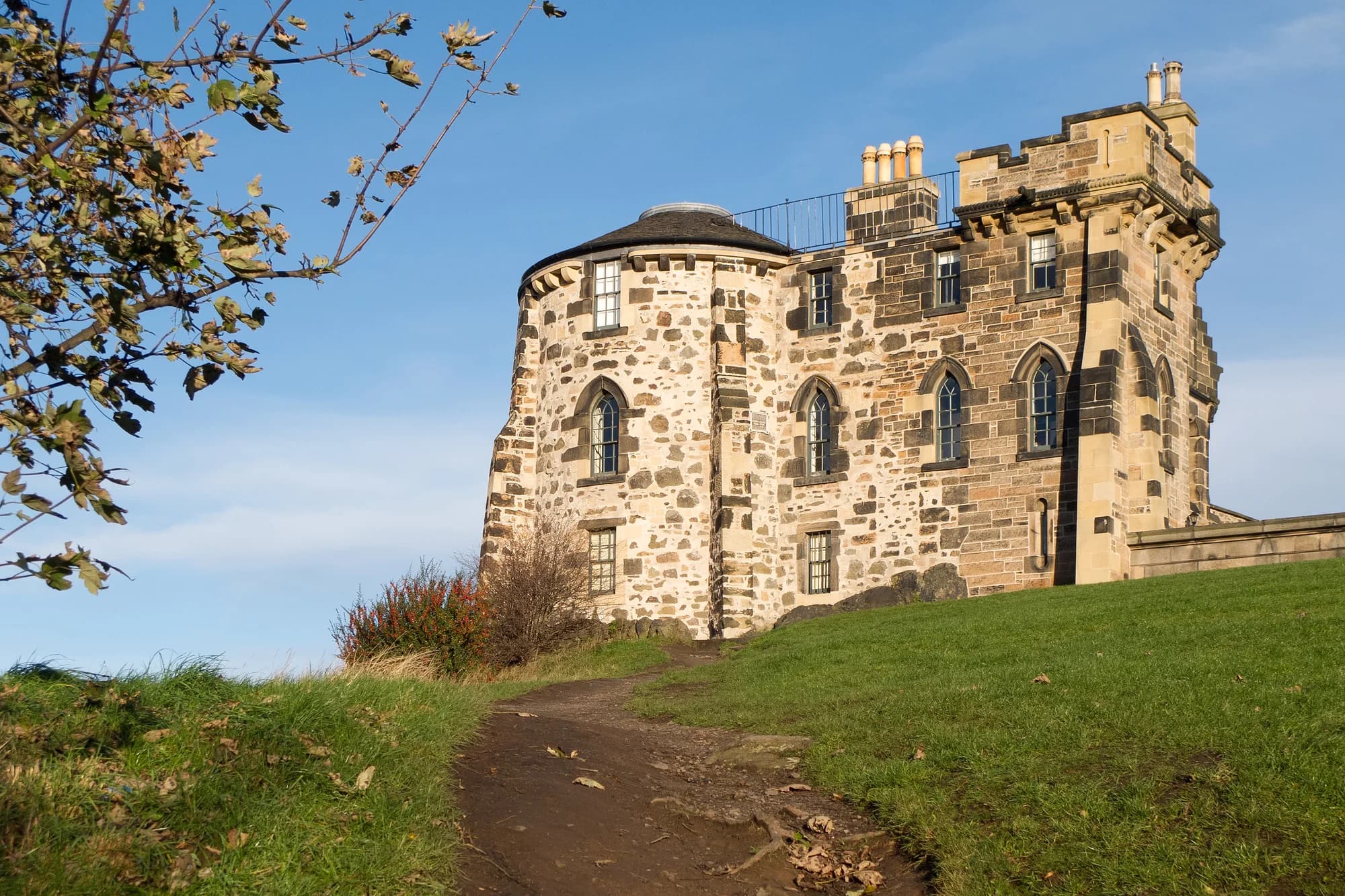
Edinburgh's closes are the legacy of the medieval burgage-plot system, in which long narrow strips of land were allocated to burgesses from the 12th century, creating a dense vertical city where tenements were built seven, ten, even fourteen storeys high — among the earliest 'skyscrapers' in Europe. Mary King's Close, sealed beneath the Royal Exchange (now the City Chambers) in 1753, preserves tenement dwellings from the plague-ridden 1640s with archaeological fidelity, complete with original timber beams, stone hearths, and excavated artifacts including children's toys and apothecary bottles.
The Scotch whisky experience in Edinburgh is, for many visitors, a gateway to a lifelong relationship. The Scotch Whisky Experience on the Royal Mile offers a barrel ride through the whisky-making process — charming, educational, and slightly theme-park — followed by a tasting of four single malts from the major whisky regions. For a more serious education, the Scotch Malt Whisky Society on Queen Street, with its private members' bar and tasting rooms, offers access to single-cask, cask-strength bottlings that you will find nowhere else. The society's bottles, labelled only with cryptic names and tasting notes, are a rabbit hole from which many an enthusiast has never emerged. And Cadenhead's Whisky Shop on the Canongate, established in 1842, is the oldest independent bottler in Scotland — a small, wood-panelled room where the staff will talk to you about distillation methods for as long as you care to listen.
Navigating the Festival
The Edinburgh Festival Fringe in August is the largest arts festival in the world, with over 3,500 shows across 300 venues. Book accommodation six months in advance — prices triple and availability vanishes. The Fringe app is essential for navigating the programme; sort by venue rather than genre to avoid dashing across town between shows. Buy tickets for a few marquee shows in advance, then leave gaps for discoveries — the best thing you see will almost certainly be something you had never heard of. The Royal Mile during the Fringe is a maelstrom of flyerers, street performers, and human statues. Embrace the chaos or escape to the New Town, which remains relatively sane.
Dean Village is Edinburgh's secret, though not especially secret anymore. A ten-minute walk from the west end of Princes Street, the path descends sharply into a wooded gorge along the Water of Leith, and suddenly you are in a nineteenth-century milling village of half-timbered houses and cobbled lanes gathered around a rushing river. Well Court, the centrepiece, was built in the 1880s as model housing for workers by the philanthropist Sir John Findlay, and its red sandstone clock tower and steep pitched roofs could have been lifted from a Bavarian village. The walk along the Water of Leith from Dean Village to the Scottish National Gallery of Modern Art — about twenty minutes along a wooded path where herons stand motionless in the shallows and the city's noise is entirely absent — is one of Edinburgh's great urban walks.
The city's relationship with literature borders on the obsessive, and the central figure in this romance is not, as you might expect, Robert Burns, but Sir Walter Scott. The Scott Monument on Princes Street — 200 feet of Victorian Gothic excess, a stone space rocket encrusted with statuary — is the largest monument to a writer anywhere in the world. Climbing its 287 steps is a mild ordeal (the spiral staircase narrows to a width that discriminates against adults) but the view from the top gallery, looking straight down Princes Street to the Castle, is the classic Edinburgh shot. The Writers' Museum, tucked away in Lady Stair's Close off the Lawnmarket, is a more intimate affair — rooms of manuscripts, portraits, and personal effects belonging to Scott, Burns, and Stevenson — while the Scottish Storytelling Centre on the Royal Mile keeps the oral tradition alive with nightly performances.
“There are no foreign lands. It is the traveler only who is foreign”
The Harry Potter connection, while not officially sanctioned, is undeniable. J.K. Rowling wrote much of the first book in Edinburgh cafes — The Elephant House on George IV Bridge (now sadly damaged by fire) and Nicolson's Cafe — and the city is thick with locations that seem to have leaked directly into the books. George Heriot's School, with its turrets and towers, bears a more-than-passing resemblance to Hogwarts. Greyfriars Kirkyard, behind the Elephant House, contains the grave of one Thomas Riddell — and yes, the spelling is close enough. Victoria Street, a gentle curve of colourful shopfronts leading down to the Grassmarket, is widely accepted as the model for Diagon Alley. The Potter Trail, a free walking tour, weaves these threads together with wit and a healthy scepticism about which connections are genuine and which are tourist-board wishful thinking.
Hogmanay, Edinburgh's New Year celebration, is not a party. It is a three-day cultural phenomenon that transforms the entire city. The torchlight procession on 30 December — thousands of people carrying flaming torches through the Old Town, led by pipers and drummers — is a spectacle of primal theatre. The street party on the 31st, with its multiple stages and the mass rendition of Auld Lang Syne, draws 75,000 people to Princes Street. And the Loony Dook on New Year's Day — hundreds of people in fancy dress running into the freezing waters of the Firth of Forth at South Queensferry, beneath the spans of the Forth Rail Bridge — is either the bravest or the most foolish thing you will ever do, depending on your tolerance for cold water and the constitution of your hangover.
Frequently Asked Questions
When is the best time to visit Edinburgh? August is extraordinary and exhausting. The Festival transforms the city into a global cultural capital, but it also transforms it into a very crowded, very expensive one. May and June offer the best balance: reasonable weather, long daylight hours (it stays light until nearly 11pm at midsummer), and the city in full bloom without the August crush. October brings autumn colour and a certain Gothic atmosphere that suits the Old Town perfectly. Winter is cold, dark, and magical — the Christmas market in Princes Street Gardens, the Hogmanay celebrations, and the low winter light turning the Castle golden.
How do I dress? Layers, always. Edinburgh weather is famously changeable — "four seasons in one day" is not hyperbole. A waterproof jacket is essential regardless of the forecast. Comfortable walking shoes with good grip are non-negotiable: the city is built on hills, the cobblestones are slippery when wet, and you will walk more than you expect. In the evening, Edinburgh dresses up more than most British cities — a jacket for men and an equivalent for women will stand you in good stead at the better restaurants.
How many days should I stay? Four days minimum. This gives you time for the Castle, the Royal Mile and Old Town exploration, Arthur's Seat, the National Museum of Scotland, Dean Village and the Water of Leith walk, at least one serious meal, and a day trip — either to South Queensferry for the Forth Bridges, or to Rosslyn Chapel (made famous by The Da Vinci Code but genuinely extraordinary in its own right). If you are here during the Festival, give yourself at least five days and plan your shows in advance.
Where should I stay? The Balmoral, with its clock tower that always runs three minutes fast to help travellers catch their trains, is the grande dame, presiding over the east end of Princes Street. The Scotsman, housed in the former offices of the newspaper of the same name, occupies a prime position on the North Bridge. For boutique charm, The Raeburn in Stockbridge offers comfortable rooms above one of the city's best gastropubs. And for luxury with a view, The Witchery by the Castle, with its theatrical, oak-panelled suites, sits directly across from the Castle gates.
Calton Hill at sunrise, the unfinished National Monument columns stark against a pink sky, the city spread beneath in shades of grey and gold
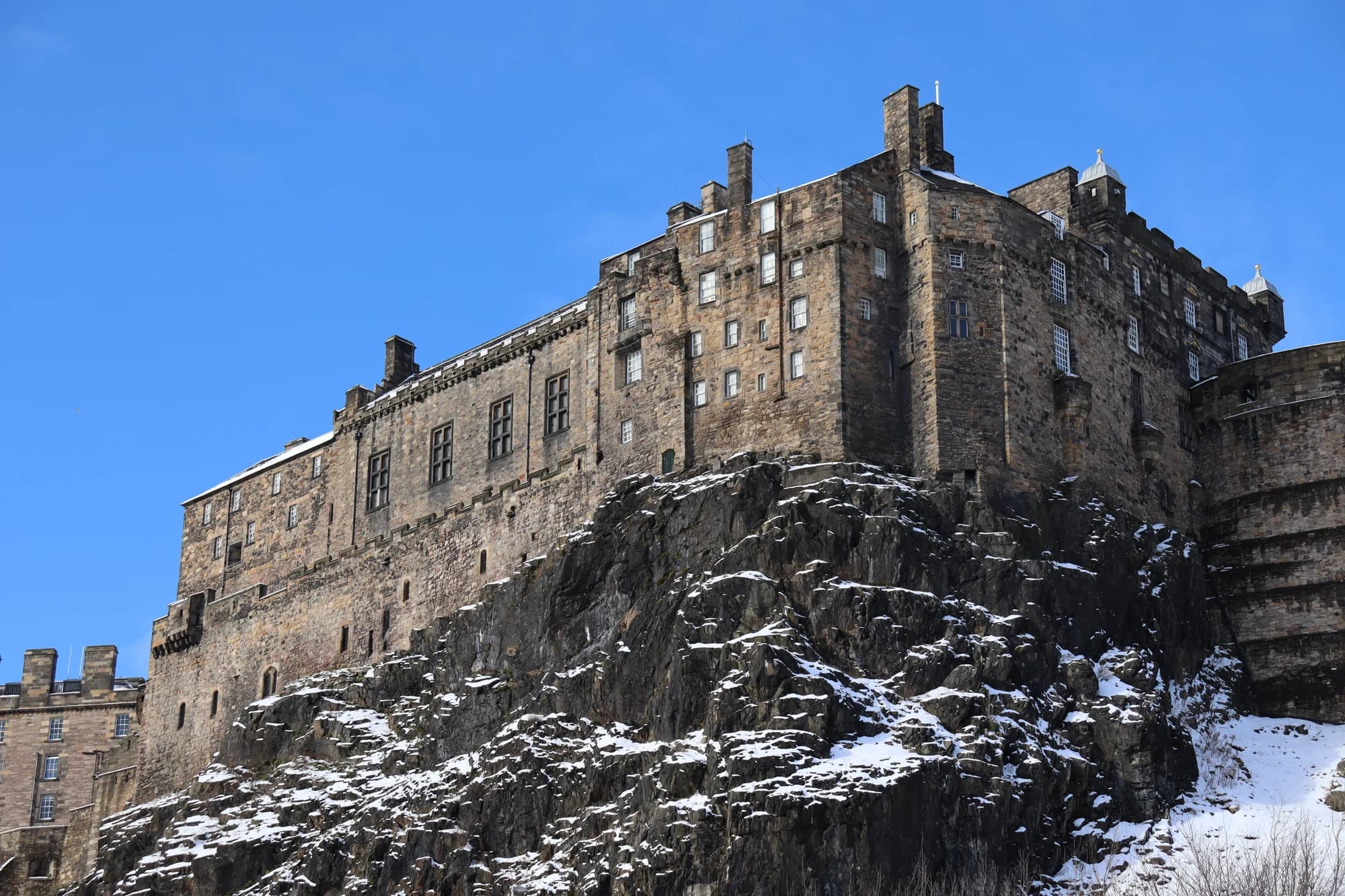
The National Monument, intended since 1822 as a full-scale replica of the Parthenon to honour Scottish soldiers and sailors who fell in the Napoleonic Wars, ran out of funding in 1829 after only twelve columns were erected, earning the nicknames 'Edinburgh's Disgrace' and 'Scotland's Folly.' Calton Hill also hosts the Nelson Monument, whose time ball — a large sphere that drops at precisely 1 pm daily since 1852 — once provided ships on the Firth of Forth with a visual chronometer signal that allowed navigators to calculate longitude. The hill is one of Edinburgh's seven ancient summits and was designated a UNESCO World Heritage Site in 1995 as part of the Old and New Towns of Edinburgh.