There are places in Europe where beauty feels almost too precisely calibrated, as though a set designer with impeccable taste and an unlimited budget had been let loose on the landscape. Lucerne is one of those places. Curled around the northwestern corner of the vast, fjord-like Lake Lucerne and ringed by mountains that rise straight from the water as though thrust upward by some geological tantrum, this medieval Swiss city has been pulling travellers into its orbit for centuries. Queen Victoria came here. So did Goethe, Wagner, and Mark Twain. Twain, never one for understatement, called it "the charmingest place" he had ever seen, and even allowing for nineteenth-century hyperbole, it is difficult to mount a counterargument.
The city announces itself gently. You arrive by train — likely from Zurich, a journey of barely forty-five minutes that unspools through green pastureland before depositing you at the station designed by Santiago Calatrava — and step out onto the Bahnhofplatz to find the lake waiting for you, a sheet of bottle-green water stretching south toward the Uri Alps. The air smells of water and pine and, depending on the season, roasting chestnuts. The mountains seem close enough to reach out and touch: Pilatus to the south, Rigi to the east, their peaks dusted with snow well into late spring. This is not backdrop. This is main event.
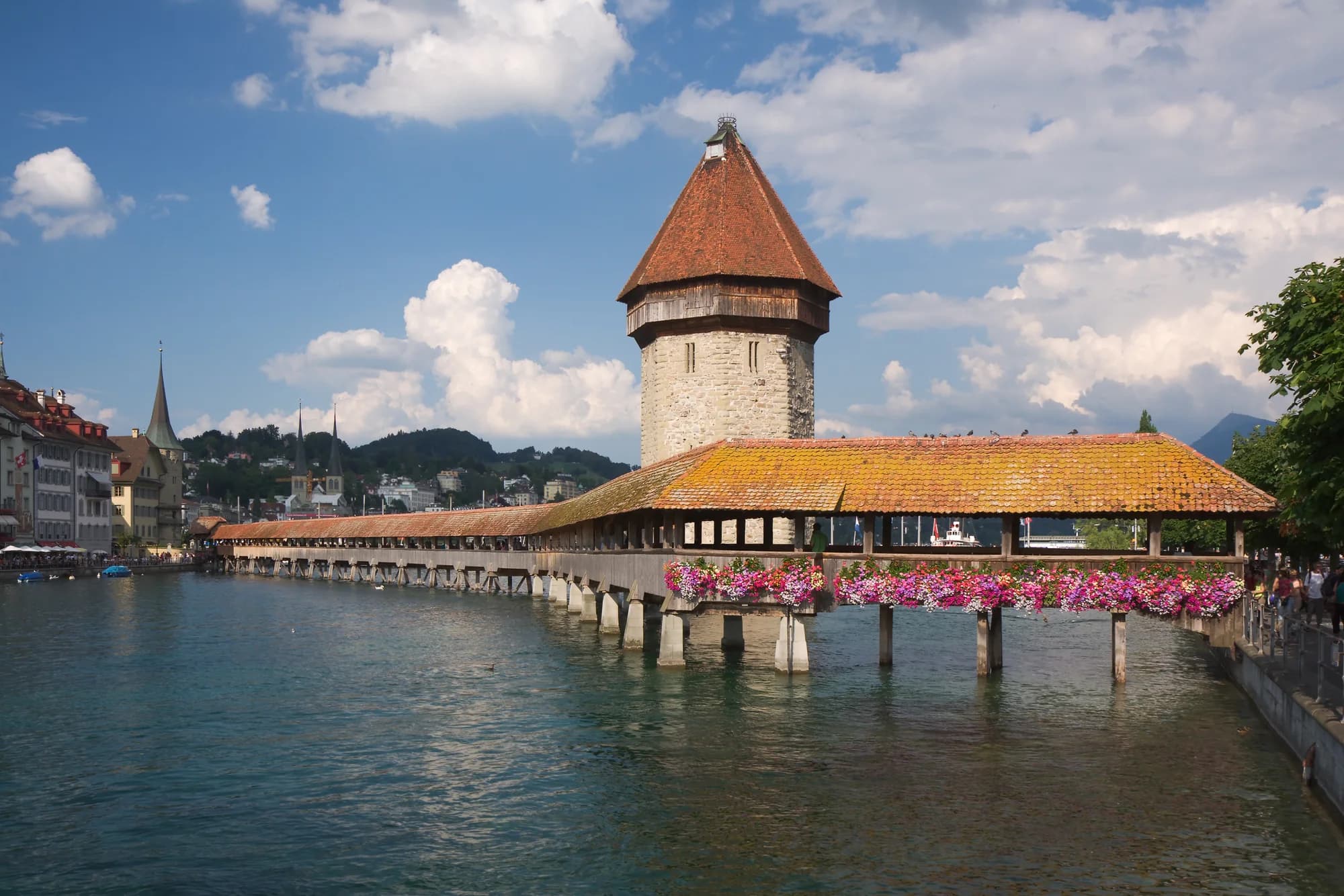
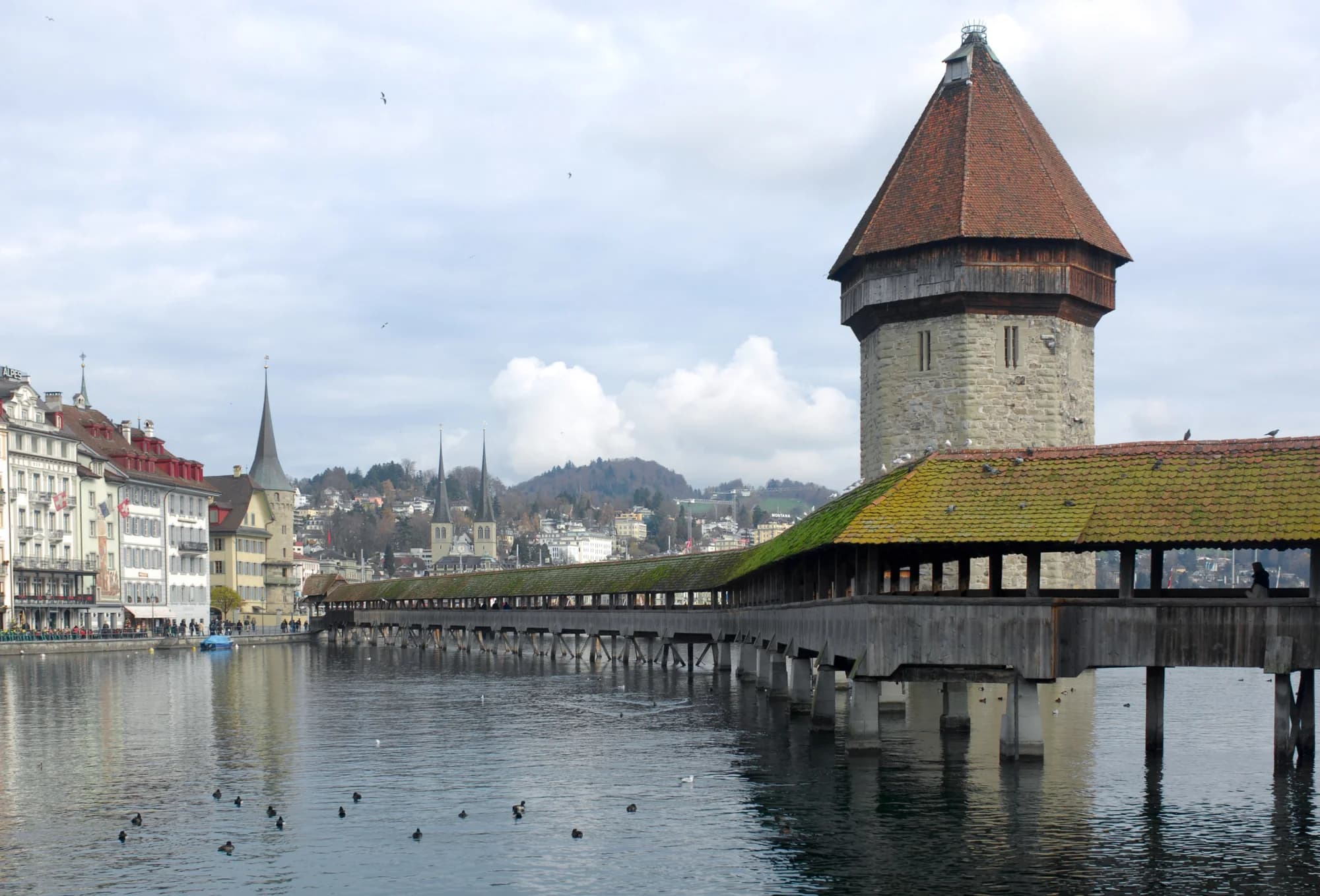
The Kapellbrücke and Water Tower at twilight, their reflections mirrored perfectly in the still waters of the Reuss River
The Kapellbrücke (Chapel Bridge), built in 1333, is the oldest wooden covered bridge in Europe and the oldest surviving truss bridge in the world — its zigzag form deliberately engineered to span the Reuss River at its widest point while compensating for the strong current without central piers. The octagonal Wasserturm (Water Tower), which predates the bridge by approximately 30 years, has served as a treasury, a prison, and a torture chamber over its 700-year history — though its most benign function was as the secure archive for Lucerne's municipal documents. On August 18, 1993, a fire — likely started by a discarded cigarette — destroyed two-thirds of the bridge and 86 of the 158 triangular paintings; the restoration, completed in just eight months using original 14th-century timber salvaged from the lake bed, is regarded as one of the finest heritage reconstruction projects of the 20th century.
The Kapellbrücke, or Chapel Bridge, is Lucerne's postcard, its logo, its reason for appearing on a hundred million Instagram feeds. Built in 1333 as part of the city's fortifications, it is the oldest wooden covered bridge in Europe and the oldest surviving truss bridge in the world. It snakes diagonally across the Reuss River, its timber piles dark with age, its interior roof lined with a cycle of seventeenth-century triangular paintings depicting scenes from Swiss history and the lives of the city's patron saints. In 1993 a fire — possibly started by a cigarette — destroyed much of the bridge and eighty-six of the 158 paintings. The reconstruction, completed in eight months, was an extraordinary feat of Swiss precision and civic will. Today the bridge is both ancient and reborn, the charred timbers of the Water Tower at its end a permanent reminder of what was almost lost. Walk it at dawn, before the tour groups arrive, when the only company is the swans gliding beneath the arches and the distant chime of church bells rolling down from the Hofkirche.
A ten-minute walk from the bridge, carved into a sandstone cliff face above a reflecting pond, the Lion Monument — the Löwendenkmal — has been moving visitors to silence since 1821. Mark Twain described it as "the most mournful and moving piece of stone in the world." The dying lion, pierced by a broken spear and shielding a fleur-de-lis shield with its paw, commemorates the Swiss Guards who were massacred during the storming of the Tuileries Palace in the French Revolution. It is smaller than photographs suggest, and all the more powerful for it. The lion's expression — eyes half-closed, mouth slack with approaching death — achieves something that monumental sculpture rarely manages: genuine pathos. The reflecting pond, the grotto setting, the canopy of trees: it all works, and it works on everyone.
“The most mournful and moving piece of stone in the world”
Lucerne's Altstadt, or old town, spreads along the right bank of the Reuss in a warren of car-free lanes and cobbled squares. The buildings here wear their frescoes like faded ballgowns. The Weinmarkt square, where Lucerne's Passion Play was performed for centuries, is ringed by painted facades — biblical scenes, mythological figures, heraldic crests — executed during the sixteenth and seventeenth centuries by master craftsmen whose names history has mostly forgotten. The Rathaus, built in the Italian Renaissance style between 1602 and 1606, rises from the riverbank on sturdy stone arches, its clock tower presiding over the Kornmarkt with the quiet authority of four centuries. Nearby, the Spreuerbrücke — the lesser-visited sister of the Kapellbrücke — spans the Reuss with its own series of painted panels, these ones a Dance of Death cycle by Kaspar Meglinger. Sixty-seven panels survive, each one a memento mori in wood and pigment, reminding the medieval burgher that death comes for everyone: the pope, the emperor, the merchant, the milkmaid.
Switzerland's mountains are not merely scenery here; they are an invitation. Mount Pilatus, whose sawtooth profile dominates the southern skyline, is reached by the world's steepest cogwheel railway — a gradient of 48 percent that makes the carriages feel as though they are climbing a ladder tilted against the sky. The journey, from the lakeside suburb of Alpnachstad, takes thirty minutes and deposits you at 2,128 metres, where views stretch across seventy-three named Alpine peaks. The mountain's summit is a study in extremes: in summer, wildflowers and grazing ibex; in winter, a snow globe of pristine white. The descent via the aerial cableway to Kriens — a two-stage gondola ride that glides silently over pine forests and alpine meadows — offers the classic "golden round trip" that every Swiss tourism brochure extols and that, for once, genuinely delivers.
The summit of Mount Pilatus in summer, a panorama of Alpine peaks stretching to the horizon under an impossibly blue Swiss sky
Mount Pilatus (2,128 m), named not for Pontius Pilate — the medieval legend that the Roman governor's body was thrown into a lake on its summit, causing violent storms — but more prosaically from the Latin mons pileatus, "cloud-capped mountain," dominates Lucerne's southern skyline with its sawtooth ridge of seven peaks. The Pilatus railway, completed in 1889, remains the world's steepest cogwheel railway at a gradient of 48% (rising 1,629 metres in just 4.6 km) — an engineering feat designed by Zurich-born Eduard Locher, who solved the problem of extreme gradient by inventing a double-rack system with horizontally opposed cogwheels that lock the train to the track. On the summit, a panorama of 73 named peaks — from the Black Forest to the Bernese Oberland — unfolds, along with the geological evidence of the African-European collision: the Pilatus massif is composed of African-origin sedimentary rock that was thrust over the European continental margin during the Alpine orogeny, a phenomenon known as the Glarus Thrust, a UNESCO World Heritage tectonic feature visible from the summit trails.
Across the lake, Mount Rigi — the "Queen of the Mountains" — offers a gentler experience. Europe's first mountain cogwheel railway has been hauling visitors to the summit since 1871, and the views from the top, at just under 1,800 metres, are arguably the finest in central Switzerland: thirteen lakes laid out like scattered sapphires, the Black Forest visible on clear days, and the entire chain of the Bernese Oberland — Eiger, Mönch, Jungfrau — strung along the southern horizon. The railway itself, with its vintage red carriages and unhurried pace, is a piece of living industrial archaeology.
Lucerne's musical heritage runs deeper than most visitors realise. Richard Wagner arrived here in 1866, fleeing creditors and scandals, and settled into the Tribschen villa on a promontory jutting into the lake. It was here that he completed Die Meistersinger von Nürnberg, worked on the Ring cycle, and composed the Siegfried Idyll — a birthday gift for his wife Cosima that was first performed on the villa's staircase on Christmas morning 1870. The villa is now the Wagner Museum, a pilgrimage site for devotees where you can see the Erard grand piano on which he composed, original manuscripts in his spidery hand, and the very staircase where that first, intimate performance took place. Even if Wagner leaves you cold, the gardens, sloping down to the lake with views of the mountains, are worth the twenty-minute walk from the city centre.
Golden Round Trip Strategy
Book the Golden Round Trip to Pilatus online a day in advance. The route — boat from Lucerne to Alpnachstad, cogwheel railway up, cable car down to Kriens, bus back to Lucerne — is the definitive Pilatus experience. Go on a weekday morning to avoid the worst of the crowds, and check the summit webcam before you leave: there is no point making the ascent if the mountain is socked in cloud. The boat leg alone, threading across Lake Lucerne with the mountains rising on all sides, justifies the ticket price.
The KKL Luzern — the Culture and Convention Centre — is the city's great architectural statement of the modern era. Designed by Jean Nouvel and opened in 1998, it juts over the lake on slender stilts, its vast copper roof cantilevered over the water in a gesture of breathtaking structural audacity. The main concert hall, sheathed in maple and cherry wood, is considered one of the finest listening spaces in the world, with acoustics by Russell Johnson that draw the world's great orchestras. The Lucerne Festival, held here each summer and at Easter, is one of the classical music calendar's essential events. Even if you are not attending a concert, the lakeside terrace at the KKL's Seebar is the city's finest spot for an Aperol spritz as the sun drops behind Pilatus.
The Swiss Museum of Transport, a short walk along the lakefront, is the most visited museum in Switzerland — a claim that might sound improbable until you step inside. This is not a dry collection of exhibits in glass cases. It is an immersive, hands-on celebration of mobility in all its forms: locomotives you can climb into, flight simulators, a planetarium, a film theatre with Switzerland's largest screen, and the Swiss Chocolate Adventure, a ride that combines Willy Wonka whimsy with Swiss efficiency. You will arrive sceptical and leave converted. The museum's collection of vintage Swissair posters alone is worth the admission.
A Belle Époque lake steamer cutting across Lake Lucerne, the paddle wheels churning turquoise water, mountains mirrored in the wake
The fleet of five paddle steamers on Lake Lucerne — Uri (1901), Unterwalden (1902), Schiller (1906), Gallia (1913), and Stadt Luzern (1928) — is the largest preserved fleet of Belle Époque steamers on any Swiss lake, each vessel powered by its original steam engine (converted from coal to oil in the 1970s) and maintained to museum standards by the SGV (Schifffahrtsgesellschaft des Vierwaldstättersees). The steamers ply Lake Lucerne — Vierwaldstättersee, literally "Lake of the Four Forest Cantons" — a body of water 38 km long and 214 metres deep that is actually four connected lake basins formed by the glacial over-deepening of the Reuss River valley during the last Ice Age. The lake's complex, fjord-like shape — with arms stretching into Uri, Schwyz, and Unterwalden — meant that until the mid-19th century, the lake steamers were the only practical transport linking the cantons that formed the original Swiss Confederation in 1291.
The lake steamers are not merely transport; they are time travel. The fleet of five paddle steamers, built between 1901 and 1928, are among the finest preserved examples of Belle Époque marine engineering in Europe — all polished brass, varnished teak, steam engines that thrum with a living pulse beneath your feet. You can take them anywhere on the lake: to Weggis, the resort town where Rachmaninoff lived; to Vitznau, the gateway to Rigi; to Brunnen, where the lake narrows into its most dramatic, fjord-like section, the cliffs of the Rütli meadow — where Switzerland was founded, legend says, in 1291 — plunging into deep water. First-class tickets grant access to the upper deck saloon, where you can take lunch with a glass of Chasselas while the mountains scroll past the windows like a Cinemascope film.
A Culinary City in a Culinary Nation
Swiss cuisine labours under a reputation for being heavy, brown, and cheese-drenched. Lucerne, to its credit, has been quietly dismantling this stereotype. The city's dining scene punches well above its weight, with a constellation of restaurants that marry Swiss ingredients to international technique.
At the top of the pyramid sits Focus, the two-Michelin-starred restaurant at the Hotel Atlantis by Giardino, where chef Nenad Mlinarevic — one of Switzerland's most decorated culinary figures — turns out plates of extraordinary precision: lake fish with fermented vegetables, aged beef with miso and Swiss truffle, desserts that look like architectural models. It is fine dining of the highest order, and priced accordingly, but the lunch menu offers a more accessible entry point. In the old town, Wirtshaus Galliker has been serving Lucerne's burghers since 1856 from a menu that has barely changed: Luzerner Chügelipastete (a vol-au-vent filled with veal and mushrooms in cream sauce), Rösti, lake perch fillets in butter. Four generations of the Galliker family have presided over this wood-panelled dining room, and the experience — noisy, warm, utterly without pretension — feels like stepping into someone's (very old, very talented) kitchen.
“Simplicity, carried to an extreme, becomes elegance”
The Wochenmarkt, held every Tuesday and Saturday on the banks of the Reuss, is where you understand what Swiss culinary tradition actually means: cheeses from Alpine pastures you could walk to, air-dried beef from the Grisons, breads that are still warm, cherries and apricots in summer, wild mushrooms in autumn. The vendors are farmers, not traders — the person selling you the Alpkäse probably milked the cows. This is not a tourist market. This is where Lucerne shops.
Where to Stay
The grand dame of Lucerne hospitality is the Hotel Schweizerhof, open since 1845 and occupying the finest position in the city, directly on the lakefront promenade. Its guests have included Tolstoy, Churchill, and Truman Capote. The recent renovation has brought the rooms into the twenty-first century — all pale oak, soft greys, and bathrooms that gleam — without sacrificing the Belle Époque grandeur of the public spaces. The hotel's restaurant, Pavillon, serves French-Swiss classics under chandeliers the size of small cars.
For something more contemporary, the Hotel Montana, perched on a hillside overlooking the lake and reached by the world's shortest funicular railway, offers rooms with terraces that seem to hang directly over the water. The sunset views from the Scala restaurant's terrace are, without exaggeration, among the finest in Switzerland. At the boutique end of the spectrum, the Hotel des Balances occupies a frescoed townhouse on the Weinmarkt square, its riverside terrace restaurant one of the most romantic dining spots in the old town.
Frequently Asked Questions
What is the best time of year to visit Lucerne? High summer — July and August — delivers the most reliable weather for mountain excursions, with temperatures in the mid-twenties and long, golden evenings. It also delivers the largest crowds. May and September offer an ideal compromise: generally settled weather, thinner tourist numbers, and lower prices. Winter, from December to February, transforms Lucerne into a different city entirely. The mountains become ski destinations, the Christmas markets set up in the old town squares, and the low sun turns the lake into polished silver. The annual LiLu Light Festival in January bathes the city's landmarks in projections by international light artists.
How many days do I need? Three full days is the comfortable minimum: one for the city (bridge, old town, Lion Monument, museums), one for Pilatus, and one for Rigi or a lake steamer excursion. With a fourth day you could add a trip into the mountains of the Bernese Oberland, or simply slow down and let the city's rhythms — coffee on the lakefront, a swim at the Lido, an evening concert at the KKL — take over.
How do I get there? Lucerne sits at the centre of Switzerland's famously efficient rail network. Direct trains run from Zurich Airport (45 minutes), Geneva (2 hours 45 minutes), and Basel (1 hour). From Milan, the journey takes about three hours, much of it through the Gotthard Base Tunnel, the longest railway tunnel in the world. If you are driving, be aware that parking in the old town is limited and expensive, and the city centre is largely pedestrianised.
Is Lucerne expensive? Yes — this is Switzerland. Expect to pay CHF 25-35 for a main course at a mid-range restaurant, CHF 8-10 for a beer, and CHF 150-300 for a standard hotel room. The Swiss Travel Pass, which includes unlimited rail travel, lake steamers, and museum entry, is the most effective way of managing transport costs. Many hotels include a Lucerne Visitor Card that provides free local transport and discounts on mountain railways.
What should I pack? Layers are essential regardless of season. Even on a warm summer day, the summit of Pilatus can be 15°C colder than the city, and the wind can be biting. Comfortable walking shoes are non-negotiable — Lucerne's cobbles are hard on the feet, and the mountain paths are steep. A swimsuit, in summer, for the Lido or the lake beaches; rain gear, always, because this is the northern side of the Alps and weather systems arrive without warning.
Lake Lucerne at sunset, the water glassy and pink, the silhouette of Pilatus cutting a dark line across a sky of deepening violet
The sunset phenomenon that bathes Lake Lucerne in pink and violet — what meteorologists call Alpenglühen, the afterglow that paints the western-facing limestone of Pilatus in shades of rose and gold — occurs when the sun drops below the horizon but its light still illuminates airborne particles above the mountain peaks, scattering longer wavelengths of red and pink across the lake surface. Lake Lucerne has been the cradle of Swiss identity since 1291, when representatives of the three original cantons — Uri, Schwyz, and Unterwalden — gathered on the Rütli meadow above the lake's southern arm to swear the oath of confederation that founded the Swiss nation, an event commemorated in Friedrich Schiller's 1804 play Wilhelm Tell and Rossini's 1829 opera. The lake, with its 38 km serpentine shoreline and maximum depth of 214 metres — deeper than Lake Zurich and Lake Geneva combined — has inspired more artists and composers per kilometre of shoreline than perhaps any body of water in Europe: Wagner composed at Tribschen, Twain rhapsodised from the quays, and Turner painted the Rigi from the lake steamers so obsessively that his watercolours of Lake Lucerne now fill entire galleries at Tate Britain.