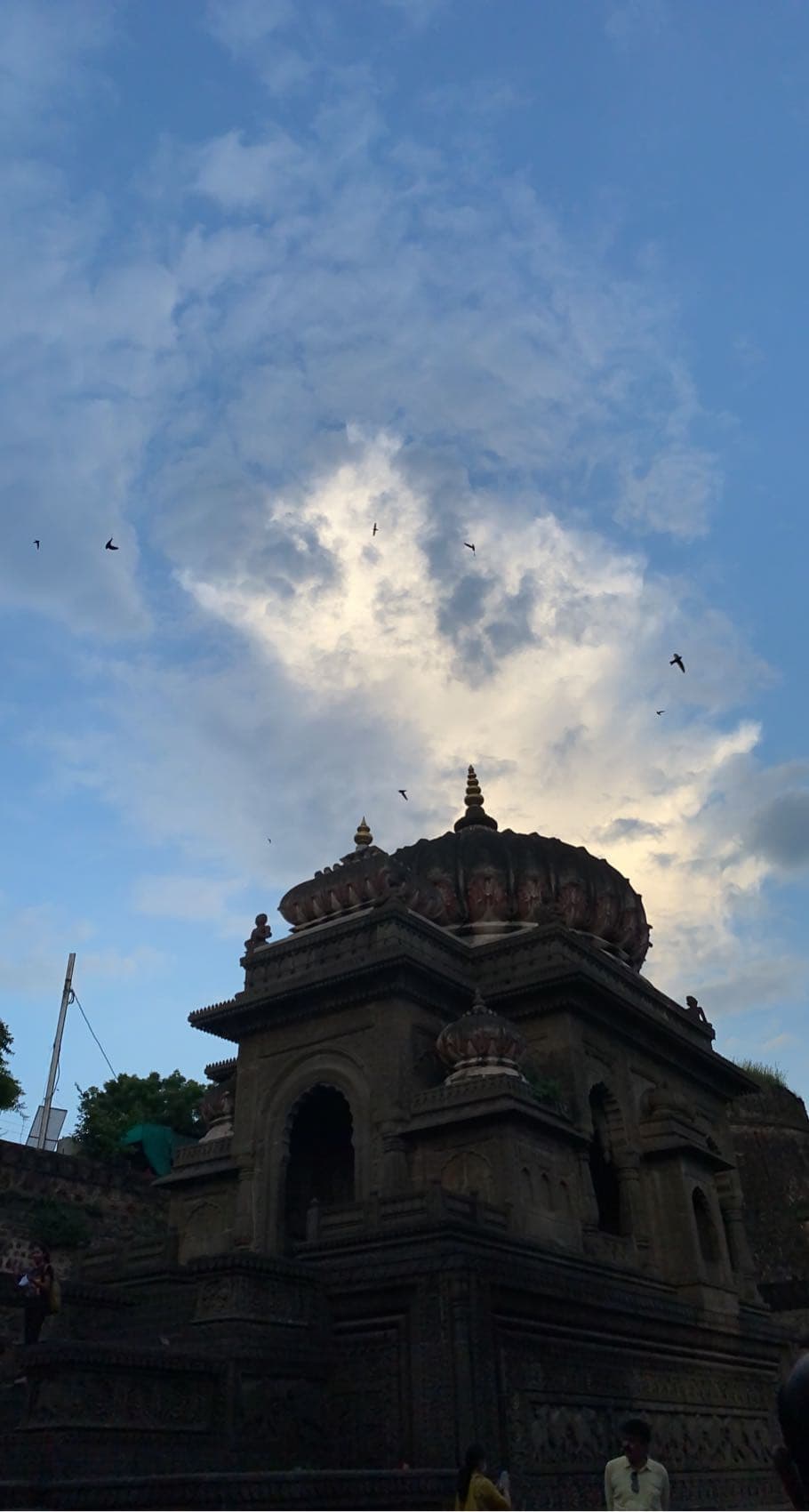
Ahilya Fort is not easy to reach, and that is the first thing to understand about it. The journey from Indore — the nearest airport, ninety-five kilometres to the south — takes two hours on roads that deteriorate from highway to country lane to a dirt track that winds through fields of cotton and soybean before depositing you at the edge of the Narmada River. Here, at the sacred ghats of Maheshwar, you leave the car and descend a flight of stone steps to a waiting boat. The crossing takes five minutes. On the far bank, the eighteenth-century fortress of Rani Ahilyabai Holkar rises from the water's edge — a cascade of sandstone ramparts, domed pavilions, and arcaded courtyards that seems to have been carved from the cliff itself. By the time you step ashore, the twenty-first century has fallen away with the dust on the road behind you.
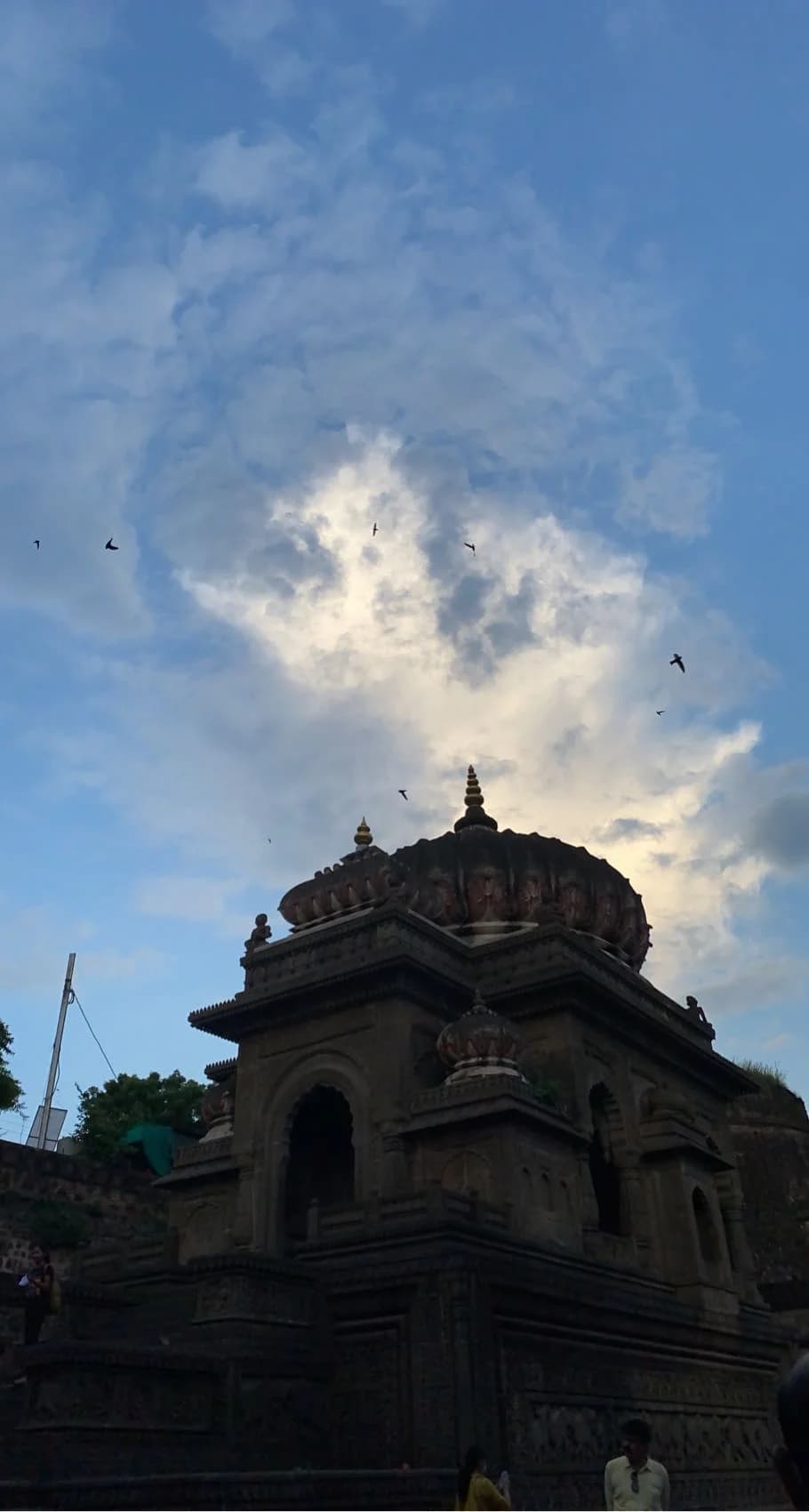
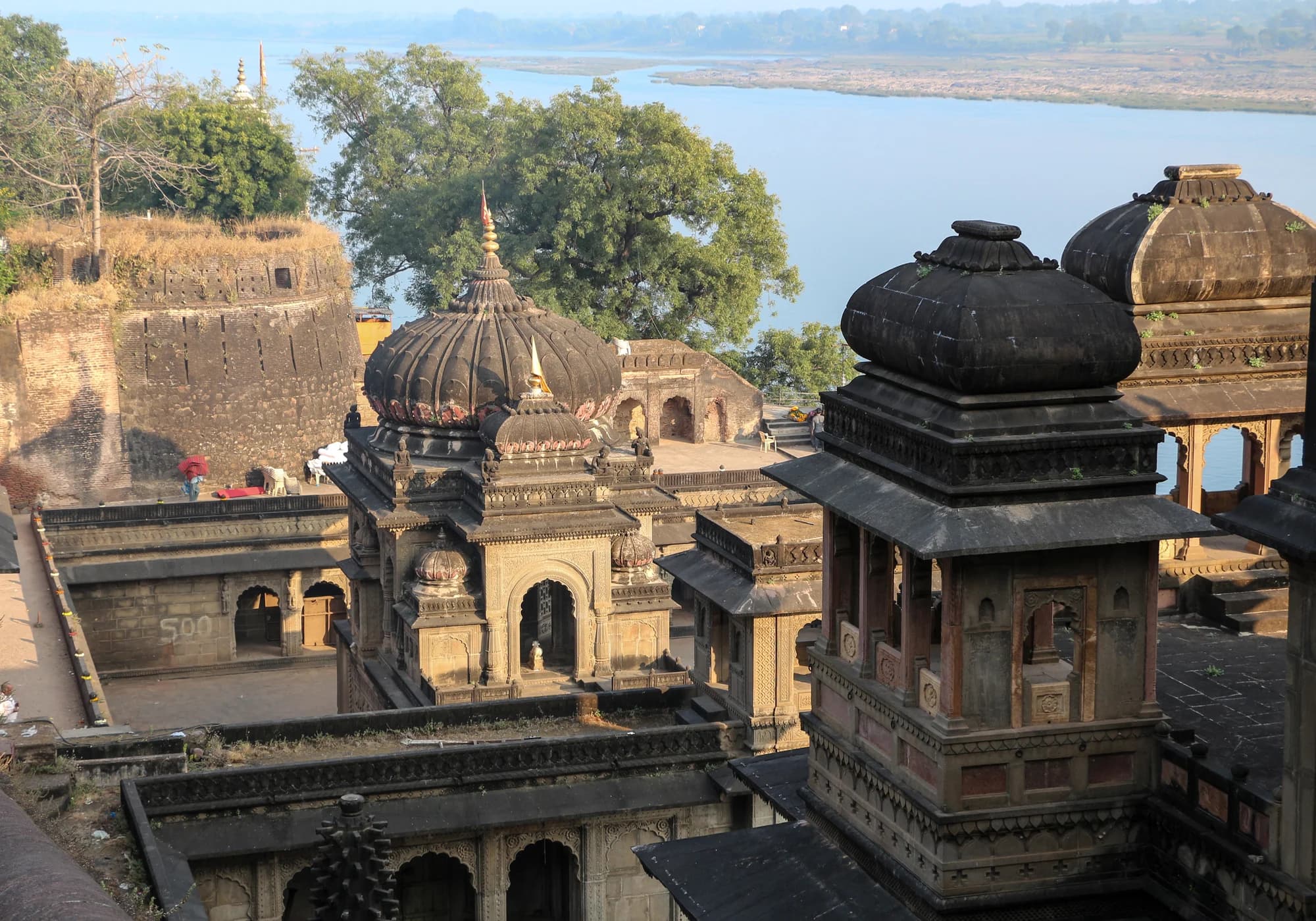
Ahilya Fort from the Narmada River at dawn — the eighteenth-century ramparts rising from the water's edge, temple spires silhouetted against a pink sky, the sacred river already alive with pilgrims and prayer
Built by Rani Ahilyabai Holkar in the 1760s, the fortress stands on the banks of the Narmada — India's holiest river after the Ganga — in the sacred town of Maheshwar, where the Philosopher Queen ruled for twenty-eight years with a wisdom and justice that earned her the devotion of her subjects
Photo: Squirealll, CC BY-SA 4.0
The woman who built this fortress was, by any measure, extraordinary. Ahilyabai Holkar became the ruler of the Malwa region in 1767, following the death of her husband and her father-in-law, and she governed for twenty-eight years with a wisdom and justice that earned her the title "The Philosopher Queen." She moved the capital of the Holkar dynasty from Indore to Maheshwar — a small town on the banks of the Narmada, India's holiest river after the Ganga — and transformed it into a centre of administration, culture, and textile production. The Maheshwari sari, still woven by hand in the town below the fort, is her legacy: she brought weavers from Surat and Varanasi to establish the craft here, and their descendants continue to work the same looms using the same patterns — fine cotton and silk in checks, stripes, and the distinctive Maheshwari border — that her patronage created. Every Maheshwari sari sold in India today traces its lineage to this warrior queen's textile policy.
The Fort Today
The fort is now a heritage hotel, managed with understated elegance by Prince Richard Holkar — a direct descendant of Ahilyabai — and his family. It is not a conventional hotel. There is no lobby, no reception desk, no room keys. The 19 rooms and tented suites are scattered across the fort's various levels, connected by steep staircases and hidden passages, each one different in size, shape, and outlook. The atmosphere is less of a commercial establishment than of a private house whose owner has, with considerable taste, invited you to stay for a few days.
The inner courtyard at Ahilya Fort — a neem tree spreading its branches over marble paving, bougainvillea in magenta and white cascading from the upper terraces, the river visible through ancient stone arches
There is no lobby, no reception desk, no room keys — the 19 rooms and tented suites are scattered across the fort's various levels, each one different in size, shape, and outlook, connected by steep staircases and hidden passages
The rooms are simple but beautiful. Whitewashed walls, high ceilings with carved wooden beams, floors of polished stone or terracotta tiles. The furniture is antique — four-poster beds, carved wooden chests, portraits of Holkar ancestors in gilded frames. The bathrooms are modern but understated, with rainfall showers and, in some suites, deep stone tubs positioned to catch the morning light. The best rooms face the river; open your windows at dawn, and the sound that fills the room is the chanting of priests and the splash of pilgrims at the ghats below — a sound that has been the same for three centuries.
The gardens, terraced down the hillside from the fort's ramparts to the water's edge, are an essay in tropical abundance: frangipani, bougainvillea, mango trees, and the sacred tulsi plant in terracotta pots. The swimming pool, set into a terrace above the river, is a rectangle of turquoise water framed by stone arches, with a view that sweeps across the Narmada to the temples on the far bank. It is one of the most serene pool settings in India.
The Narmada: India's Holiest River
The Narmada is unlike any other river in India. It flows westward, against the general grain of the subcontinent's geography, from its source in the Amarkantak hills to the Arabian Sea. It is worshipped as a goddess — Narmada Devi — and the act of walking its entire length, a journey of some 1,300 kilometres, is considered one of the great pilgrimages of Hinduism. Maheshwar, with its temples and ghats, is one of the river's most sacred sites.
The ghats — the stone steps leading down to the water — are the centre of life in Maheshwar. At dawn, pilgrims descend to bathe in the river's green-black waters. Priests perform puja at the small temples that line the banks. Women wash clothes on the stone steps, their saris bright against the grey stone. Boatmen pole their vessels across the river, ferrying pilgrims and, increasingly, visitors from the fort. The scene has changed remarkably little since Ahilyabai's time — only the mobile phones and the occasional selfie-stick mark the passage of centuries.
A sunset boat ride on the Narmada is Ahilya Fort's essential experience. The boatman — a local villager who has navigated these waters for decades — poles the craft slowly upstream as the sun drops behind the temples of the far bank. The river turns from green to gold to silver. The chanting from the ghats grows more intense as the evening aarti ceremony begins — bells, drums, the rhythmic recitation of Sanskrit verses, the flicker of oil lamps reflected in the dark water. You drift in silence, a witness to a ritual that has been performed on this river bank for a thousand years.
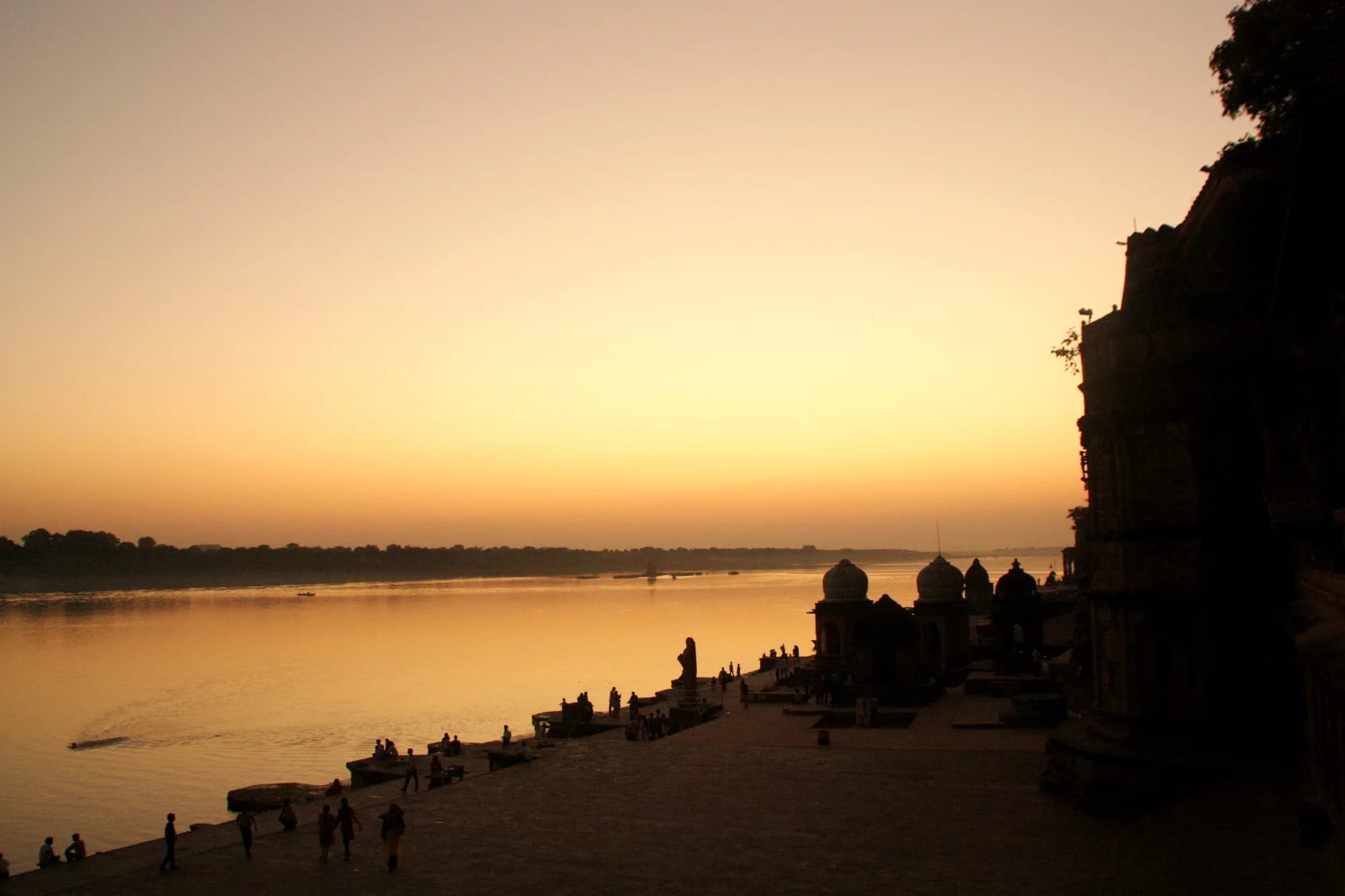
The Narmada River at sunset — pilgrims bathing at the ghats, the spires of Maheshwar's temples silhouetted against a golden sky, a boatman poling his craft across the sacred water, the chant of the evening aarti drifting across the river
The ghats of Maheshwar are among the most beautiful in India — a sweeping arc of stone steps descending to the sacred Narmada, where the evening aarti ceremony transforms the riverbank into a theatre of fire, chant, and devotion
“Ahilya Fort is not a hotel. It is a meditation on what India was and what, in its best moments, it still can be.”
Dining: Flavours of Malwa
The kitchen at Ahilya Fort is helmed by cooks who have been with the Holkar family for decades, and the menu reflects the distinctive cuisine of the Malwa region — a style of cooking that is less known than the royal cuisines of Rajasthan but no less accomplished. Malwa's food is predominantly vegetarian, influenced by the Jain and Gujarati traditions, and characterised by a subtle, layered spicing that rewards attention.
Breakfast is served on the terrace overlooking the river: fresh tropical fruit, poha (flattened rice with turmeric, peanuts, and curry leaves), eggs cooked to order, and the fort's own honey from hives kept in the gardens. Lunch is a thali of Malwa specialities: dal bafla (the Malwa version of Rajasthan's dal baati, wheat dough balls baked and then soaked in ghee), bhindi masala, aloo methi, and the region's distinctive kadhi — a yoghurt-and-besan curry that is thinner and tangier than its Rajasthani counterpart.
Dinner is served by candlelight in the fort's courtyard or, on special occasions, on the ramparts with the river below and the stars above. The menu changes daily based on what is fresh and what the cooks feel like preparing. There is no printed menu, no wine list (though beer and basic spirits are available). The luxury here is not in choice but in the quality of what arrives on your plate — ingredients grown in the fort's own gardens, recipes refined over three centuries, and the ineffable taste of food prepared by people who have been cooking it their entire lives.
The Weavers of Maheshwar
The town below the fort is home to approximately 2,500 handloom weavers, the descendants of the craftsmen whom Ahilyabai brought here in the eighteenth century. A visit to the weaving workshops — which the fort can arrange — is a masterclass in textile production. You watch the entire process: the spinning of the yarn, the dyeing (Maheshwar's cotton saris are renowned for their vibrant, fast colours), the setting of the warp on the loom, and the weaving itself, the shuttle flying back and forth in a blur of practised motion. The weavers — many of them women — work in small workshops attached to their homes, and they are happy to demonstrate their craft. You will almost certainly buy a sari or a dupatta; the prices are a fraction of what you would pay in a Delhi or Mumbai boutique, and the quality — fine cotton, pure silk, zari borders of real gold and silver thread — is exceptional.
A Maheshwari weaver at her loom — the shuttle paused mid-flight, the warp threads a rainbow of dyed cotton and silk, the distinctive Maheshwari border pattern emerging beneath her skilled fingers
Rani Ahilyabai brought weavers from Surat and Varanasi to establish the craft of Maheshwari sari weaving — their descendants continue to work the same looms using the same patterns that her patronage created 250 years ago
When to Visit
October through March offers the most pleasant climate. The Narmada is at its fullest after the monsoon (September-October), and the surrounding countryside is a vivid green. Avoid April through June unless you are comfortable with temperatures above 40°C, though the fort's thick stone walls provide natural cooling that makes even the hottest days bearable.
What to Bring
A good book, because the fort's gardens and terraces were designed for reading. Comfortable walking shoes for the ghats and the town. Modest clothing for temple visits. A swimsuit for the pool. Cash — enough for sari purchases, temple donations, and tips — because the nearest ATM is in the town, a 15-minute walk.
An open mind. Ahilya Fort rewards travellers who arrive without an agenda and are content to let the river's rhythms set their own.
Frequently Asked Questions
How many nights should I stay? Three minimum. You need one day to decompress from the journey, one day for the ghats, the weavers, and a temple walk, and one day to do nothing at all — the fort's greatest luxury. Four or five nights allow for a deeper unplugging.
How do I get there? Fly to Indore (IDR), then a two-hour drive arranged by the fort. Alternatively, fly to Bhopal (BHO) and drive four hours. The approach to the fort via the Narmada boat is part of the experience — do not try to reach it by road; there is none.
Is it suitable for solo travellers? Yes — the fort's small scale, communal dining, and the warmth of the Holkar family's hospitality make it one of India's most welcoming properties for solo visitors. Many guests arrive alone and leave having made friends.
What about electricity and WiFi? The fort has electricity, hot water, and perfectly adequate WiFi, but it also has a pragmatic relationship with all three. Power cuts are occasional and brief. The WiFi is functional but not fast. Roll with it.
Is there a dress code? Relaxed. Modest clothing for temple visits (covered shoulders and knees). Comfortable, cool fabrics — cotton and linen — for the daytime. A shawl for evening, as the river breeze can be cool even in summer.
Ahilya Fort at dusk from the Narmada — the sandstone ramparts glowing gold in the last light, the temple bells of Maheshwar ringing the evening aarti, the sacred river flowing westward as it has since before memory, carrying the prayers of a thousand pilgrims toward the Arabian Sea
A stay at Ahilya Fort is not a hotel experience — it is an immersion in the living history of Malwa, the spiritual heritage of the Narmada, and the enduring legacy of one of India's greatest rulers