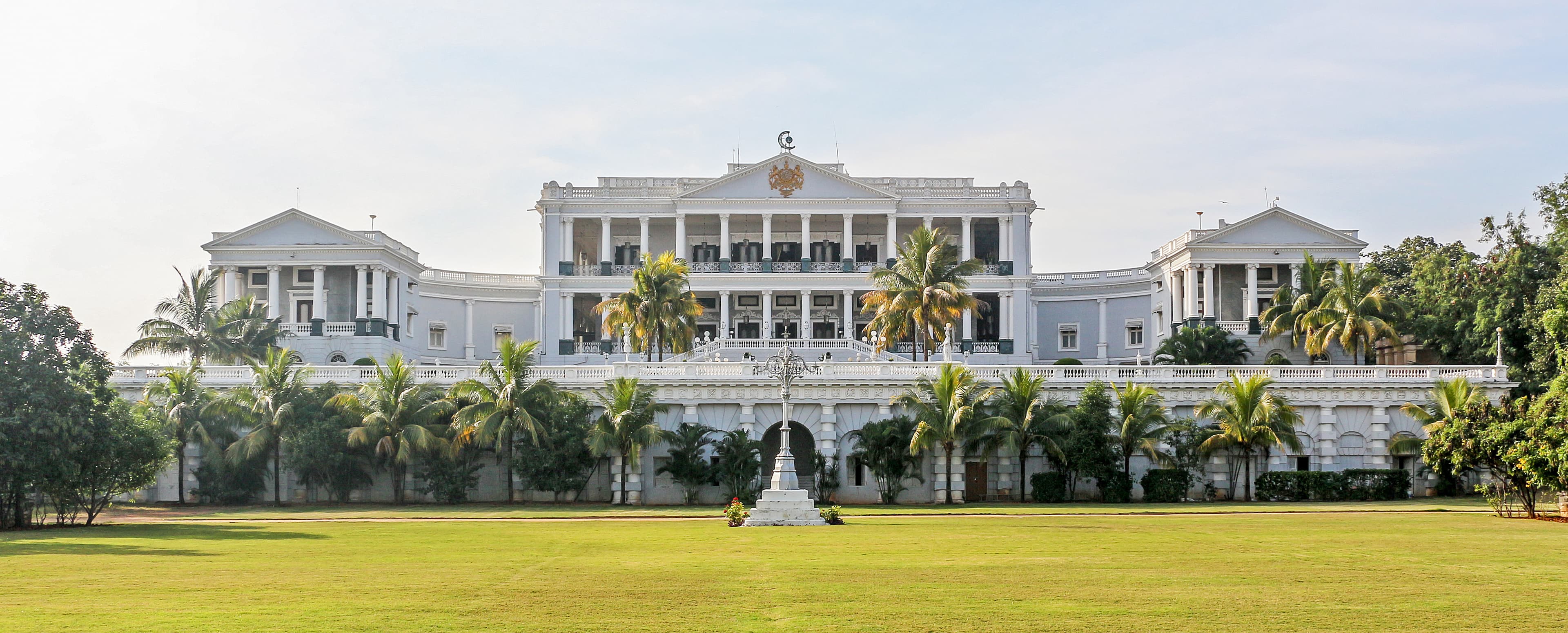
There is a certain kind of architecture that makes you stop breathing. Not because it is large — though Falaknuma Palace is very large — but because it is improbable. Perched two thousand feet above the city of Hyderabad on a granite hill called Koh-e-Tur (the Mountain of Tur), the palace appears as a mirage rendered in stone: Italian Renaissance palazzos transposed onto the Deccan plateau, Tudor Gothic windows opening onto views of minarets and biryani shops, a Venetian chandelier glittering above a durbar hall where the Nizam — the richest man in the world — once received kings. This is Falaknuma. The name means "Mirror of the Sky," and it is, like everything the Nizams touched, both literal and profound.
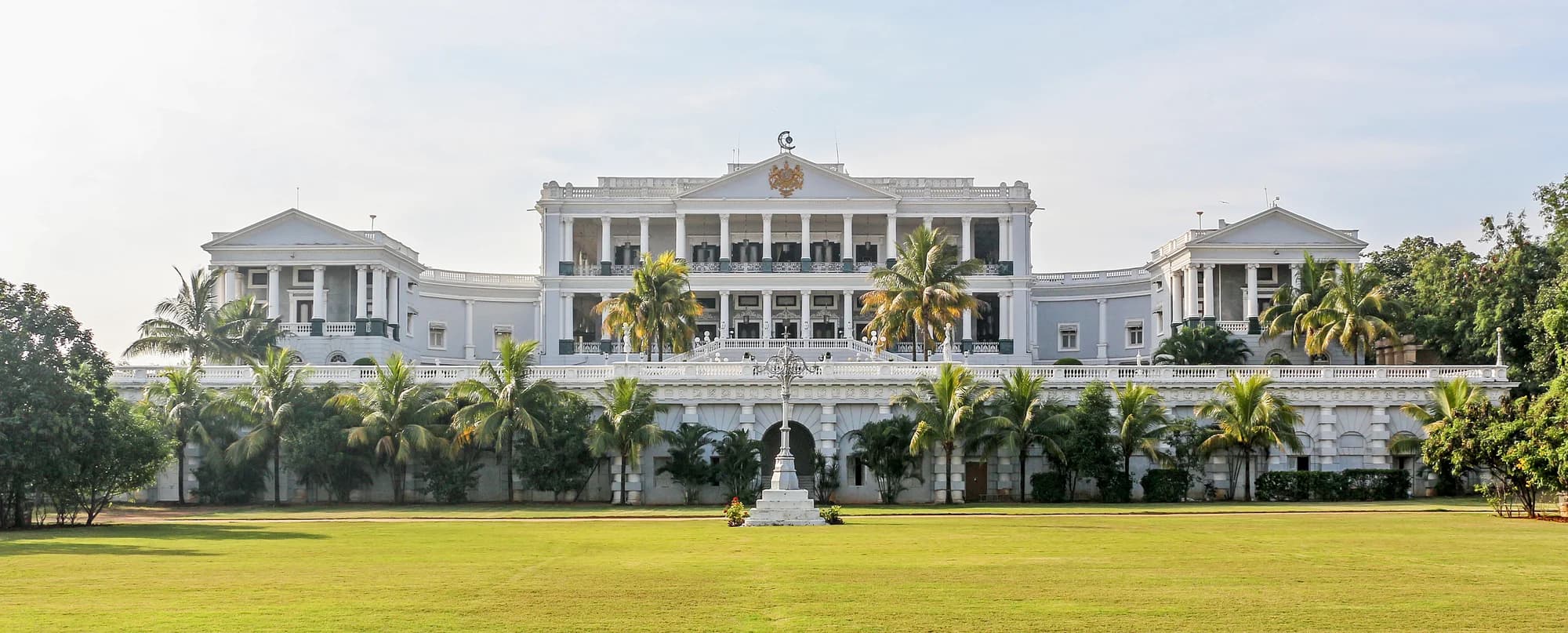
Falaknuma Palace at twilight — the white marble facade glowing rose-gold against the Deccan sky, the city of Hyderabad sprawled two thousand feet below, the palace's distinctive dome and turrets silhouetted against gathering dusk
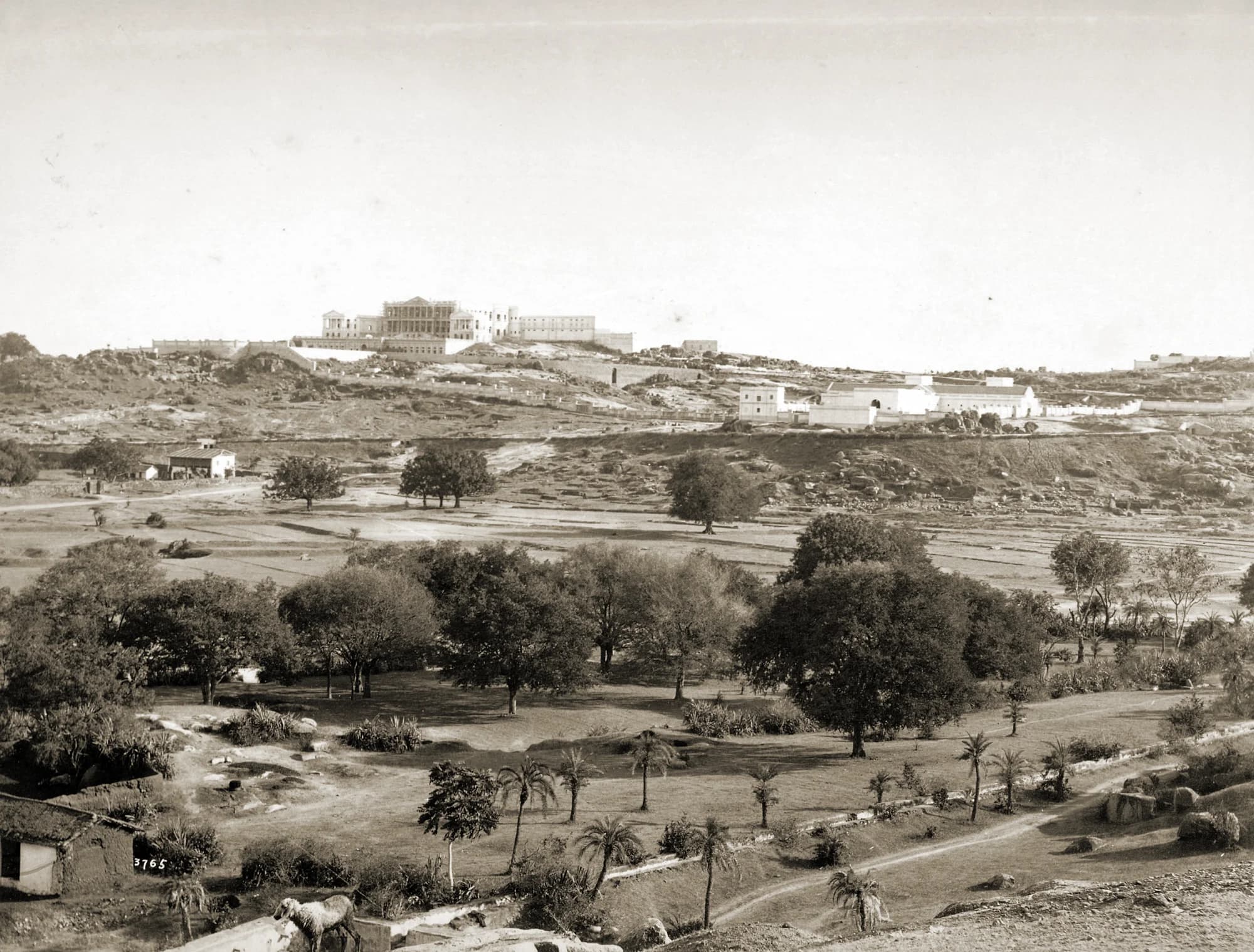
Commissioned in 1884 by Nawab Sir Viqar-ul-Umra and designed by Anglo-Italian architect William Ward Marrett, the palace was sold to the sixth Nizam — then the wealthiest individual on earth — in 1897, becoming a royal retreat perched 2,000 feet above Hyderabad
Photo: Bernard Gagnon, CC BY-SA 3.0
The palace was commissioned in 1884 by Nawab Sir Viqar-ul-Umra, the Prime Minister of Hyderabad and a man whose architectural ambitions far exceeded his station. He spent nine years and a fortune building what was, at the time, the most expensive private residence in the Deccan — a hybrid of Italian palazzo, Tudor country house, and Mughal pleasure pavilion, designed by an Anglo-Italian architect named William Ward Marrett who had never designed anything remotely this ambitious before, and would never design anything this ambitious again. In 1897, Viqar-ul-Umra made a decision that would alter the palace's destiny: he sold it to his sovereign, the sixth Nizam, Mahbub Ali Pasha, for the sum of forty lakh rupees — a figure so far below cost that it was, in essence, an offering. The Nizam accepted the gift with the nonchalance of a man who was, at that moment, the wealthiest individual on earth.
The Richest Man in the World
A brief digression on Nizami wealth is necessary, because without it the palace makes no sense. The Nizams of Hyderabad ruled a kingdom the size of France — 86,000 square miles of the Deccan plateau — from 1724 until 1948, when the Indian Army annexed the state in Operation Polo. At its peak, the dynasty controlled the Golconda diamond mines, which produced the Koh-i-Noor, the Hope Diamond, the Orlov, and virtually every legendary gemstone in European crown collections. The seventh and last ruling Nizam, Mir Osman Ali Khan, was declared the richest man in the world by Time magazine in 1937. His personal fortune, estimated at $2 billion in 1940s dollars (approximately $230 billion today), was so vast that he used the 185-carat Jacob Diamond — one of the largest in the world — as a paperweight. For three decades.
“There are wealthy men, and then there was the Nizam. The difference is the Jacob Diamond — that he used as a paperweight.”
This was the context in which Falaknuma operated. It was not merely a palace. It was a statement. When the Nizam received guests here — viceroys, maharajas, King George V, the Shah of Persia — he was not merely entertaining. He was demonstrating, in marble and crystal and Burmese teak, that the Deccan was a civilisation unto itself, answerable to no one.
The Architecture: A European Dream in the Deccan
Falaknuma is, architecturally speaking, a building that should not exist. Marrett, working from the Nawab's sketches and his own feverish imagination, produced a design that fuses Italian Renaissance symmetry with English Tudor detailing, all of it executed in white marble quarried from Rajasthan and transported two thousand kilometres by rail and bullock cart. The central block is flanked by two wings that sweep outward in a crescent — a layout borrowed from European palace architecture but adapted to the Deccan climate with deep verandahs, jali screens, and interior courtyards designed to trap cool air.
The palace contains 220 rooms spread across 22,000 square metres. The state reception rooms — the Durbar Hall, the Banquet Hall, the Ballroom — occupy the ground floor, each one a crescendo of decorative excess that somehow, miraculously, never tips into kitsch. The ceilings soar forty feet overhead, supported by columns of Italian marble. The floors are laid with Carrara tiles in geometric patterns that took Italian craftsmen three years to complete. The windows are Venetian stained glass, commissioned from the same Murano workshops that supplied the Doge's Palace. Every room is an argument for the proposition that beauty and wealth, when deployed with genuine taste, are not opposing forces.
The Durbar Hall — a forty-foot ceiling supported by Italian marble columns, Carrara tile floors in geometric patterns, Venetian stained-glass windows filtering the Deccan light into jewel-toned pools across the marble
The Durbar Hall is where the Nizam received kings and viceroys — its forty-foot ceiling, Italian marble, and Venetian chandeliers were designed to communicate, in the universal language of architecture, that the ruler of Hyderabad was the equal of any monarch on earth
The 101-Seat Dining Table
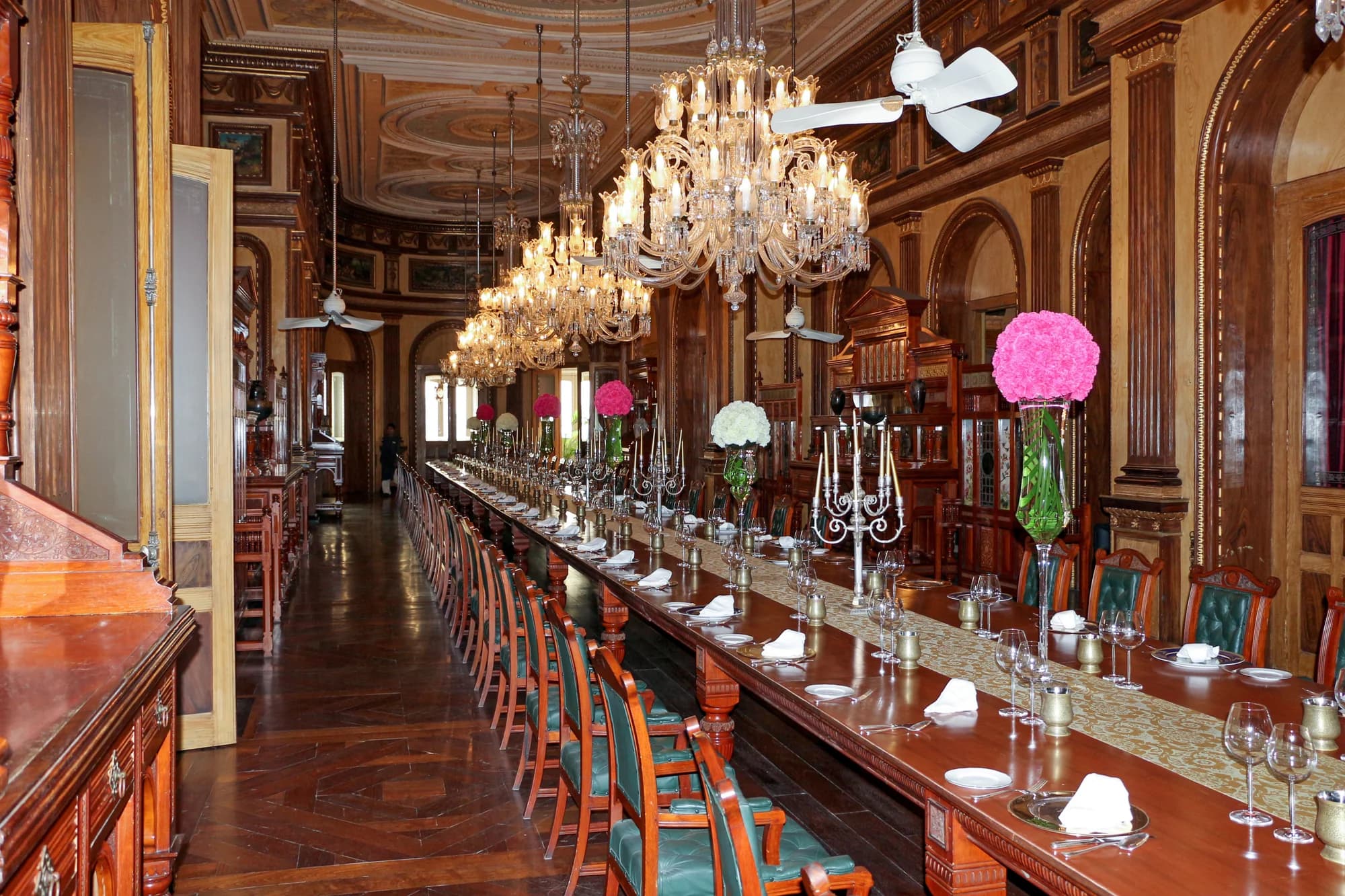
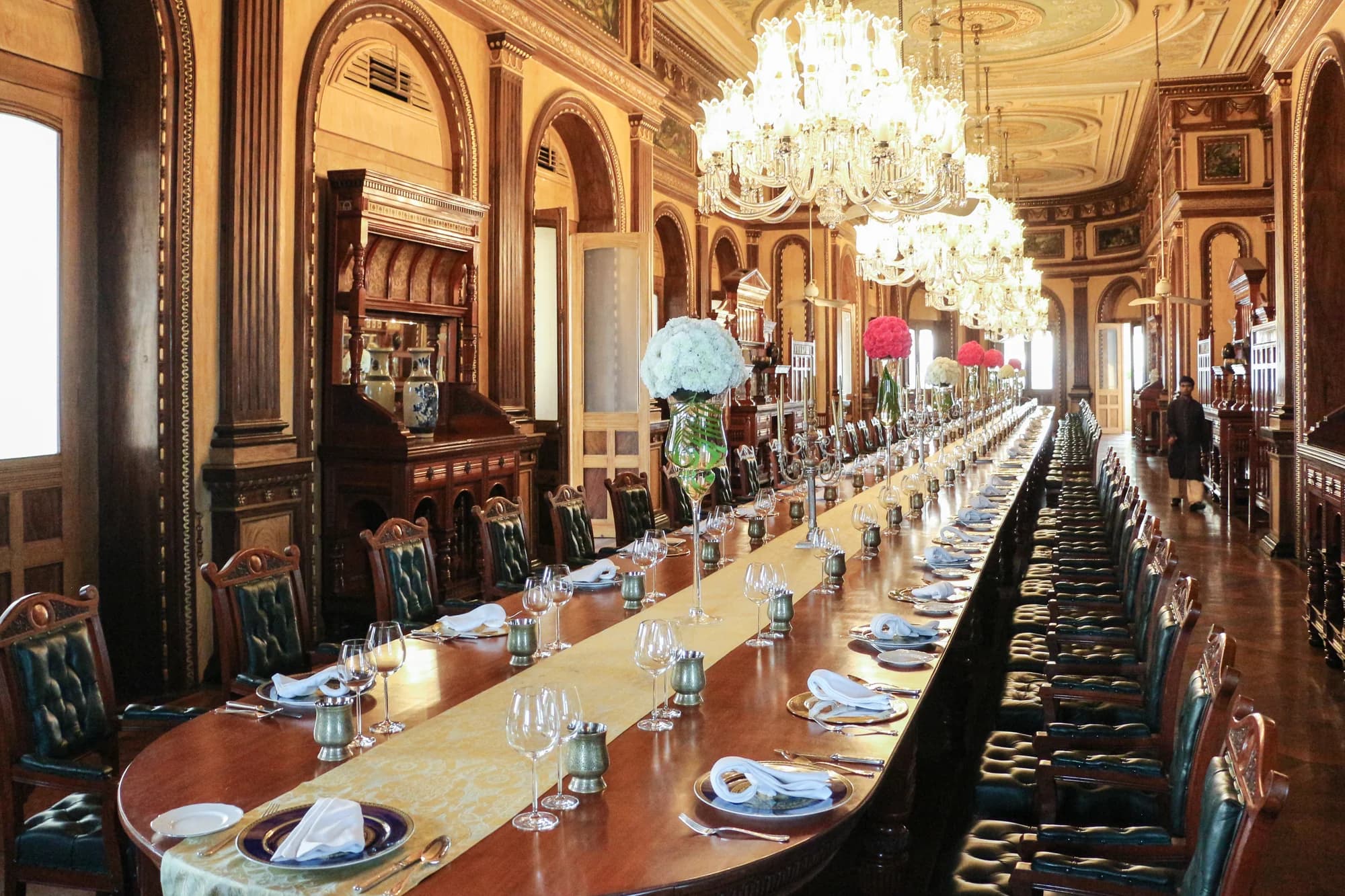
The Banquet Hall at Falaknuma contains the longest dining table in the world. It seats 101 guests along a single stretch of carved Burmese teak, and it required the hall to be built around it — the table was assembled in situ and cannot be removed without dismantling a wall. The place settings are Sèvres porcelain, commissioned from the French royal manufactory in 1895. The crystal is Baccarat. The silver is Georgian, marked with the lion passant of the London assay office.
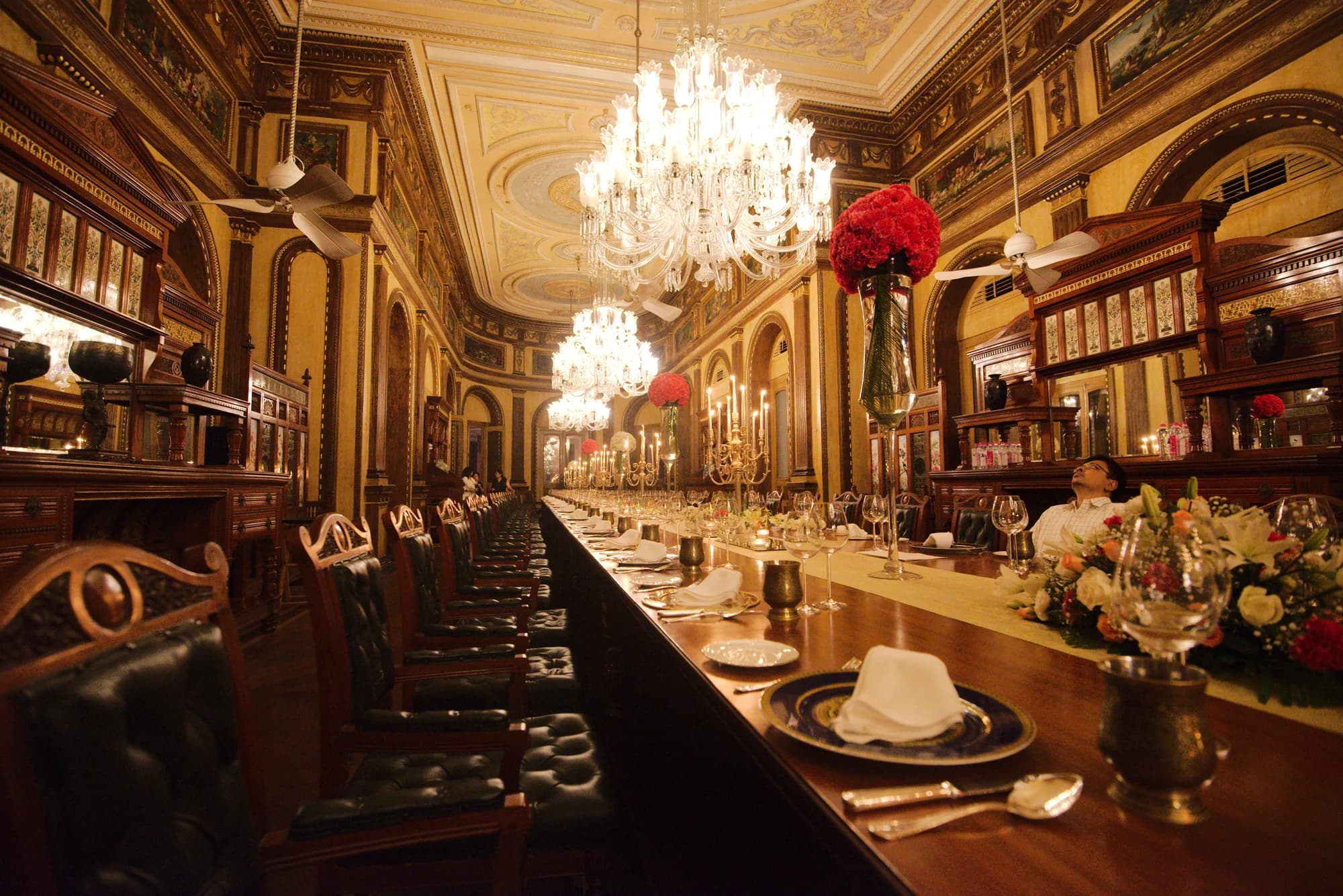
The 101-seat dining table — the world's longest, stretching the entire length of the Banquet Hall beneath chandeliers of Venetian crystal, Sèvres porcelain and Baccarat crystal gleaming at every place setting
The table, measuring 108 feet, was commissioned by the Nizam for state banquets — the Sèvres porcelain service was custom-made in France, and the table's extraordinary length allowed the Nizam to seat 101 guests without any one of them being farther from him than another
At the head of the table, a single chair sits elevated on a marble dais: the gaddi, or throne seat, reserved for the Nizam. The chair is surprisingly modest — carved teak, velvet upholstery, no gold leaf — and the modesty is deliberate. The Nizam did not need to announce his status. The table did it for him. When you dine here today, as a guest of the Taj Falaknuma Palace hotel (which has operated the property since 2010 after a decade-long, meticulously documented restoration), you are served a Hyderabadi feast that draws from the royal kitchens' original recipes. The biryani alone — kacchi-style, with marinated mutton layered with half-cooked basmati rice and sealed under a dough lid for hours of slow, aromatic cooking — is worth the journey from anywhere on earth.
The Library: Windsor in the Deccan
The palace library is a replica of the library at Windsor Castle. This is not metaphorical. The sixth Nizam visited Windsor in 1892 and was so struck by the reading room — its carved walnut galleries, its coffered ceiling, its atmosphere of imperial scholarship — that he commissioned an exact copy for Falaknuma. Burmese teak was substituted for English oak, but otherwise the replication is faithful to the millimetre. The collection numbers 6,000 volumes, including first editions of literary classics, medieval manuscripts, and a complete set of the Encyclopaedia Britannica from 1771. The walnut ceiling, carved by craftsmen brought from England for the purpose, is a masterpiece of woodwork — every panel a different botanical motif, every joint invisible, the whole thing suspended forty feet above the reading tables like the underside of heaven.
The walnut-ceilinged library — a faithful replica of Windsor Castle's reading room, 6,000 volumes lining carved gallery shelves, afternoon light filtering through stained glass onto leather-bound spines
The Nizam's library was modelled on the library at Windsor Castle — a deliberate gesture of parity between the ruler of Hyderabad and the British monarch, the 6,000 volumes covering every subject that interested a man who could afford to be interested in everything
The library was the Nizam's personal refuge. He was, by all accounts, a solitary man despite his power — more comfortable among books than courtiers, more interested in poetry than politics. He would retreat here for hours, reading Persian ghazals and English novels, while his prime ministers ran the kingdom and his wives waited in the zenana. The room retains that atmosphere: scholarly, quiet, a space designed for thought rather than display.
The Arrival: By Horse-Drawn Carriage
The approach to Falaknuma is theatrical in a way that only the Nizams could have conceived. You do not drive up to the door. You drive to the base of the hill, to a ceremonial gatehouse where a liveried staff in traditional Hyderabadi sherwanis awaits. From here, you are transported to the palace in a horse-drawn carriage — a restored Victorian landau, exactly as guests would have arrived in the Nizam's day. The climb takes fifteen minutes, winding up a road lined with frangipani and bougainvillea, the palace revealing itself in increments: first the dome, then the wings, then the full improbable edifice silhouetted against the enormous Deccan sky.
The horse-drawn carriage ascending Koh-e-Tur — a restored Victorian landau drawn by two white horses, frangipani blossoms lining the winding road, the palace dome emerging through the trees
Guests arriving at Falaknuma are met at the base of Koh-e-Tur by a restored Victorian landau — the twenty-minute ascent by horse-drawn carriage recreates the approach that the Nizam's guests would have experienced when the palace first opened its doors
At the porte-cochère, a ceremonial guard in the scarlet-and-gold livery of the Nizam's household presents arms. A garland of jasmine and roses is placed around your neck. Attar — the traditional Hyderabadi perfume, distilled from sandalwood and damask roses — is dabbed on your wrists. A silver goblet of chilled falooda, the rose-scented milk drink that is Hyderabad's answer to the lassi, appears in your hand. By the time you step through the carved teak doors into the Grand Foyer — a space of white marble, crystal chandeliers, and a ceiling painted with a celestial map of the Deccan sky as it appeared on the night of the palace's inauguration — you have been comprehensively transported. Whatever world you arrived from has ceased to exist.
The Suites
The palace offers sixty rooms and suites, each one a study in restrained Deccani luxury. The colour palette is white, ivory, and the pale celadon green that Hyderabadi aristocrats have favoured for centuries. The furniture is reproduction — faithful to the original designs, executed by the same families of craftsmen who furnished the palace in the 1890s — and the fabrics are handwoven silks from the weavers of Pochampally and Gadwal. Even the most modest room features fourteen-foot ceilings, French windows opening onto private gardens or verandahs, and bathrooms of white Makrana marble.
The Nizam Suite, the palace's flagship accommodation, occupies the former private apartments of the sixth Nizam himself. It spans 1,800 square feet and includes a drawing room with a working fireplace (a rarity in the Deccan, but the Nizam enjoyed his evening fires even in Hyderabad's mild winters), a dining room seating eight, a study lined with original bookshelves still stocked with the Nizam's volumes, and a bedroom dominated by a carved four-poster bed beneath a frescoed ceiling depicting the night sky over Golconda. The bathroom features a freestanding copper bathtub — an exact reproduction of the Nizam's own — and a shower carved from a single block of Italian Carrara marble. The suite's private balcony, perched at the highest point of the palace, offers views that stretch to the horizon: the old city with its minarets and domes, the glass towers of HITEC City glittering in the distance, and the vast Deccan plateau rolling away to the west.
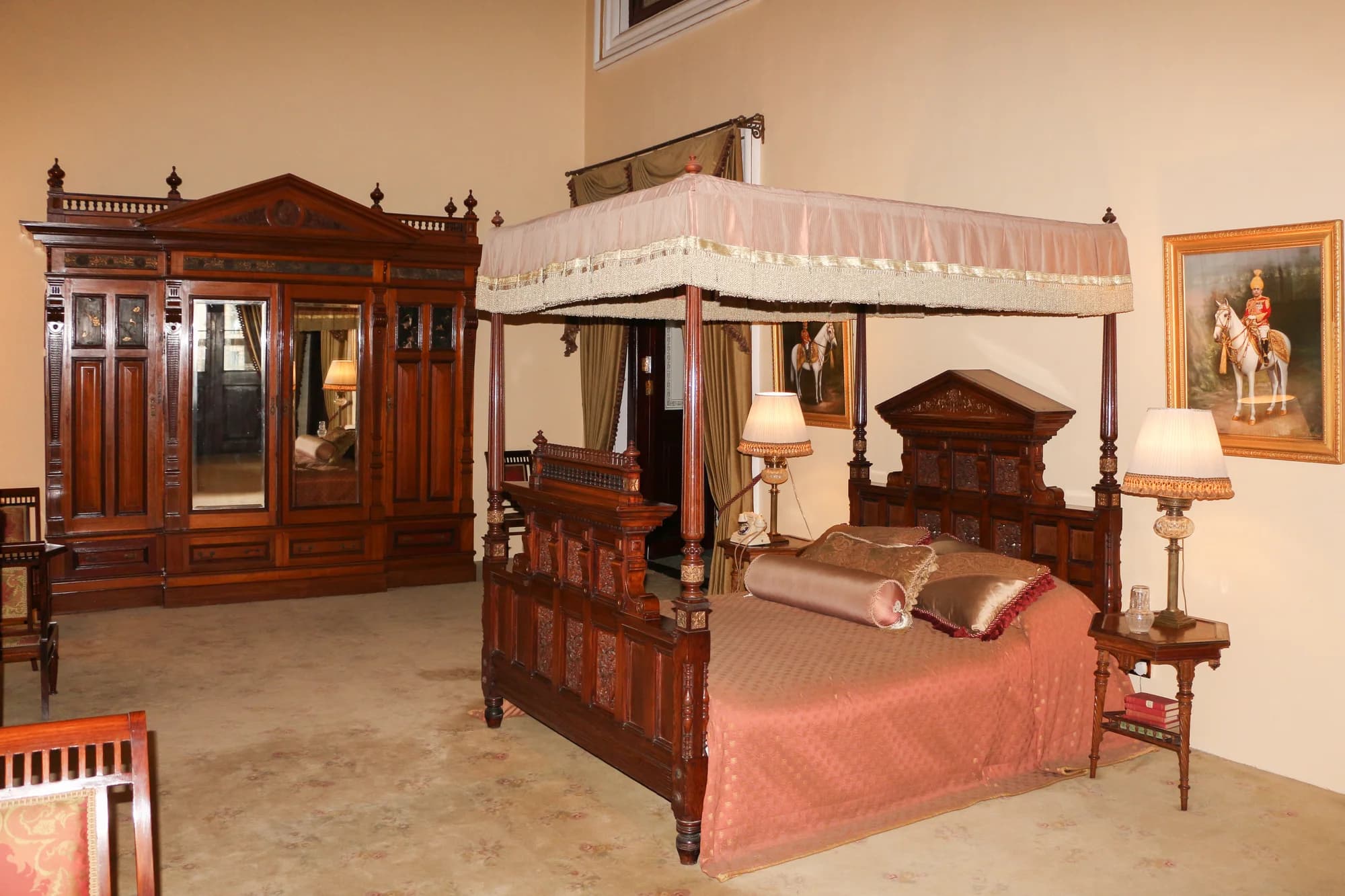
The Nizam Suite bedroom — a carved four-poster bed beneath a frescoed ceiling of the Golconda night sky, French windows opening onto a private balcony with views across Hyderabad to the horizon
The Nizam Suite occupies the palace's former royal apartments — its frescoed ceiling, depicting the night sky above the Golconda Fort, was painted by court artists who studied under European masters brought to Hyderabad specifically for the palace's decoration
The Grand Royal Suites, six in total, each occupy corners of the palace with dual-aspect views and private verandahs. They are named for historical figures associated with Falaknuma: the Viqar Suite, the Osman Suite, the Mahbub Suite. Each is decorated with archival photographs and artefacts from the palace's collection — a pair of the Nizam's spectacles, a handwritten letter, a silver paan box — that transform the room from a hotel suite into a museum vitrine.
Hyderabadi Cuisine: The Nizam's Table
The culinary programme at Falaknuma is, appropriately, the most ambitious of any heritage hotel in India. Hyderabadi cuisine is one of the subcontinent's great culinary traditions — a synthesis of Mughal sophistication, Deccani spice, and the Arab and Persian influences that arrived with the Qutb Shahi dynasty in the sixteenth century — and the palace's kitchens are its most authoritative custodians.
Adaa, the signature restaurant, occupies the former royal dining chamber. The room is intimate by palace standards — seating only forty — with walls panelled in carved teak and a ceiling of painted ivory. The menu is a curated tour of Nizami cuisine: Pathar Ka Gosht (lamb fillets seared on a heated granite slab, a technique unique to Hyderabad), Haleem (a slow-cooked porridge of wheat, mutton, and lentils that takes eighteen hours to prepare and is, during Ramadan, the city's obsession), and the Hyderabadi Biryani — kacchi-style, the marinated meat and par-cooked rice sealed under a flour lid and cooked over charcoal until the flavours fuse into something that bears approximately as much resemblance to restaurant biryani as a symphony orchestra bears to a busker.
Adaa restaurant — candlelit tables of carved teak beneath a painted ivory ceiling, the Hyderabadi biryani emerging from its sealed pot in a cloud of saffron-scented steam, a sommelier pouring an oaked Chardonnay into Baccarat crystal
Adaa serves Hyderabadi cuisine refined to its highest expression — the biryani, sealed in a pot with dough and slow-cooked for hours, is the definitive version of the dish that defines the city's culinary identity
Dessert at Adaa is not an afterthought. The Double Ka Meetha — bread pudding enriched with condensed milk, saffron, and cardamom, then baked under a crust of caramelised sugar — was invented in the Nizam's kitchens and perfected here. The Khubani Ka Meetha, stewed apricots topped with clotted cream, is the most elegant dessert in the Indian repertoire, and Falaknuma's version, made with apricots from the palace's own orchards, is definitive.
The palace also offers private dining experiences that would have been unimaginable during the Nizam's reign, when protocol dictated that the ruler dined alone. A candlelit dinner on the Jade Terrace, with the city lights of Hyderabad twinkling two thousand feet below, is one of the most romantic tables in Asia. A dinner in the library, surrounded by the Nizam's books and the scent of old leather and sandalwood, feels less like a meal than a séance — a communion with a world that vanished in 1948 but whose material remains surround you entirely.
The Scorpion-Shaped Pool and the Gardens
The palace grounds cover 32 acres atop Koh-e-Tur, and the gardens are, appropriately, a blend of Mughal geometry and English romanticism. The central formal garden, laid out in the traditional charbagh pattern (four quadrants divided by water channels), is planted with roses, jasmine, and the fragrant mogra that perfumes the evening air from October through March. The terraced gardens cascade down the hillside in a series of levels, each one with a different botanical theme: a palm court, a frangipani grove, a bougainvillea walk.
The swimming pool, carved into the hillside below the palace, is shaped like a scorpion — a whimsical touch attributed to the sixth Nizam, who was fascinated by the desert fauna of the Deccan and kept a private zoo on the palace grounds. The pool is edged in white marble and surrounded by cabanas draped in white linen, and the view from the water — the palace rising above you, the city spread below, hawks circling on thermals in the space between — is, without exaggeration, one of the great swimming pool views in the world.
The scorpion-shaped infinity pool — white marble edging, cabanas draped in white linen, the palace dome reflected in turquoise water, Hyderabad's cityscape stretching to the horizon beyond
The pool, shaped like a scorpion — the zodiac sign of the Nizam who commissioned the palace — is positioned on a terrace below the palace, its infinity edge seemingly spilling over the Deccan plateau toward the city 2,000 feet below
The Nizam's Legacy
The sixth Nizam died in 1911, and the palace passed to his son, Mir Osman Ali Khan, the seventh and last ruling Nizam. Osman Ali Khan was a different kind of ruler — less extravagant, more ascetic, a man who dressed in simple white cotton and slept on a thin mattress despite his inconceivable wealth. He used Falaknuma sparingly, preferring the less ostentatious King Kothi Palace in the city below, and the palace entered a long, slow decline. By the time the Taj group signed a management agreement in 2000, Falaknuma was a ghost of itself — structurally sound but stripped of its furnishings, its marble stained by decades of Deccan monsoon, its gardens overgrown, its library silent.
The restoration took ten years and is reported to have cost over ₹100 crore ($12 million). Every fresco was cleaned centimetre by centimetre. Every chandelier was disassembled, its crystals catalogued, cleaned, and rehung. The library's walnut ceiling was restored by the same family of craftsmen who had carved it a century earlier — their great-grandsons, working from the original patterns. The result is not a recreation. It is a resurrection. When Falaknuma reopened as a hotel in 2010, it did not feel like a heritage conversion. It felt as though the Nizam had simply stepped out for a moment and would return at any time.
“Falaknuma is not a hotel in a palace. It is a palace that happens to take reservations — and only just barely.”
Insider Tips
Arrival Timing
Schedule your arrival for late afternoon. The horse-drawn carriage ride up Koh-e-Tur is most magical in the golden hour, when the Deccan light turns the white marble to honey and the city below begins to glitter. The palace's sunset ceremony — a brief aarti (prayer ritual) in the Grand Foyer — is performed each evening and is worth witnessing.
Biryani Masterclass
Book the Hyderabadi Biryani Masterclass at least three days in advance. The palace's master chef — a khansama whose family has served the Nizam's kitchens for four generations — teaches the kacchi technique in the palace's training kitchen. You will learn more about rice, spice, and patience in two hours than most cookbooks convey in two hundred pages.
Suite Selection
The Grand Royal Suites in the east wing offer sunrise views over the old city — the Charminar, the Mecca Masjid, the minarets of the Chowmahalla Palace — that are worth the premium. The west wing faces the gardens and pool, which is quieter and more private but lacks the dramatic city views. For honeymooners, the Nizam Suite's private balcony is the most romantic breakfast spot in Hyderabad.
Frequently Asked Questions
Is Falaknuma Palace worth the price? Yes — unequivocally. This is not merely a luxury hotel; it is one of the most historically significant buildings in South India, restored to a standard that rivals any heritage property in the world. The combination of architecture, cuisine, and the intangible sense of inhabiting a space shaped by one of history's wealthiest dynasties justifies the rates. If you are visiting Hyderabad for any reason beyond a business meeting, Falaknuma should be your accommodation.
Can non-guests visit the palace? The palace offers guided heritage walks for non-resident visitors, typically lasting ninety minutes and covering the principal state rooms, the library, and the gardens. These are available in limited time slots (usually 10:00 AM and 2:00 PM) and must be booked in advance. However, the hotel wings, pool, and restaurants are reserved exclusively for registered guests, and the separation is carefully maintained.
How many nights should I stay? Minimum two nights. Three is ideal. The palace and its dining programme reward unhurried inhabitation, and the experiences — the biryani masterclass, the heritage walk, the library hours — cannot be compressed into a single overnight stay. If your itinerary permits, four nights allows for genuine immersion: a day exploring the old city (Charminar, Chowmahalla Palace, the Golconda Fort), a day at the palace spa and pool, and evenings devoted to the culinary programme.
What is the dress code? During the day, resort casual is appropriate throughout the property. For dinner at Adaa, gentlemen are expected to wear closed shoes and a collared shirt; jackets are appreciated but not required except during the winter months (November to February). For afternoon tea in the Jade Terrace, smart casual. Hyderabad is a conservative city by Indian standards; modest dress is appreciated in the public areas, though pool attire is perfectly acceptable at the swimming pool.
What is the best time to visit? October through February offers the most pleasant climate, with daytime temperatures of 22-30°C and cool, comfortable evenings. This is peak season, and the palace is at its most atmospheric — the gardens in full bloom, the Deccan winter light, a full house of interesting international guests. March to May brings Hyderabad's fierce summer (35-45°C), but the palace's thick stone walls and modern air-conditioning make interiors perfectly comfortable, and rates drop by up to 30 percent. The monsoon (June to September) is a surprisingly beautiful season — dramatic storms rolling across the Deccan, the gardens impossibly green, and very few other guests.
Is the palace suitable for children? Yes, though with the caveat that Falaknuma is fundamentally a serene, historically significant property. The staff are exceptionally warm toward young guests and will arrange child-friendly meals and age-appropriate activities. The gardens offer ample space for exploration, and the horse-drawn carriage is a highlight for children of all ages. However, the atmosphere is formal and quiet — families with very young or highly energetic children may find a resort with dedicated children's programming more suitable, though children over the age of eight who can appreciate the palace's unique character will be enchanted.
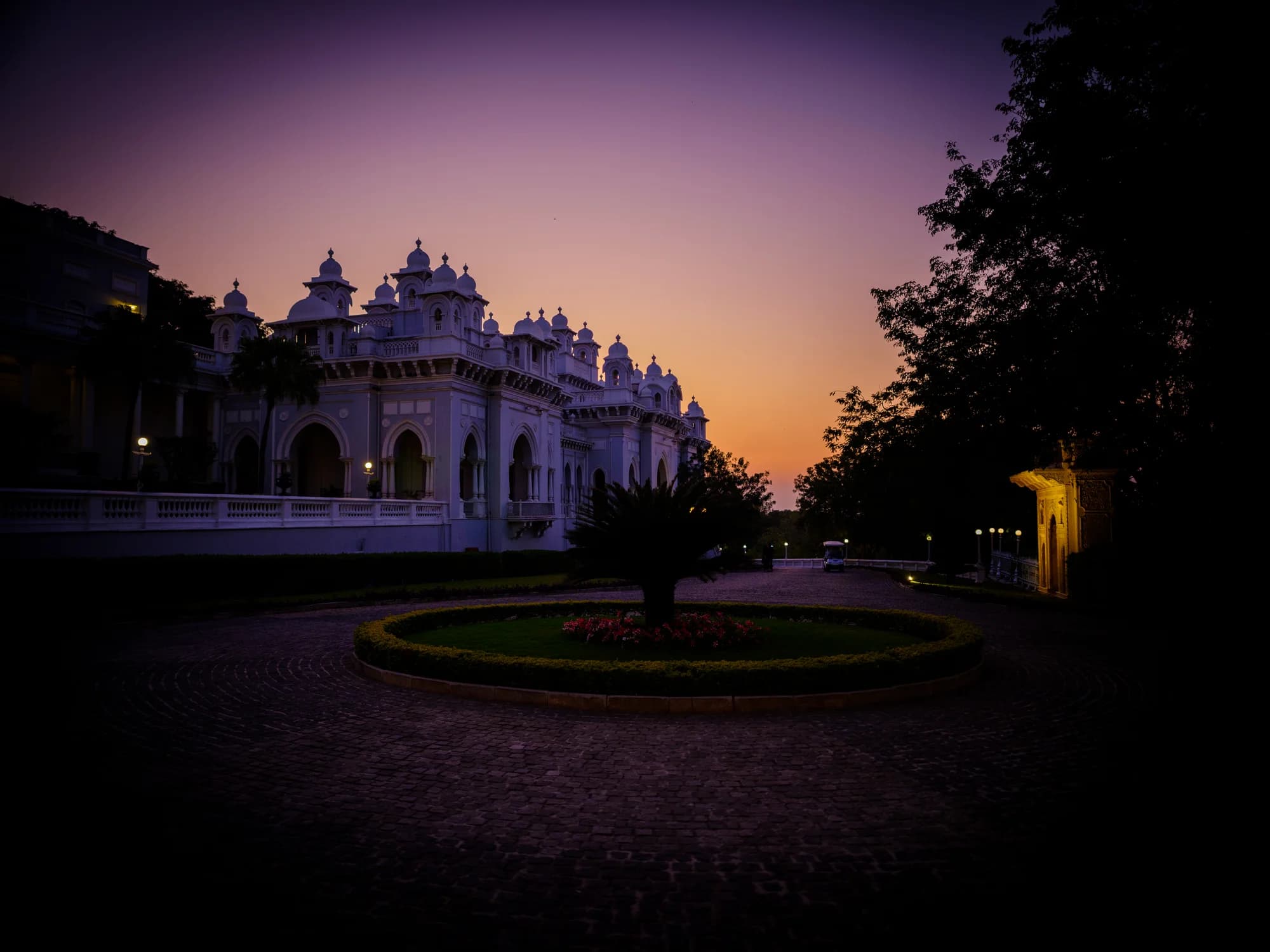
Falaknuma Palace at blue hour — the white marble facade illuminated from within, the crescent wings embracing the formal gardens, Hyderabad's city lights glittering two thousand feet below, the dome catching the last amber light of the Deccan sunset
At blue hour, the palace achieves its full architectural meaning — not merely a building but a vision, a mirror of the sky that reflects the ambition of a dynasty that ruled the Deccan for two centuries and counted its wealth not in rupees but in the dreams made manifest in stone
Photo: Sanshiro KUBOTA, CC BY 2.0