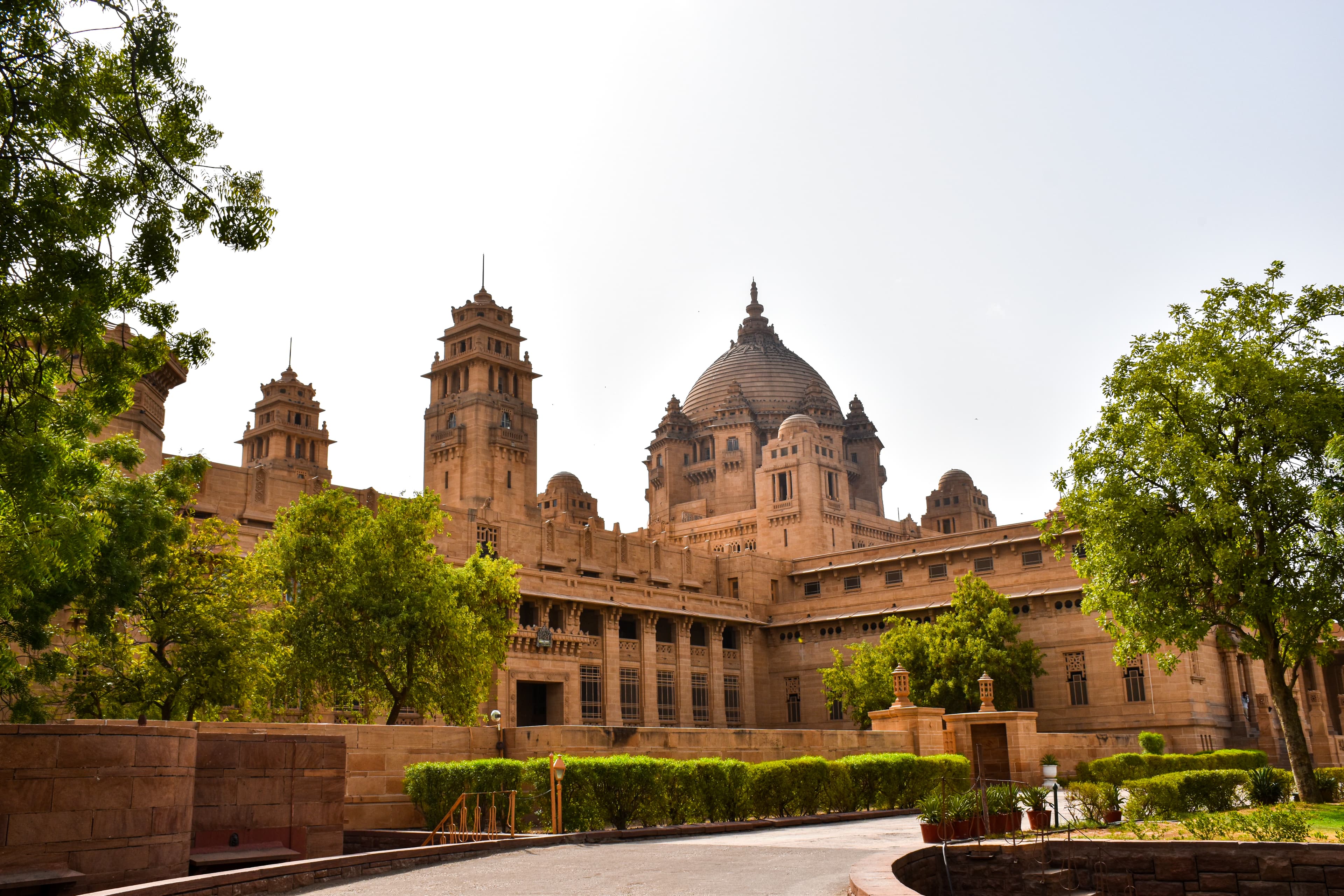
The year is 1924. The Kingdom of Marwar, once among the most powerful princely states of Rajputana, faces a humanitarian crisis. Three consecutive years of devastating drought and famine have swept across the Thar Desert. The peasants, the backbone of Marwar's agrarian economy, are dying. The coffers are emptying. The British Raj offers little relief. The Maharaja of Jodhpur, Umaid Singh, surveys the suffering from the ramparts of Mehrangarh Fort and makes a decision that would define his reign — and produce one of the most extraordinary architectural achievements of the twentieth century.
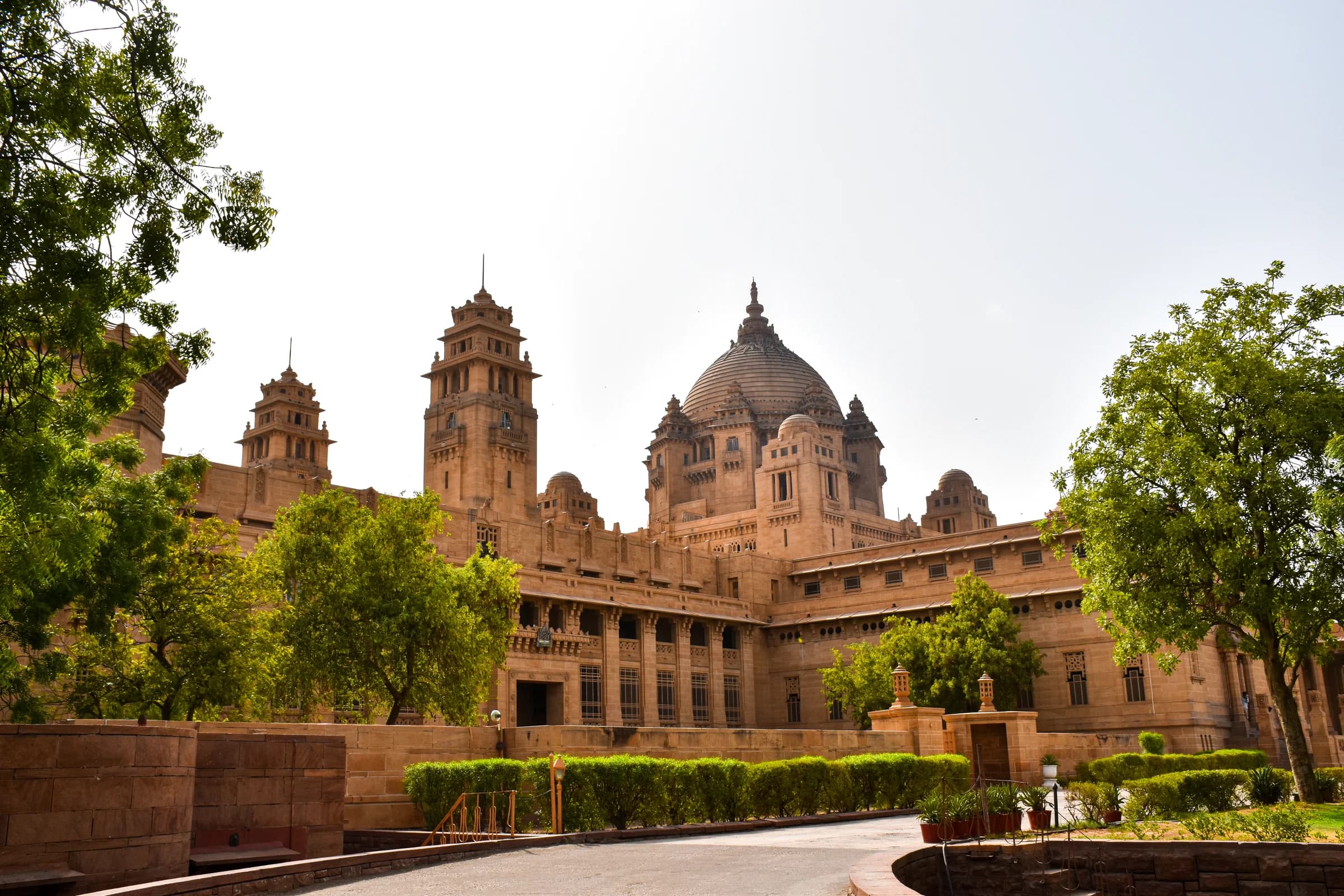
Umaid Bhawan Palace viewed from the eastern approach road — the golden Chittar sandstone dome and cupola rise above the blue city of Jodhpur, framed against the stark beauty of the Thar Desert
The palace's golden sandstone, quarried from local Chittar stone, was transported by camel cart across sixteen years of construction, each block shaped by hand by a workforce of nearly three thousand craftsmen
Photo: Atman06, CC BY-SA 4.0
He would build a palace. Not an act of royal vanity, but an audacious public works project — employing thousands of starving subjects at a time when there was no other work to be had. For sixteen years, from 1928 to 1943, an army of nearly three thousand labourers, stone carvers, masons, and artisans shaped the golden Chittar sandstone into what remains, to this day, one of the largest private residences on earth.
The Hunger Palace
The locals call it the "Hunger Palace" — not as criticism, but as remembrance. The Chittar Palace, as it was originally known, was conceived as famine relief. Maharaja Umaid Singh, a man of considerable foresight who had studied the modernising reforms of other princely states, recognised that direct charity would merely postpone disaster. What the people needed was employment — sustained, dignified work that would put food on their tables through the worst years and leave behind something permanent.
“My grandfather did not build this palace for himself. He built it so his people would not starve.”
The budget sanctioned was ₹9.4 million — a staggering sum in 1928, equivalent to approximately ₹300 crore ($37 million) today. But this was never about the cost. It was about survival. At the height of construction, the palace employed 3,000 workers directly and sustained perhaps 10,000 more indirectly — the stone quarriers, the camel-cart drivers hauling sandstone blocks, the families who cooked meals for the labourers, the merchants who supplied tools and materials.
Henry Lanchester's Desert Masterpiece
The Maharaja commissioned Henry Vaughan Lanchester, a British architect of considerable reputation who had served as president of the Royal Institute of British Architects. Lanchester's brief was extraordinarily ambitious: create a palace that would honour Rajput architectural tradition while embracing the modernity of the twentieth century. The result is a building that defies easy categorisation.
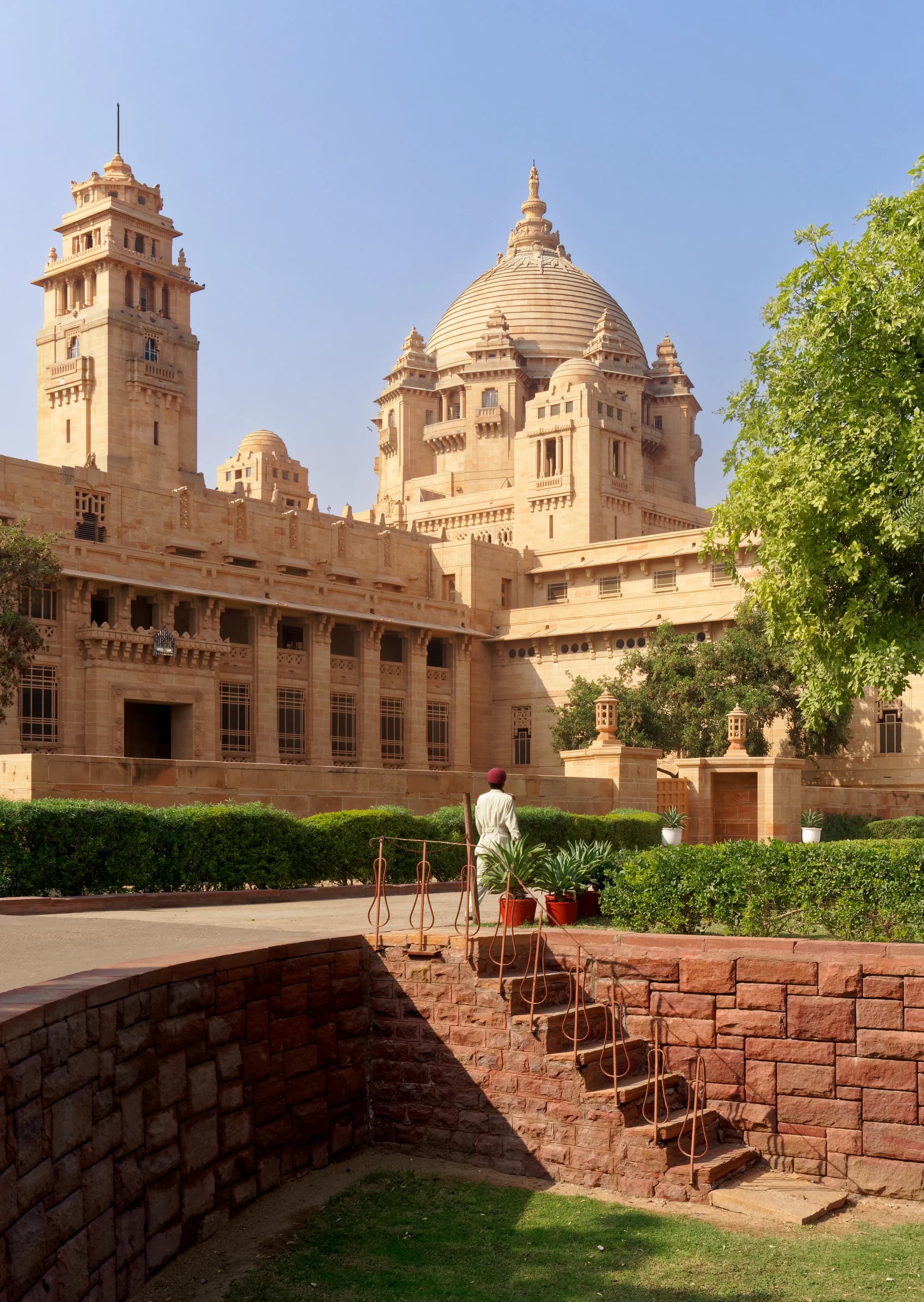
The central dome and cupola of Umaid Bhawan Palace — a 105-foot-high fusion inspired by the Buddhist stupa at Sanchi and the Taj Mahal, rendered in the streamlined geometry of Art Deco
Henry Lanchester's design synthesises the Sanchi stupa's hemispherical dome, the Taj Mahal's proportions, and the emerging Art Deco movement's linear sensibility into a unified architectural language that belongs entirely to itself
Photo: Jakub Hałun, CC BY-SA 4.0
Lanchester took the Buddhist stupa at Sanchi as his inspiration for the dome, the Taj Mahal for its proportions, and the emerging Art Deco movement for its sensibility. But he did something more radical: he wove indigenous Rajasthani elements throughout — the carved jali screens that filter desert light into geometric patterns, the jharokha balconies that recall Rajput fort architecture, the interior courtyards inspired by traditional haveli design.
The floor plan is an exercise in symmetry. Two parallel wings sweep outward from the central dome in a crescent formation — the Zenana (women's quarters) on one side, the Mardana (men's quarters) on the other, a traditional separation rendered in thoroughly modern architectural language. The entire structure, 347 rooms across 26 acres, sits atop Chittar Hill, the highest point in Jodhpur, its golden silhouette visible from every corner of the city below.
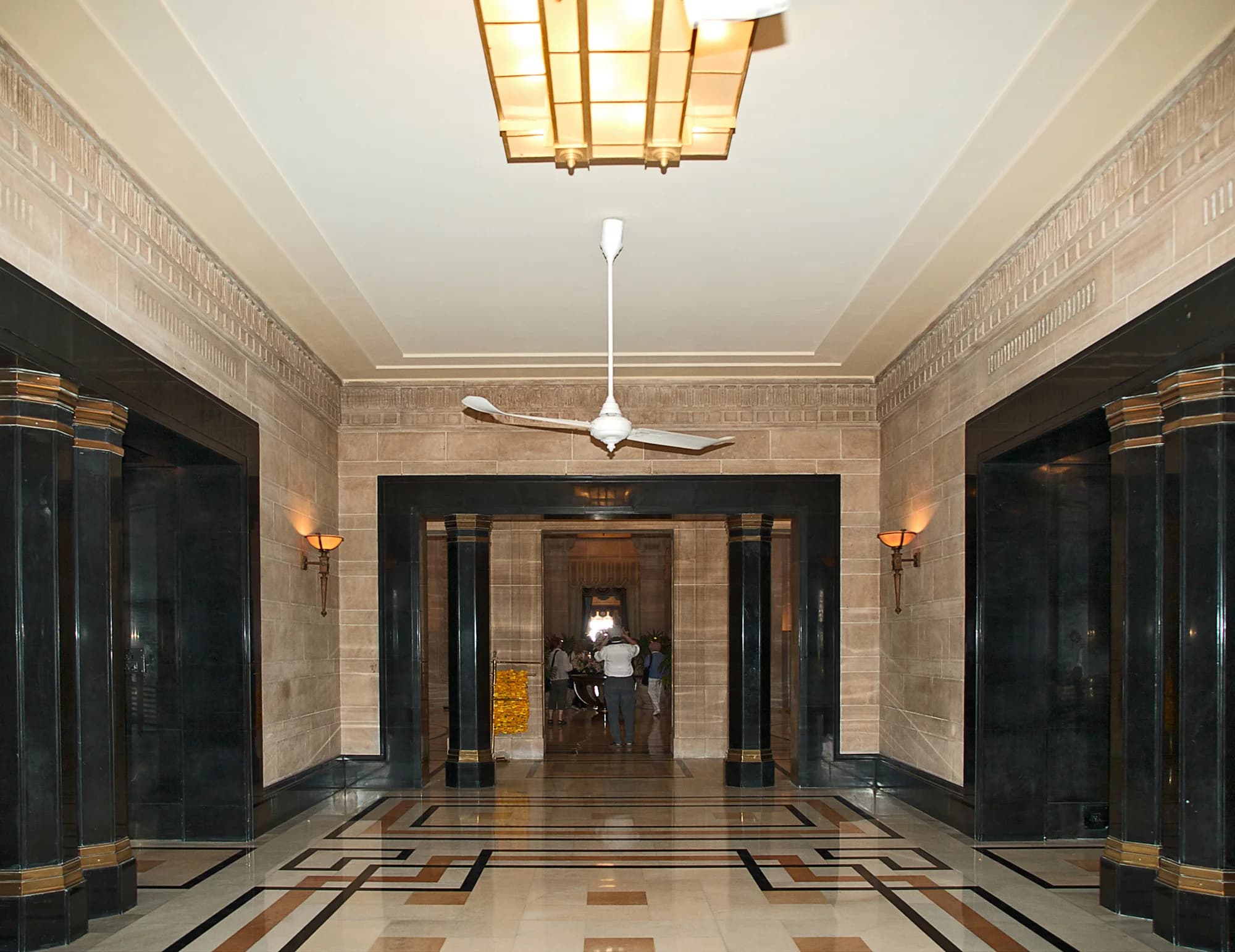
The Durbar Hall — a 150-foot-long ceremonial chamber with a gilded ceiling, Czechoslovakian crystal chandeliers, and murals depicting scenes from the Ramayana by Polish artist Stefan Norblin
Norblin, who fled wartime Europe and found refuge in this unlikely corner of Rajasthan, executed what many consider his greatest body of work across the palace's ceremonial rooms — a fusion of European Art Deco illustration and classical Indian miniature painting that exists nowhere else in the world
An Interior That Rivals the Exterior
Step inside and the palace reveals its most surprising secret: this is not merely a Rajput palace dressed in Art Deco clothing. It is a complete, uncompromised Art Deco interior — one of the finest and largest anywhere in the world.
The furniture was designed by Maples of London, the same firm that furnished the Titanic. The lifts were supplied by Otis. The air-conditioning system, astonishing for a palace built in the 1930s in the Indian desert, was among the first ever installed in a private residence anywhere in Asia. The bathrooms feature pink and green marble, the corridors are lined with Burmese teak, and the public rooms are decorated with murals by Polish artist Stefan Norblin, who fled wartime Europe and found, in this unlikely corner of Rajasthan, a canvas worthy of his ambitions.
Norblin's murals deserve special mention. Across the walls and ceilings of the palace's ceremonial rooms, he painted scenes from Hindu mythology in a style that fuses European Art Deco illustration with classical Indian miniature painting. In the Durbar Hall, the Ramayana unfolds across 150 feet of wall space. In one throne room, Krishna dances with Radha in a jungle of leopards and peacocks rendered in gold leaf. Norblin, who would later return to Poland, left behind what many consider his greatest body of work — and almost no one outside Rajasthan knows it exists.
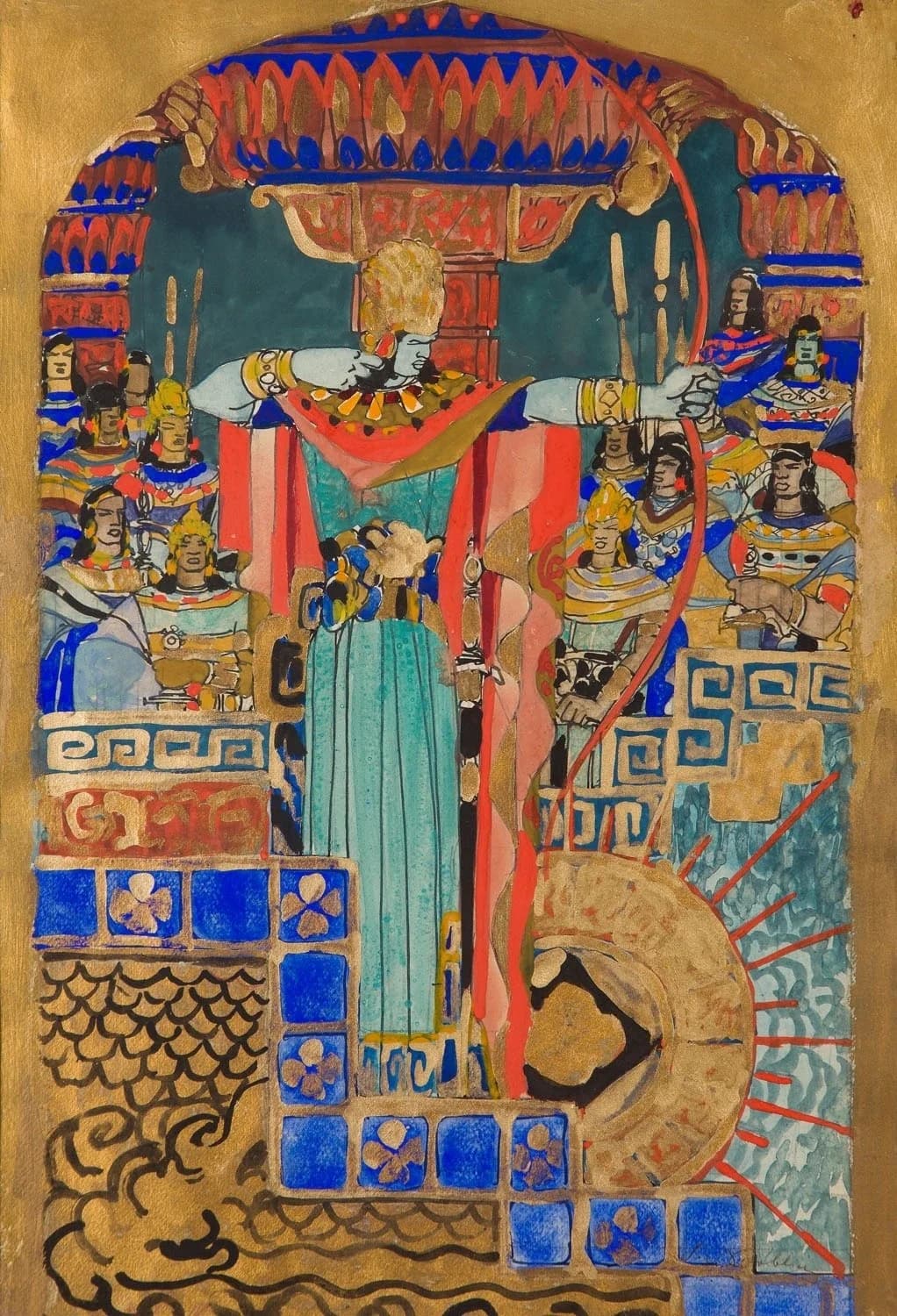
Stefan Norblin's murals in the throne room — gold-leaf deities, emerald jungles, and Art Deco geometry rendered across thirty-foot walls, restored by Polish and Indian conservators between 2006 and 2011
The conservation project, coordinated by Poland's Ministry of Culture and led by Józef Steciński, required five years to stabilise paintings that had suffered from decades of climatic exposure in the desert palace
The Arrival Experience
The driveway to Umaid Bhawan is an essay in anticipation. You pass through wrought-iron gates, past immaculate lawns where peacocks strut with the casual ownership of creatures who have never been told they do not own the place, and then the palace reveals itself gradually — first the dome, then the wings, then the full 347-room edifice rising from the hilltop, turning from honey-gold to burnt amber as the desert sun makes its daily passage overhead.
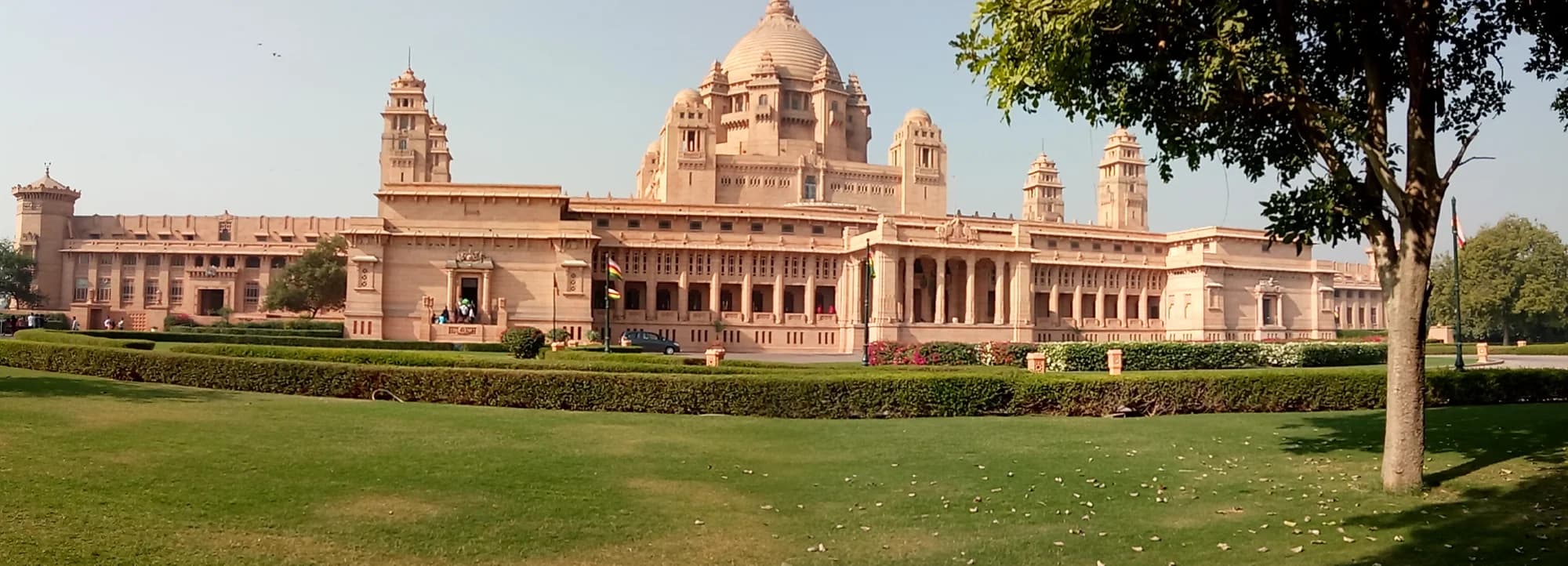
The grand entrance portico at Umaid Bhawan Palace — liveried staff in traditional Jodhpuri attire await guests at the porte-cochère, where the Maharaja's vintage Rolls-Royce and Bentley motorcars are permanently stationed as a tribute to the family's automotive passion
The palace maintains a fleet of twenty-two perfectly preserved vintage motorcars, including a 1937 Rolls-Royce Phantom III, housed in a dedicated museum wing on the palace grounds
A liveried doorman in a saffron turban and crisp white kurta approaches as your car pulls to a stop. Your bags disappear — you will not see them again until they materialise, as if by sorcery, in your suite. A garland of marigolds is placed around your neck. A tikka of vermillion and sandalwood paste is applied to your forehead. A silver tray materialises bearing chilled glasses of champagne and freshly pressed pomegranate juice. You have not yet entered the building, and already the palace has begun its work of seduction.
This is the thing about Umaid Bhawan that no photograph quite captures: the palace is not merely a hotel. It is the actual, functioning residence of the Maharaja of Jodhpur. His Highness Gaj Singh II and his family live in one wing of the palace. When you stay here, you are, in a very real sense, a guest of the royal family. The photographs in the corridors are not reproductions — they are the family album. The polo trophies in the display cases were won by the Maharaja himself, an accomplished player who captained the Indian national team to victory in the 1960s. The history here is not curated. It is lived.
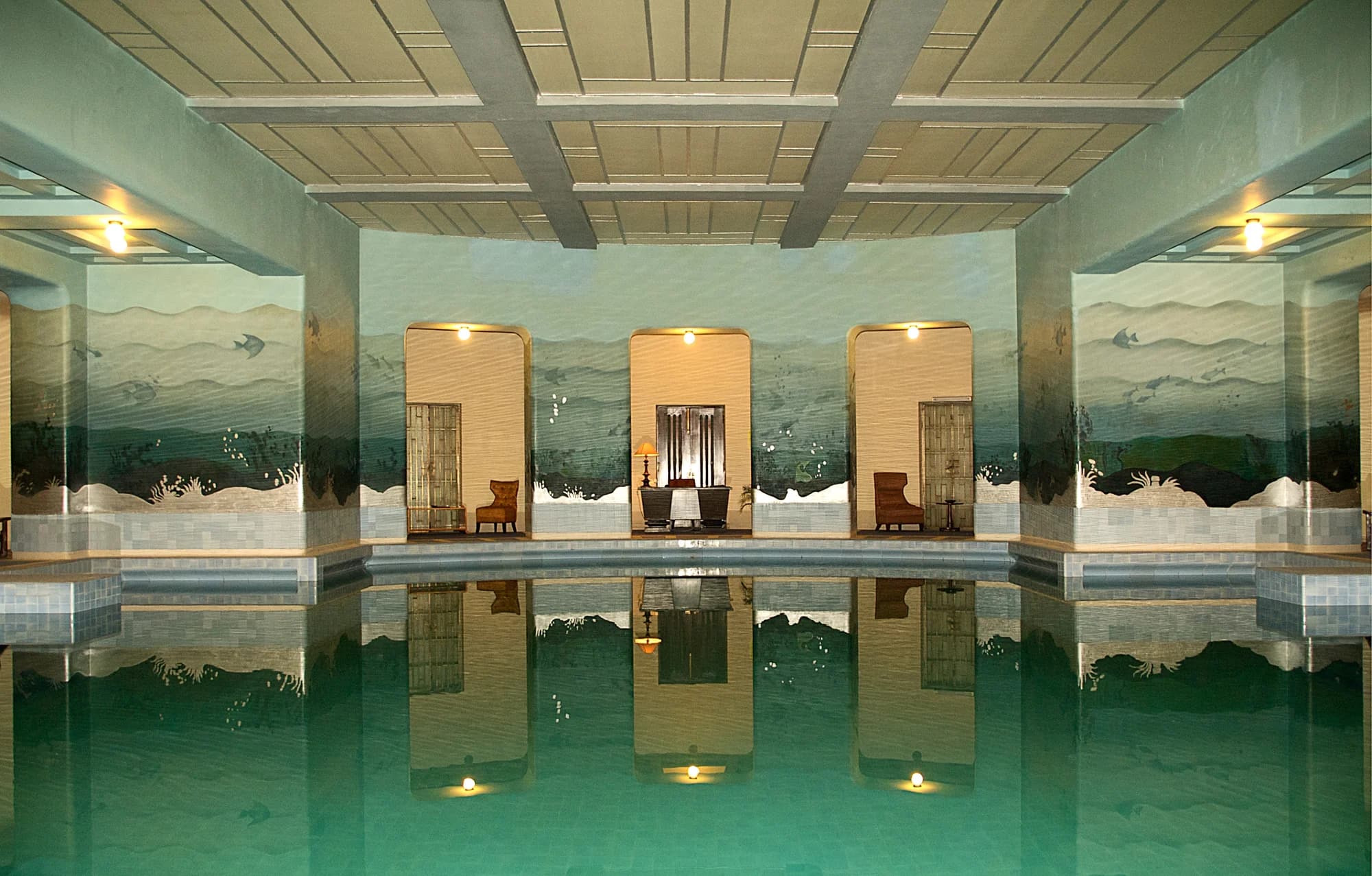
The swimming pool at Umaid Bhawan — an azure rectangle set into emerald lawns, flanked by classical stone pavilions, the palace dome rising majestically beyond
The underground pool, designed by Lanchester and built using the same Chittar sandstone as the palace, features a distinctive Art Deco geometry — an unexpected flourish in a desert palace where every drop of water was once carried by hand
The Suites: Where You Will Sleep
The palace offers seventy rooms and suites, each distinct, spread across the zenana wing. They range from the entry-level Palace Rooms — a misnomer if ever there was one, since even the most modest accommodation here features twelve-foot ceilings, Art Deco furniture, and bathrooms of pink Italian marble — to the Maharaja Suite and Maharani Suite, which occupy the palace's most privileged positions beneath the central dome.
The Maharaja Suite is a fever dream of luxury. Six hundred square metres of space. A private terrace overlooking the Mehrangarh Fort in the distance. A drawing room panelled in Burma teak, furnished with original Art Deco pieces commissioned from Maples of London. A dining room seating twelve. A study with a fireplace and a personal bar. The bedroom is dominated by a custom-made bed crowned with the Jodhpur royal crest, hand-carved in teak and gilt. The bathroom, clad floor-to-ceiling in rose-veined Italian marble, features a bathtub carved from a single block of the same stone — a tub so large, so deep, so determinedly sybaritic that it has earned its own mention in architectural histories of the subcontinent.
The Maharani Suite, slightly smaller at 450 square metres, is no less magnificent but conceived with a different sensibility — more intimate, more feminine, decorated in shades of blush, champagne, and dove grey. The dressing room alone is larger than most hotel suites in Paris. Both suites command rates starting from ₹6,00,000 ($7,200) per night in peak season, and both are frequently booked months in advance by the sort of traveller for whom a mere five-star hotel is insufficient.
For the merely wealthy rather than the stratospherically rich, the Royal Suites offer a more accessible taste of palatial living — still enormous at 200 square metres, still decorated with original Art Deco furniture, still staffed by a dedicated butler who will unpack your luggage, press your linen, and draw your bath with rose petals at precisely the temperature you prefer. The Historical Suites, decorated with photographs from the palace archives, tell the story of the Jodhpur royal family through carefully curated visual narratives.
Dining at the Palace
Risala, the palace's signature restaurant, occupies the former state dining room. The space alone merits a visit: vaulted ceilings soar thirty feet overhead, walls are decorated with Norblin's mythological murals, and chandeliers of Bohemian crystal cast a warm amber glow across tables set with royal crested silverware and Baccarat crystal.
The kitchen is helmed by chefs trained in the royal kitchens of Rajasthan, and the menu is a deliberate celebration of Marwari cuisine — the cooking of the Marwar region that has, for centuries, been the private culinary inheritance of Jodhpur's royal households. Laal Maas, the fiery mutton curry that is Rajasthan's signature dish, is prepared here according to a recipe that the royal family has guarded for generations. The mutton, sourced from the palace's own farms, is cooked slowly with Mathania red chillies — a variety grown only in a single village near Jodhpur, prized for their deep crimson colour and complex, smoky heat. The result is a dish that bears approximately as much resemblance to restaurant Laal Maas as a Rolls-Royce bears to a hatchback.
The thali experience — a selection of twelve dishes served on a silver platter — is the restaurant's most comprehensive introduction to Marwari cuisine. It includes Ker Sangri (dried desert beans and berries, a dish born of scarcity that has become a delicacy), Gatte ki Sabzi (gram flour dumplings in yoghurt gravy), Dal Baati Churma (the quintessential Rajasthani comfort food), and, in winter, Saag — a slow-cooked preparation of mustard greens and spinach enriched with white butter. Desserts include Malai Ghewar, a disc of deep-fried batter soaked in saffron syrup and topped with thickened milk, silver leaf, and slivered almonds.
For those who prefer their luxury with a side of international cuisine, Pillars — the palace's colonnaded verandah restaurant — serves Continental and pan-Asian dishes throughout the day, with the pool and gardens providing a backdrop that no interior designer could improve upon. Afternoon tea on the lawn, with the palace dome catching the golden light of late afternoon, is a ritual that should not be missed.
Experiences Worth the Journey
The palace offers a concierge service that operates at a level most hotels do not know exists. They will arrange a private visit to the royal family's vintage car collection — twenty-two perfectly maintained motorcars including a 1937 Rolls-Royce Phantom III, a 1927 Rolls-Royce Twenty, and several Bentleys that belonged to the Maharaja's father. They will organise a tour of the family armoury, a collection of Mughal and Rajput weaponry that rivals any museum collection in India. They can arrange a private dinner in the Mehrangarh Fort, the fifteenth-century citadel that towers over Jodhpur, with the entire fort — usually crowded with tourists — closed to all but your party.
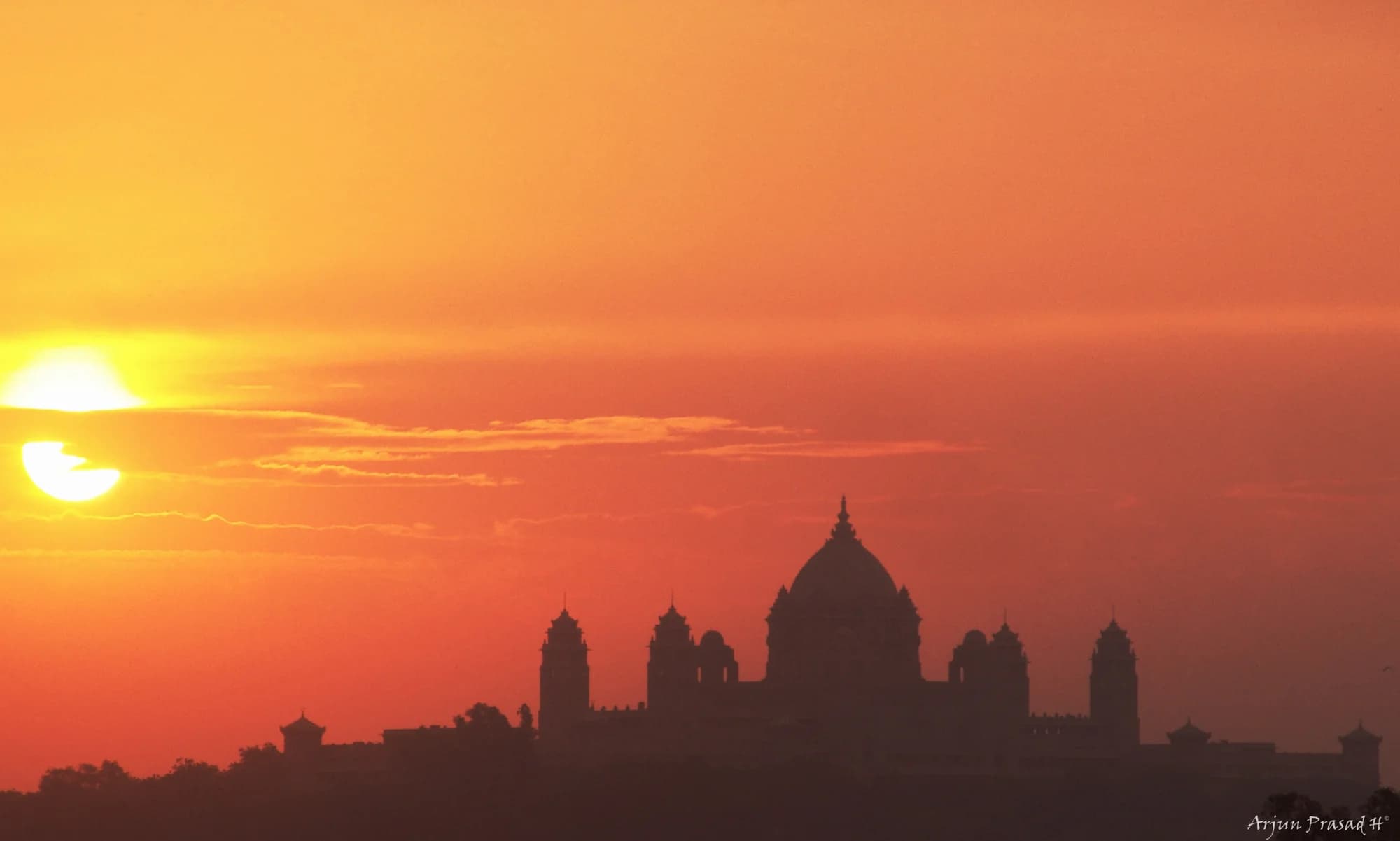
Sunset aperitifs on the palace terrace — a dedicated butler arranges champagne and canapés as the sun descends behind Mehrangarh Fort, turning the desert sky through every shade of orange, rose, and violet
The terrace, positioned on the western wing, was deliberately oriented to capture the sunset over the Thar Desert — Lanchester considered the play of natural light an essential architectural element
The palace's equestrian program deserves particular attention. Jodhpur is the birthplace of the breeches that bear its name, and the royal family's connection to polo is so deep that the city's polo ground is named after the late Maharaja Hanwant Singh. Guests can ride the palace's Marwari horses — a breed distinguished by their inward-curving ears and legendary endurance — across the palace grounds at dawn, accompanied by a member of the royal stables. The stables themselves, housed in a wing of the palace, are immaculate Art Deco structures where each horse's name is engraved on a brass plaque above its stall.
The Mehrangarh Connection
No stay at Umaid Bhawan is complete without understanding its relationship to Mehrangarh Fort — the 560-year-old citadel that looms over Jodhpur from a 400-foot basalt cliff four kilometres from the palace. The old fort and the new palace are two chapters of the same story: one built for defence, the other for diplomacy; one a fortress against invaders, the other a statement of princely modernity. The palace concierge can arrange an after-hours tour of Mehrangarh that avoids the crowds entirely — you walk through halls of mirrored glass and gilded ceilings with only a historian from the Mehrangarh Museum Trust as your guide, and the experience is, without exaggeration, one of the most profound cultural encounters India has to offer.
Final Word
Umaid Bhawan Palace is not the most expensive hotel in India. It is not the most modern. It is not the most convenient, if your definition of convenience involves being near a metropolitan airport or a beach club. But it is, without serious competition, the most complete expression of royal Indian hospitality that exists in the world today.
“There are great hotels. There are palaces. And then there is Umaid Bhawan — a category of one.”
You come here not for a hotel stay but for an immersion in a way of life that no amount of money can recreate elsewhere. You come here because you understand that heritage is not something you visit — it is something you inhabit, if only for a few nights. You leave understanding why those three thousand starving farmers and their families, ninety years ago, took rough Chittar sandstone and their bare hands and built something that would outlast their suffering by centuries.
Insider Tips
Booking Strategy
Book at least four months in advance for the Maharaja and Maharani Suites — they are often reserved by returning guests and royal family acquaintances. The best value period is May to September, when Jodhpur's fierce summer heat drives rates down by as much as forty percent; the palace is fully air-conditioned and you will have the property nearly to yourself.
Polo Season
If your dates are flexible, plan around the Jodhpur polo season (December to February). The Maharaja frequently hosts matches, and palace guests receive privileged access to the royal enclosure. The atmosphere — champagne on the lawns, thoroughbreds thundering past, the palace dome in the background — is something no luxury travel experience quite matches.
Suite Selection
Request a room in the east wing for sunrise views of Mehrangarh Fort. The west wing faces the pool and gardens — more private but without the fort's dramatic silhouette. For honeymooners, the Historical Suites in the zenana wing offer the most romantic proportions and the quietest location. Avoid ground-floor rooms near the lobby, where foot traffic from day visitors can be audible.
Frequently Asked Questions
Is Umaid Bhawan Palace worth the price? Yes — for the right traveller. If you value historical authenticity, architectural significance, and the intangible quality of inhabiting a genuine royal residence, nowhere in India compares. If you are simply looking for a luxury hotel with modern amenities, there are excellent alternatives in Jodhpur at lower prices. The palace is a heritage experience first and a hotel second. Understand this distinction, and you will understand its value.
Can non-guests visit the palace? The palace museum and a portion of the grounds are open to visitors during daytime hours (₹200 for Indian nationals, ₹1,500 for foreign visitors). However, the hotel wing, restaurants, and pool area are reserved exclusively for registered guests. This separation is carefully maintained — hotel guests never feel that their palace is being overrun by tourists.
How many nights should I stay? Minimum three nights. Four to five is ideal. Anything less than three and you will feel rushed; the palace and its experiences are designed for leisurely inhabitation, not efficiency. Budget permitting, seven nights allows for genuine immersion — morning rides, afternoon museum visits, evening polo matches, and days of simply reading in the loggia with nothing but the desert breeze and the occasional peacock for company.
What is the dress code? During the day, resort casual is acceptable throughout the property. For dinner at Risala, gentlemen are expected to wear closed shoes and a collared shirt; jackets are appreciated but not required outside the winter months. For afternoon tea, smart casual. For the Maharaja's polo matches, the invitation will specify the dress code — typically blazers for gentlemen and day dresses or Indian formal wear for ladies.
Is the palace suitable for children? Yes, surprisingly. The palace staff are exceptionally warm toward young guests and will arrange child-friendly meals, treasure hunts in the gardens, and pony rides at the stables. The pool area is family-friendly during daytime hours. However, the palace's atmosphere is fundamentally serene — children who require active, high-energy entertainment may be happier at a resort with dedicated kids' programming.
What is the best time of year to visit? October through March offers the most comfortable climate, with daytime temperatures of 20-30°C and cool, pleasant evenings. This is also peak season, and the palace is at its most vibrant — polo matches, festive dinners, and a full house of interesting guests. December and January are the busiest months; book well ahead. July to September brings the monsoon, which in Rajasthan is brief and romantic — dramatic skies, cooling rains, and significantly lower rates. May and June are fiercely hot (40°C+), but the palace's thick stone walls and modern air-conditioning make it perfectly comfortable indoors, and the value proposition is exceptional.
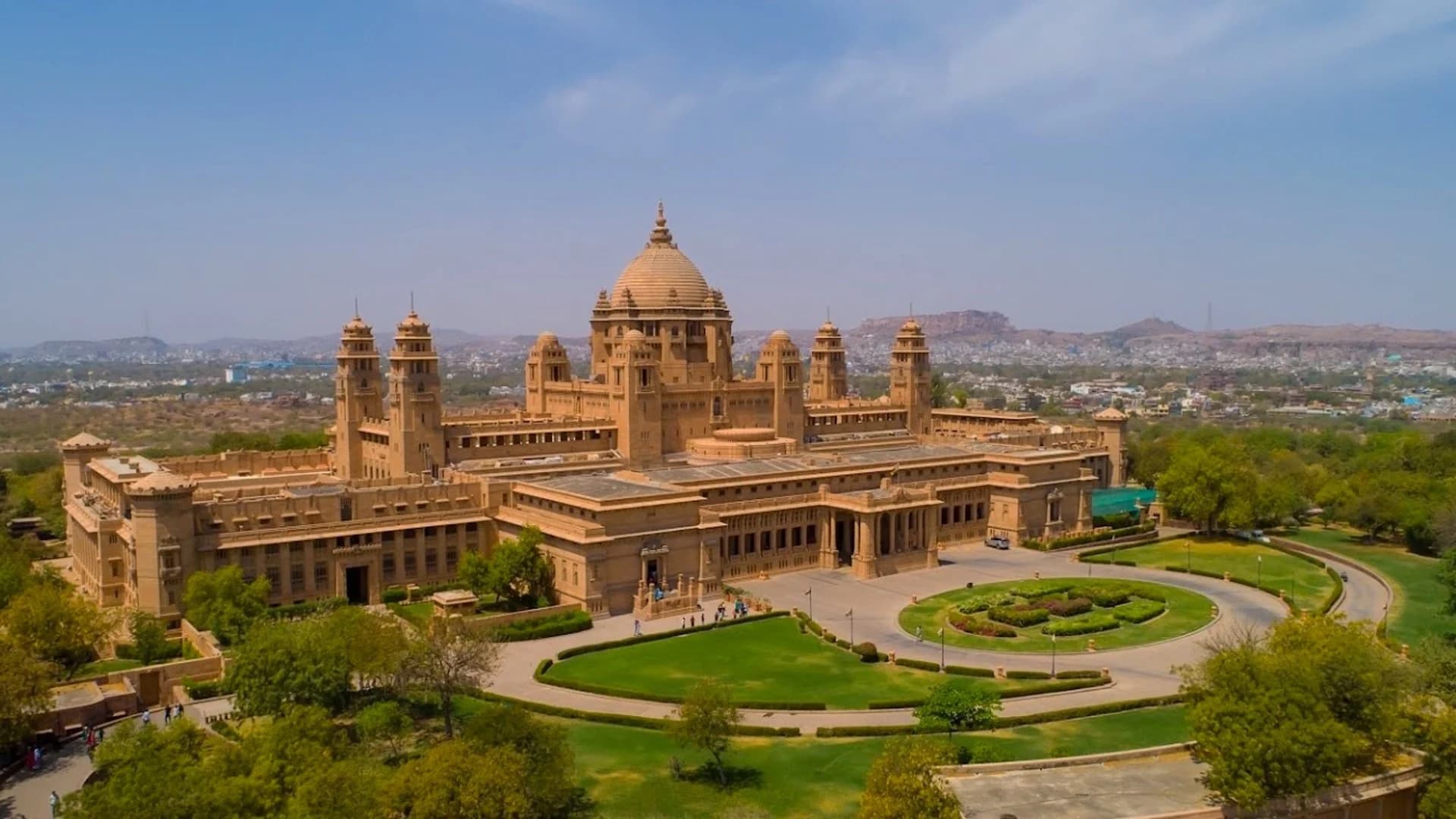
Aerial view of Umaid Bhawan Palace at sunset — 26 acres of manicured grounds spread across Chittar Hill, the crescent wings embracing formal gardens, Chittar sandstone glowing gold against the deepening desert sky
The palace's 347 rooms occupy only a portion of the 26-acre estate; the remainder comprises gardens, a polo ground, stables, and the private residence of the Jodhpur royal family