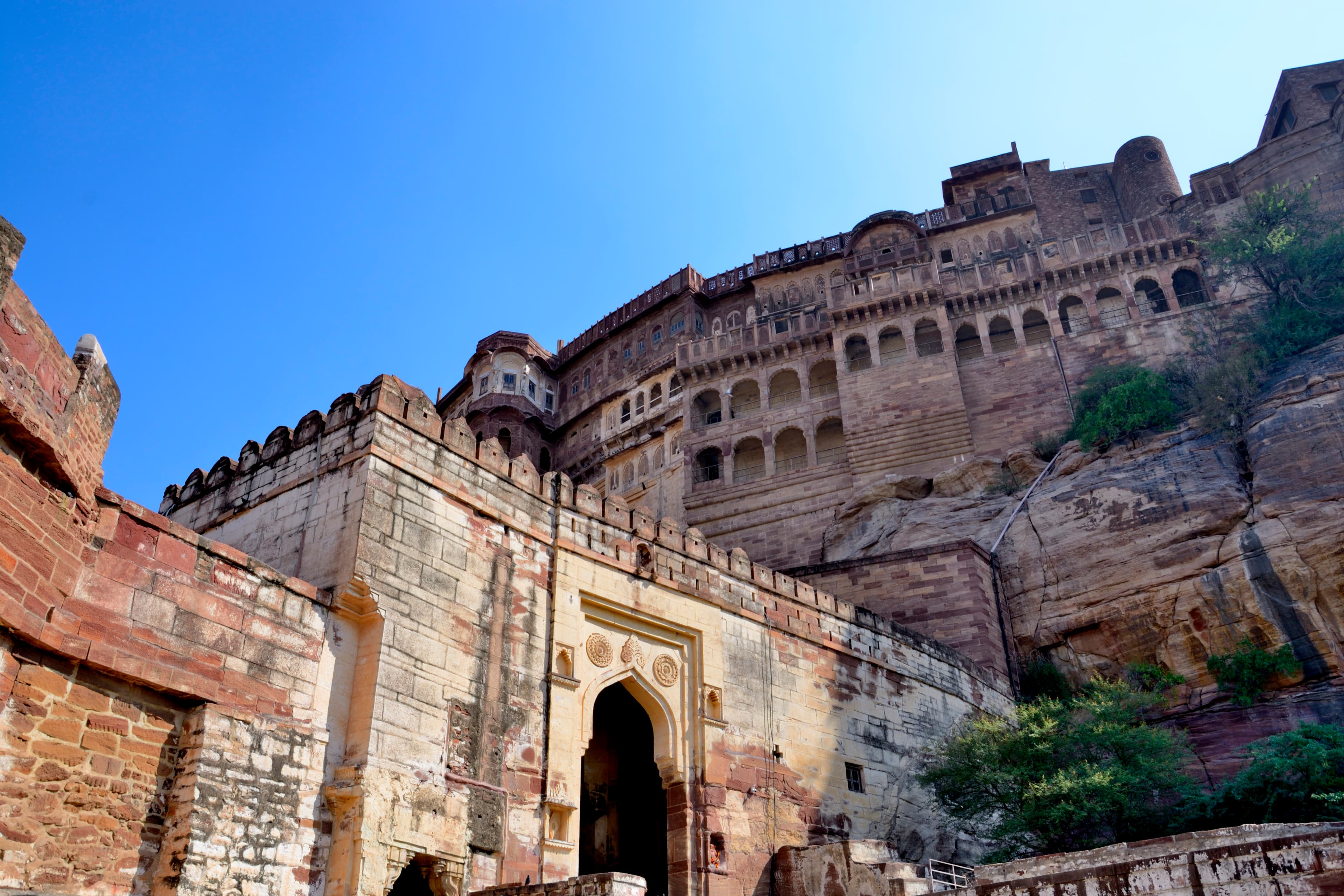
There is a moment, at RAAS Jodhpur, when the light shifts and the ancient walls of Mehrangarh Fort turn from sandstone-grey to molten gold, and every guest on the terrace simultaneously reaches for their camera. Then, almost as one, they put it down. Some spectacles resist capture. The fort, rising from a 400-foot basalt cliff directly above the hotel, is not merely a view — it is a presence, a gravitational force that shapes every experience at what is arguably India's most dramatically situated boutique heritage hotel.
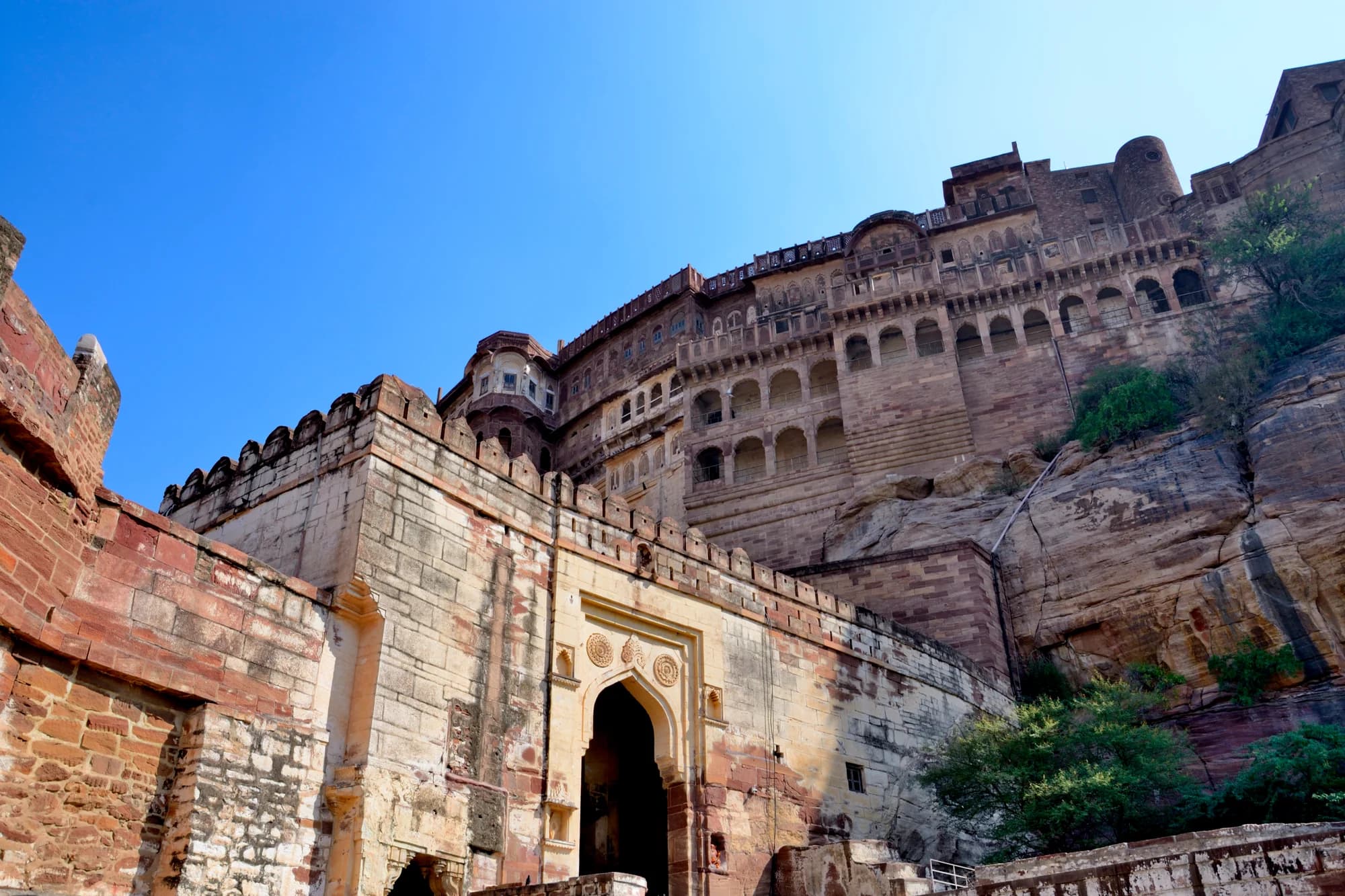
Mehrangarh Fort, Jodhpur — the 560-year-old citadel rising from a 400-foot basalt cliff above RAAS Jodhpur, its golden sandstone ramparts floodlit at dusk against a violet desert sky
Built by Rao Jodha in 1459, Mehrangarh is one of the largest forts in India — its walls are 118 feet high in places and 69 feet thick, an engineering achievement that has never been breached in battle, and the defining presence at every moment of a stay at RAAS
Photo: Sharvarism, CC BY-SA 4.0
RAAS occupies a cluster of 18th-century havelis — the traditional courtyard mansions of Rajasthan's merchant class — in the Walled City of Jodhpur, at the very foot of the fort. The name is an acronym: Rajasthan Art, Architecture, and Soul. It is an ambitious claim, and one that the property delivers on with a conviction that has, since its opening, redefined what a heritage hotel in India can be. This is not a palace conversion, not a royal residence repurposed for paying guests. It is something rarer: a meticulous restoration of vernacular architecture infused with a contemporary design sensibility so confident, so restrained, so utterly at ease with itself that you forget, within minutes of arriving, that you are in a hotel at all.
The Restoration
The project began with a ruin. Three connected havelis, dating from the late 1700s, had been abandoned for decades. Their jharokha balconies had crumbled. Their courtyards were choked with debris. Their carved sandstone facades were blackened by centuries of desert wind and monsoon rain. A conventional developer would have demolished and rebuilt. The brothers who founded RAAS — Nikhilendra and Dhananajaya Singh, descendants of the Rathore clan that once ruled Jodhpur — chose the harder path.
A restored jharokha balcony in the heritage wing — intricate sandstone latticework filters the fierce desert sun into geometric patterns across hand-stitched cotton bedding and polished concrete floors
Local masons whose grandfathers had worked on the original havelis were brought back to teach a new generation the techniques of traditional Jodhpuri stonework — each carved panel was catalogued, assessed, and either restored in situ or replicated using Chittar sandstone from the same quarries that supplied the builders of Mehrangarh
The restoration took four years. Local masons, many of whose grandfathers had worked on the original havelis, were brought back to teach a new generation the techniques of traditional Jodhpuri stonework. Each carved panel was catalogued, assessed, and either restored in situ or carefully replicated using Chittar sandstone from the same quarries that supplied the builders of Mehrangarh five centuries earlier. The havelis' original internal courtyards — the heart of traditional Rajasthani domestic architecture — were preserved not as museum pieces but as functioning communal spaces around which the hotel's life now revolves.
What makes RAAS extraordinary is the juxtaposition. The three heritage havelis form the hotel's historical core, their rooms featuring original fresco fragments, deep-set windows designed to exclude the desert heat, and the unmistakable patina of buildings that have witnessed two centuries of Jodhpuri life. But connected to them, through a sequence of courtyards and water channels, is a contemporary wing — a structure of glass, steel, and polished local stone that makes no attempt to mimic the havelis' architectural language. The effect, which should be jarring, is instead thrilling: old and new in confident dialogue, neither diminishing the other.
The Architecture of Light
The contemporary wing was designed by the Delhi-based architectural firm Studio Lotus, and it is a masterclass in contextual modernism. The building employs the same local sandstone as the heritage havelis, but in clean, unadorned planes. Glass walls face inward toward the courtyards, blurring the distinction between interior and exterior. Water channels — a nod to the stepwells and baolis of traditional Rajasthani architecture — run through the public spaces, cooling the air and providing a gentle soundtrack of running water that follows you from the lobby to the pool.
The contemporary wing by Studio Lotus — planes of local sandstone and glass framing a water channel inspired by Rajasthani stepwells, the Blue City's rooftops visible beyond, Mehrangarh looming overhead
The Delhi-based firm Studio Lotus designed the contemporary wing as a masterclass in contextual modernism — employing the same local sandstone as the heritage havelis but in clean, unadorned planes, blurring the distinction between interior and exterior through glass walls facing inward toward the courtyards
The lighting design deserves special mention. At night, the entire property is illuminated not by floodlights but by hundreds of concealed LED fixtures that trace the architectural lines of the buildings and wash the stone walls in a warm amber glow. The fort above is lit by the Archaeological Survey of India's floodlights, and the visual conversation between the two — the ancient citadel blazing white-gold, the hotel glowing amber at its feet — is one of the most beautiful nighttime spectacles in Rajasthan.
The Rooms
RAAS offers 39 rooms across the heritage and contemporary wings, and the choice between them is genuinely meaningful — not merely a matter of budget but of sensibility.
The Heritage Rooms occupy the restored havelis and are exercises in atmospheric restraint. Walls are whitewashed lime plaster, revealing the texture of the original stone beneath. Floors are polished concrete or reclaimed teak. Furniture is custom-designed in a contemporary Rajasthani idiom: low daybeds in hand-blocked cotton, side tables of reclaimed railway sleepers, lamps of beaten brass. Bathrooms are open to private internal courtyards, with rain showers that mimic the monsoon. The windows are small, deeply recessed, and shuttered — as they were designed to be in the 18th century — creating interiors of cave-like coolness even when the Jodhpuri sun is at its fiercest.
A Heritage Room at dusk — lime-plastered walls glowing in lamplight, a low daybed in hand-blocked cotton, the original stone arch of the haveli framing a private courtyard bathroom
The Heritage Rooms occupy the restored havelis — walls are whitewashed lime plaster revealing the texture of original stone beneath, floors are polished concrete or reclaimed teak, and the small, deeply recessed windows create interiors of cave-like coolness even when the Jodhpuri sun is at its fiercest
The Contemporary Rooms, in the new wing, are larger and lighter. Floor-to-ceiling glass doors open onto private terraces with views either of the fort or of the internal courtyards. The palette is monochrome — white walls, grey stone, black steel — with accents of Rajasthani colour provided by hand-embroidered throws, block-printed cushions, and the ever-present blue of Jodhpur's sky. Bathrooms feature freestanding stone tubs positioned beside windows that frame the fort. The best rooms in this wing are the RAAS Suites, which occupy corner positions with views in two directions and terraces large enough for private dinners.
The Pool: Rajasthan's Most Photographed
The infinity pool at RAAS has achieved a level of Instagram fame that threatens to overshadow the hotel itself. It deserves its reputation. The pool is positioned on an elevated terrace in the contemporary wing, its far edge aligned so precisely with the fort that, from the right angle, the water appears to merge with the ancient stone walls. At dusk, when the fort is floodlit and the pool is illuminated from within, it becomes a mirror reflecting the citadel — a composition so perfect that it looks, even in person, like a rendering.
The infinity pool at twilight — the water a perfect mirror of Mehrangarh Fort floodlit above, submerged loungers at the near edge, the first stars appearing in the desert sky
The infinity pool at RAAS has achieved a level of Instagram fame that threatens to overshadow the hotel itself — its far edge is aligned so precisely with the fort that, from the right angle, the water appears to merge with the ancient stone walls
The pool area is furnished with daybeds, cushioned loungers, and private cabanas that can be reserved for the day. Service is attentive without being intrusive — chilled towels appear at regular intervals, fresh fruit skewers are offered mid-morning, and the cocktail menu, delivered on a leather-bound tablet, includes a dangerously drinkable saffron-and-gin concoction called the Mehrangarh Martini.
Dining with the Fort
Baradari, the hotel's signature restaurant, occupies a pavilion in the central courtyard. The name means "twelve doors" — a reference to the open-sided structure that allows diners to look out in every direction: toward the heritage havelis on one side, the contemporary wing on another, the internal gardens, and always, always, the fort above. The kitchen serves a menu that the hotel describes as "modern Rajasthani," which in practice means traditional recipes executed with lighter techniques and plated with contemporary precision.
The Laal Maas here is excellent — not the 36-spice palace version served at Umaid Bhawan, but a more accessible interpretation that allows the Mathania chillies to speak clearly. The Ker Sangri, a desert bean and berry preparation that is one of Rajasthan's most distinctive dishes, is given a citrus lift that brightens its earthy depth. The thali, served at lunch, is the most comprehensive introduction to the kitchen's capabilities — twelve dishes that range across the vegetarian repertoire of Marwari cooking, from the familiar (Dal Baati Churma) to the obscure (a preparation of desert cucumbers that most visitors have never encountered).
Baradari restaurant — candlelit tables beneath a pavilion open on all sides, the fort illuminated overhead, a thali of twelve Marwari dishes arriving on a silver platter
Baradari means 'twelve doors' — the open-sided pavilion allows diners to look out in every direction: toward the heritage havelis on one side, the contemporary wing on another, the gardens, and always, always, the fort above
Darikhana, the all-day dining courtyard, serves lighter fare throughout the day — wood-fired pizzas, grilled meats, salads assembled from the hotel's organic garden. Breakfast here, taken at a table positioned to catch the first sunlight striking the fort's ramparts, is one of the hotel's quiet pleasures. The masala omelette, made to order with fresh coriander and green chillies from the garden, is the best in Jodhpur.
Exploring the Blue City
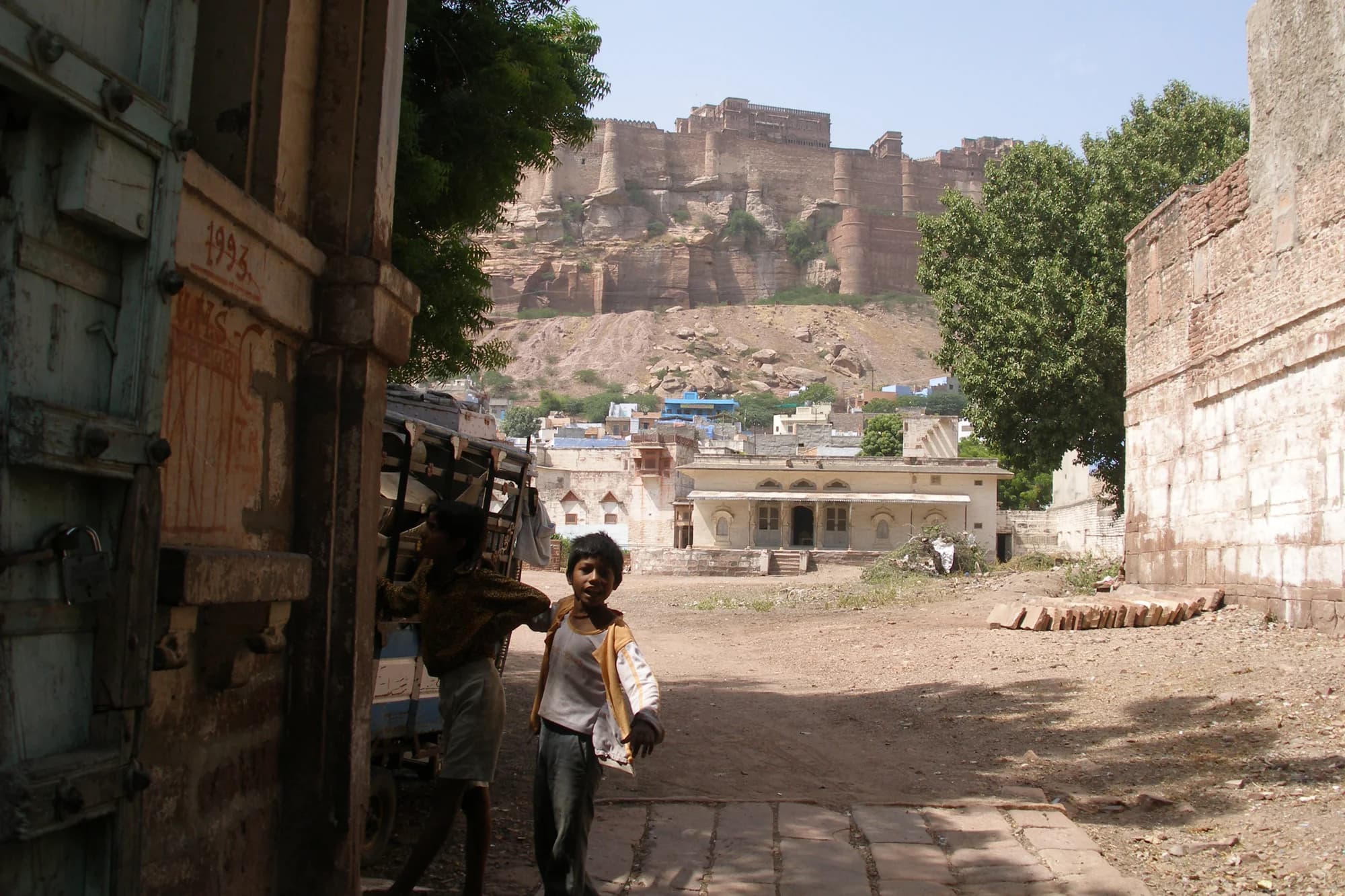
RAAS's location, in the heart of Jodhpur's Walled City, is both its greatest asset and its defining challenge. Step out of the hotel's discreet entrance and you are immediately immersed in the Blue City — the warren of indigo-washed houses, narrow lanes, and bustling bazaars that tumble down the hillside from the fort. The contrast is bracing, and deliberately so. RAAS does not attempt to insulate its guests from Jodhpur; it deposits them at its doorstep.
The hotel's concierge can arrange guided walks through the old city that most visitors never find — not the sanitized tourist routes but the real lanes where silversmiths have worked for generations, where the spice merchants of the Sardar Market grind their masalas each morning, where the descendants of the fort's original builders still carve sandstone in workshops unchanged for centuries. These walks, led by local guides who grew up in the Walled City, are the single best introduction to Jodhpur available to any visitor.
For those who prefer a more curated experience, the hotel can arrange a private tour of Mehrangarh Fort with a historian from the Mehrangarh Museum Trust. The standard tourist visit to Mehrangarh is impressive enough. The private tour, conducted after hours with the crowds gone, is transformative — you walk through the Sheesh Mahal (Mirror Palace) and the Phool Mahal (Flower Palace) accompanied only by your guide's narration and the distant sound of temple bells from the city below.
The Blue City from Mehrangarh Fort — a sea of indigo-washed houses spreading below the citadel, the stepwell of Toorji Ka Jhalra visible as a geometric incision in the urban fabric, the desert haze softening the horizon to pale gold
From the fort's ramparts, the Blue City reveals itself — Jodhpur's houses were painted blue, traditionally, to signify Brahmin residences and for the copper sulphate's cooling and insect-repelling properties beneath the fierce desert sun
Photo: Vyacheslav Argenberg, CC BY 4.0
Insider Tips
Room Selection Strategy
The Heritage Rooms offer the most atmospheric stay but have smaller windows and less natural light — choose them for romance and authenticity. The Contemporary Rooms are brighter, larger, and offer the best fort views, particularly from the upper floor. For the ultimate experience, book a RAAS Suite in the contemporary wing — the corner position gives you both fort views and courtyard views, plus a private terrace large enough for a candlelit dinner for two.
Timing Your Visit
October to March is peak season, with temperatures comfortable enough for daytime exploration. Book at least three months ahead for this period. April to June brings intense heat (40°C+) but the hotel's thick stone walls and smart design keep interiors comfortable, and rates drop significantly. July to September offers the monsoon — brief, dramatic rains that turn the desert green and bring spectacular cloud formations over the fort. This is the photographer's season.
The Stepwell Secret
The 18th-century Toorji Ka Jhalra stepwell is a five-minute walk from the hotel and is one of Jodhpur's most photogenic sites. Go at 7:00 AM, before the crowds and the heat, when the light falls vertically into the well and the geometric patterns of the staircases are at their most dramatic. The hotel can arrange a chai wallah to meet you there with freshly brewed masala chai.
Frequently Asked Questions
How does RAAS compare to Umaid Bhawan Palace? They are fundamentally different propositions. Umaid Bhawan is a 347-room palace, the actual residence of the Maharaja of Jodhpur, and one of the most extravagant hotels in the world. RAAS is an intimate 39-room boutique property at the foot of the fort, with contemporary design and a more relaxed atmosphere. The comparison is less about quality — both are exceptional — than about the kind of experience you seek. Choose Umaid Bhawan for palatial grandeur, royal history, and formal service. Choose RAAS for design-led intimacy, fort views, and location in the heart of the old city. Many discerning travellers split their stay between the two.
Is the hotel accessible for guests with mobility concerns? The heritage wing has multiple levels and steps inherent to the original haveli architecture, and is not wheelchair-accessible. The contemporary wing is more navigable, with elevators and level access to public areas and some ground-floor rooms. Guests with mobility concerns should request a ground-floor Contemporary Room and discuss specific requirements with the reservations team at the time of booking.
How many nights should I stay? Two nights minimum, three to four ideal. One night is insufficient — the fort view alone deserves a full evening of your attention, and the Walled City walks and Mehrangarh Fort tour require at least one full day. Four nights allows for a more leisurely pace: a morning at the stepwell, an afternoon by the pool, a dinner at Baradari, and a second day exploring the bazaars and the fort at a pace that does justice to both.
Is RAAS suitable for families? RAAS welcomes families but is fundamentally a romantic, adult-oriented property. The pool is not designed for children's play, and the atmosphere in the evenings — candlelit dinners, quiet conversations, the fort illuminated overhead — is best suited to couples and adult travellers. Families with older children (12+) who appreciate the cultural setting will enjoy the property. Families with young children may find the lack of dedicated kids' facilities limiting.
What is the dress code? Relaxed and resort-casual throughout the day. For dinner at Baradari, smart casual is appropriate — collared shirts for gentlemen, no swimwear. The atmosphere is less formal than at the palace hotels, and the design-conscious clientele tends toward understated elegance rather than ostentation. In winter (December to February), evenings can be cool, and a light jacket or pashmina is recommended for outdoor dining.
RAAS Jodhpur at the golden hour — the heritage havelis and contemporary wing in harmony at the foot of Mehrangarh Fort, the infinity pool reflecting the citadel's ancient ramparts, the Blue City spreading across the hillside below a sky of amber and rose
At night, hundreds of concealed LED fixtures trace the architectural lines of the buildings and wash the stone walls in amber glow — the visual conversation between ancient citadel blazing white-gold and the hotel glowing amber at its feet is one of Rajasthan's most beautiful nighttime spectacles