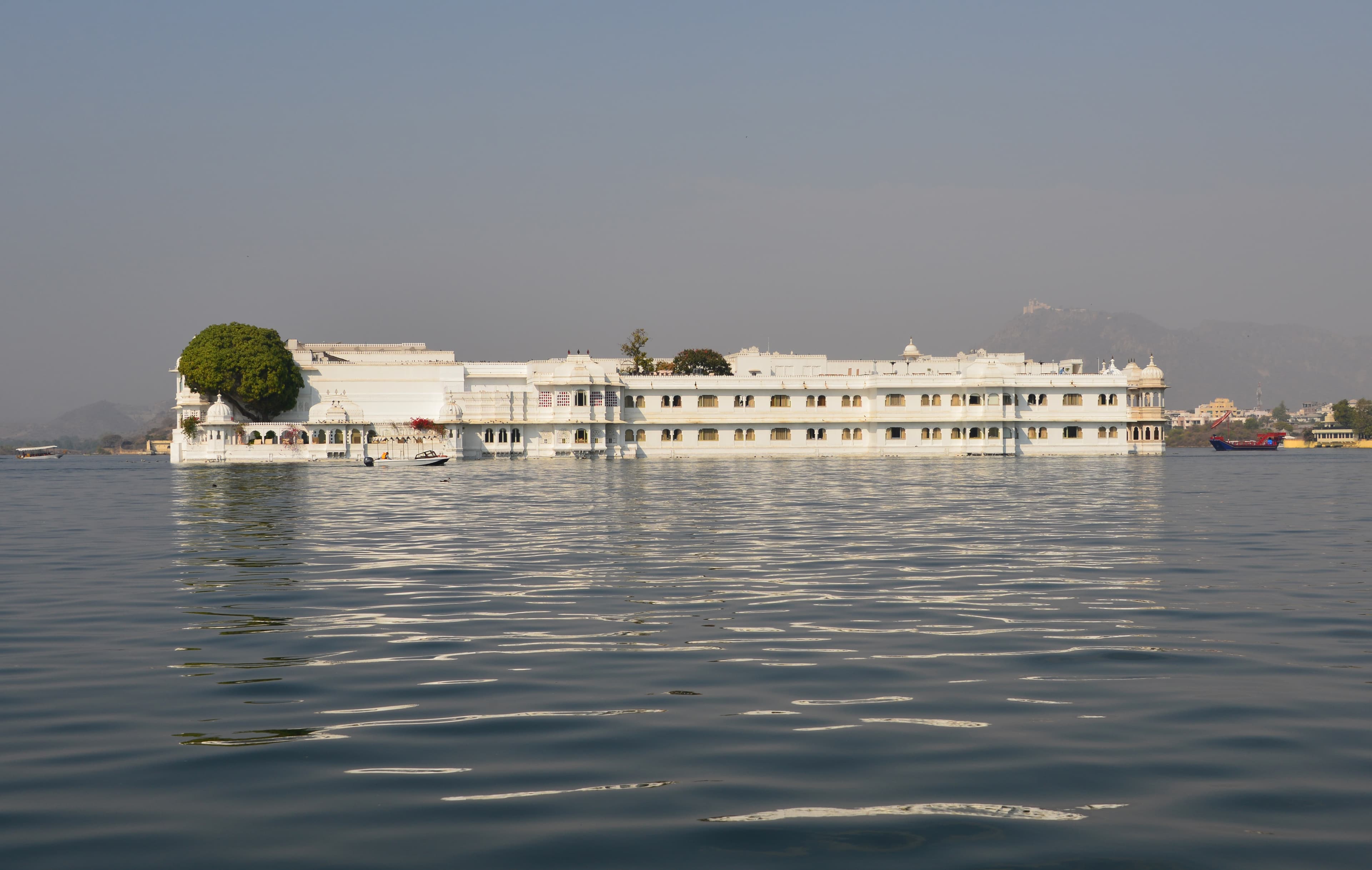
It appears first as a mirage. One moment you are on the shore of Lake Pichola, the noise of Udaipur's bazaar fading behind you, and the next you are aboard a polished teak boat gliding across water that mirrors the sky with such fidelity you cannot tell where the world ends and its reflection begins. Then, emerging from the haze of a Rajasthani afternoon, it materialises: a confection of white marble and sandstone that appears to float — genuinely, impossibly float — on the surface of the lake. This is Taj Lake Palace, and there is no arrival in Indian hospitality that compares.
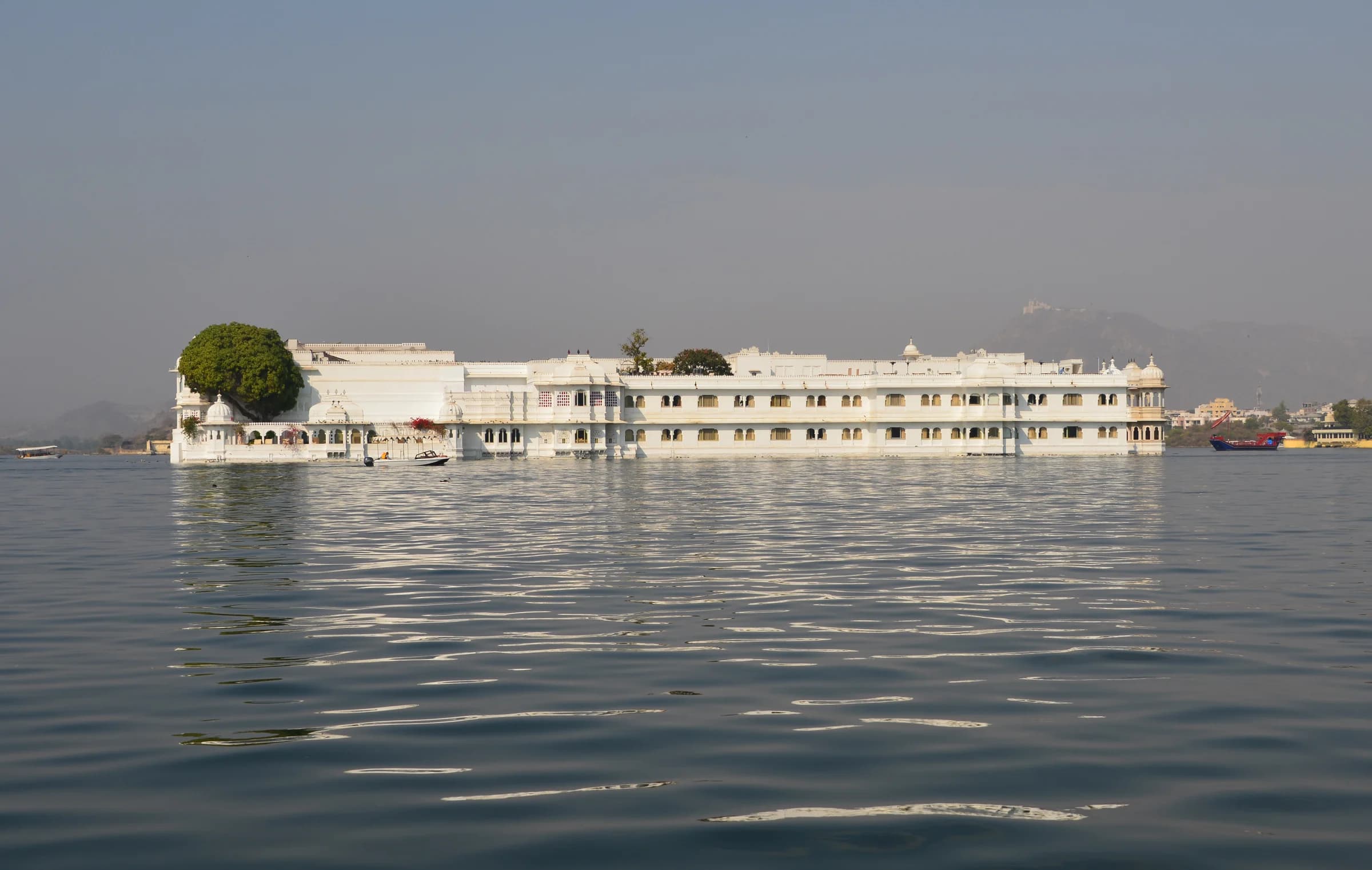
Taj Lake Palace viewed from across Lake Pichola at sunset — the white marble palace floating on the glassy water, the Aravalli Hills softening into silhouette, the entire scene suspended between sky and reflection
Built between 1743 and 1746 as the Jag Niwas pleasure palace of Maharana Jagat Singh II, the structure rises directly from a four-and-a-half-acre natural rock island in Lake Pichola, creating the illusion of a building floating without visible support
Photo: Clément Bardot, CC BY-SA 4.0
The palace was built between 1743 and 1746 by Maharana Jagat Singh II, the sixty-second ruler of the Mewar dynasty, who ruled from 1734 to 1751. The official narrative presents the palace as a pleasure pavilion — a summer retreat where the Maharana could escape the heat and intrigue of the City Palace complex across the water. The unofficial narrative, whispered for centuries in the bazaars of Udaipur, is more interesting: Jagat Singh II, a devoted follower of Lord Krishna, built the palace on Lake Pichola so he could look across the water at the Jagmandir Island Palace, where his father had famously sheltered the rebel Mughal prince Shah Jahan — the future builder of the Taj Mahal — during his uprising against his own father, Emperor Jahangir, in 1623. The palace was originally called Jag Niwas, literally "the abode of the lord of the world," and its purpose was as much spiritual as architectural.
Whatever the Maharana's motivations, the result is an architectural achievement that defies its era. The palace was built on a four-and-a-half-acre natural island foundation of solid rock beneath the lake. The walls rise directly from the water — there is no beach, no shore, no transitional space between lake and palace. The effect, particularly at dawn and dusk when the water is still, is of a building unmoored from the earth, floating in a state of permanent and graceful denial of gravity.
The eastern facade of the palace at sunrise — cupolas, chhatris, and carved jharokhas rendered in white marble, the first light turning every surface from alabaster to honey-gold, a pair of traditional wooden boats bobbing at the private jetty
The palace is oriented east by design, so the rising sun illuminates its principal facades — an architectural decision that turns every morning into a spectacle of light
The Architecture of Water and Light
The architecture of the Lake Palace is a contained masterclass in the Rajput aesthetic. The palace is oriented east, so the rising sun illuminates its principal facades. The courtyards are arranged with a precision that channels the prevailing breezes off the lake through every room and corridor — an early and remarkably effective form of natural air-conditioning that functions perfectly seven decades before the invention of mechanical cooling. The white marble surfaces, polished to a gleam that rivals the Taj Mahal itself, reflect the changing colours of the sky throughout the day: rose and gold at dawn, blinding white at noon, amber and violet at dusk, silver under moonlight.
The building comprises a series of courtyards, pavilions, terraces, and gardens arranged around a central courtyard. The lily pond, set in the heart of the palace, is fed by the lake itself, and the sound of water — trickling, lapping, reflecting — is the palace's constant and most soothing soundtrack. The carved stone jalis (lattice screens) that line the corridors serve a dual purpose: they filter the fierce Rajasthani sun into patterns of lacework shadow while allowing the lake breezes to circulate freely, a passive cooling system that the palace's twenty-first-century air-conditioning merely supplements rather than replaces.
The central lily pond courtyard — flowering lotuses floating on dark water, marble colonnades on all four sides, carved jali screens casting geometric shadows across polished floors, the blue of the Udaipur sky visible through the open roof
The courtyard is designed as a traditional chowk — the open-to-sky central space that is the heart of every Rajput palace, providing light, ventilation, and a connection to the elements
The James Bond Connection
In 1983, the producers of the James Bond film Octopussy needed a location that would embody exotic, almost-impossible luxury — a floating palace that looked too extraordinary to be real. They found Taj Lake Palace. The palace served as the principal location for the film, doubling as the residence of the titular character, played by Maud Adams. Roger Moore's James Bond arrived by boat, dined on floating terraces, and conducted the kind of glamorous espionage that only the Lake Palace could credibly host.
The film brought the palace to international attention, and the hotel — which had been acquired by the Taj group in 1971 — was transformed from a somewhat faded royal relic into one of the most sought-after addresses in global hospitality. The restoration that followed Octopussy was comprehensive: frescoes were restored, marble was repolished, gardens were replanted, and the palace emerged from the 1980s as the definitive expression of romantic Rajasthani luxury.
Today, the palace screens Octopussy every evening in the courtyard bar. Guests sip martinis — shaken, not stirred, naturally — and watch Bond navigate the very terraces and corridors they have just explored. It is the rare cinematic tribute that enhances rather than diminishes the original, and it has become one of the most charming rituals of a Lake Palace stay.
“There are hotels you check into, and there are hotels you surrender to. The Lake Palace belongs entirely to the second category.”
The Suites: Sleeping Above Water
The Lake Palace offers sixty-six rooms and seventeen suites, a deliberately intimate number that ensures the palace never feels crowded — an achievement given that it is one of the most photographed and visited hotels in India. Every room in the palace faces the water, a function of the building's design as an island rather than any particular generosity on the part of its architects, but the effect is that there are no "bad" rooms at the Lake Palace, merely rooms with more extraordinary views than others.
The Grand Royal Suites occupy the palace's most privileged positions. The Sajjan Niwas Suite, named for Maharana Sajjan Singh, features a canopied bed, a private open-air terrace with a jacuzzi, and windows that frame the City Palace complex across the lake — the palace's illuminated facade at night is a sight that justifies the suite's considerable cost on its own. The Khush Mahal Suite, slightly smaller but no less romantic, opens onto a private courtyard with a fountain and views of the Jag Mandir island palace.
The Presidential Suite, the palace's largest accommodation, occupies the upper floor of the main wing and offers a 270-degree panorama of Lake Pichola. The living room is panelled in carved teak, the bedroom features a four-poster bed beneath a ceiling painted with celestial motifs in gold leaf, and the bathroom — a cathedral of white Makrana marble — has a bathtub positioned beside floor-to-ceiling windows that look directly onto the lake. Soaking here at sunset, with the water turning gold outside and the Aravalli Hills darkening on the horizon, is one of those travel experiences that permanently recalibrates your expectations of what a hotel can be.
The Presidential Suite bedroom — a gilded four-poster bed beneath a celestial ceiling, French windows opening onto a private balcony over the water, the City Palace visible across Lake Pichola through gossamer curtains
The celestial ceiling, painted in gold leaf on a deep indigo ground, depicts the night sky as it appeared over Udaipur on the date of Maharana Jagat Singh II's coronation — a detail that connects the suite's occupant to the palace's founder across nearly three centuries
Dining on the Water
The Lake Palace's dining program is anchored by two restaurants, each of which draws its character from a different aspect of the palace's location. Neel Kamal, the formal Indian restaurant, occupies a room whose walls are decorated with frescoes depicting scenes from the life of Lord Krishna — a tribute to Maharana Jagat Singh II's devotion. The menu is a celebration of Mewari cuisine, the cooking of the Udaipur region that is distinct from the more widely known Marwari cuisine of Jodhpur. Mewari cooking is characterised by its use of yoghurt-based gravies, freshwater fish from the lake, and a gentler spice profile than the aggressively chilli-forward cooking of Marwar.
The signature dish at Neel Kamal is the Mewari Murgh — chicken slow-cooked in a gravy of yoghurt, cream, and a blend of twenty-three spices that the kitchen guards with an intensity that borders on paranoia. The recipe, the chef will tell you with a smile that does not reach his eyes, is not available under any circumstances. Also notable is the Laal Maas, which here is prepared with a restraint that distinguishes it from the fierier Jodhpuri version — still deeply flavoured with Mathania chillies, but tempered with yoghurt and ghee into something complex rather than confrontational.
Bhairo, the rooftop restaurant, serves contemporary European cuisine in an open-air setting that ranks among the most romantic dining venues in Asia. The restaurant opens only for dinner, and tables are arranged along the rooftop parapet so that every diner has an uninterrupted view across Lake Pichola. By day the space is a casual terrace; by night, lit by lanterns and candles, with the City Palace illuminated across the water and classical sitar music drifting up from the courtyard below, it becomes something approaching a religious experience for the romantically inclined. The menu changes seasonally, but the grilled lake fish — locally caught, simply prepared with herbs and lemon — is a constant and a reminder that you are, quite literally, dining above your dinner's former habitat.
Bhairo rooftop restaurant at night — candlelit tables along the parapet, the illuminated City Palace reflected in Lake Pichola, lanterns swaying gently in the lake breeze, stars mirrored in dark water
The restaurant seats only forty guests and books out weeks in advance; the western parapet tables offer the finest sunset views across the Aravalli Hills
For those seeking the ultimate private dining experience, the palace offers dinner on the Gangaur — a traditional Rajasthani boat that once belonged to the Maharana of Udaipur. The boat, a beautifully restored wooden vessel with silk cushions and a canopy, seats only two guests and departs from the palace's private jetty at sunset. A dedicated butler serves a seven-course tasting menu as the boat drifts across Lake Pichola, the palace receding behind you, the ghats of Udaipur glowing with oil lamps in the distance. It is, without competition, the most romantic dinner available anywhere in Rajasthan — and, at approximately ₹75,000 ($900) per couple, one of the more expensive as well.
The Jiva Spa
The Lake Palace's spa, operated by the Taj group's Jiva brand, occupies a wing of the palace that once housed the royal zenana (women's quarters). The treatment rooms are set around a courtyard garden planted with jasmine, frangipani, and the medicinal herbs that form the basis of the spa's Ayurvedic treatments. The signature experience, the Mewar Royal Ritual, is a four-hour sequence that begins with a consultation with the spa's resident Ayurvedic doctor, proceeds through abhyanga (warm oil massage), shirodhara (the steady pouring of warm oil onto the forehead), and udvartana (herbal exfoliation), and concludes with a rose-petal bath in a marble tub overlooking the lake.
The spa is small — only four treatment rooms — and books up weeks in advance during peak season. The reason is not merely the quality of the treatments, which is high, but the setting, which is extraordinary. Lying on a massage table while the scent of jasmine drifts through carved jali screens and the sound of the lake lapping against the palace walls provides the only soundtrack is an experience that, like so much of the Lake Palace, transcends the ordinary parameters of hotel luxury.
Jiva Spa treatment room — a marble therapy bed set beneath a carved sandstone arch, herbal oils in copper vessels, jasmine blossoms floating in water bowls, lake light filtering through jali screens
The spa occupies the former zenana wing, where the palace's women once lived in seclusion; the treatment rooms are the very chambers where Mewar's queens and princesses received their own Ayurvedic treatments
Experiences and Excursions
The Lake Palace's location on the water makes it an ideal base for exploring Udaipur, but the palace itself offers a program of experiences that could easily fill three days without ever setting foot on the mainland.
The palace's private boat, a beautifully maintained mahogany launch, offers exclusive cruises on Lake Pichola at dawn and dusk. The dawn cruise takes you past the ghats where Udaipur's residents perform their morning puja, the water still and silver, the city just beginning to stir. The dusk cruise coincides with the lighting of the oil lamps at the ghats — a ritual that transforms the lakeshore into a constellation of flickering flames reflected in dark water. Both cruises include champagne and canapés, and both are included in the room rate for suite guests.
For those interested in the palace's history, the hotel offers a private tour led by the palace historian — a gentleman who has spent forty years studying the Mewar dynasty and whose knowledge of the palace's architecture, art, and royal inhabitants is encyclopaedic. The tour covers areas of the palace normally closed to guests, including the private temple where the royal family's puja was performed daily for two hundred years, and the rooftop terraces that offer the palace's most spectacular views of the City Palace and the Aravalli Hills.
The palace also maintains a fleet of vintage cars — including a 1938 Rolls-Royce Phantom III that once belonged to the Maharana of Udaipur — and can arrange a chauffeured tour of Udaipur that includes the City Palace, the Crystal Gallery, Sahelion-ki-Bari (the Garden of the Maidens), and the Jagdish Temple. The Rolls-Royce, with its open roof and leather seats, is the preferred vehicle for the tour, though the palace's air-conditioned Mercedes fleet is available for those who prefer modern comfort to vintage romance.
The palace's private mahogany launch departing the jetty at dawn — Lake Pichola still as glass, the Aravalli Hills pink in first light, the City Palace complex a golden silhouette on the eastern shore
The mahogany launch, built in the 1940s for the Maharana's personal use, was restored by the Taj group in the 1990s and remains the most elegant way to experience Lake Pichola
Insider Tips
Room Selection Strategy
Request rooms in the eastern wing for sunrise views across Lake Pichola toward the City Palace. The western wing faces the Aravalli Hills and the sunset — equally beautiful but without the architectural drama of the illuminated City Palace at night. For honeymooners, the Grand Royal Suites offer private terraces that are completely secluded from other guests. Avoid rooms on the ground floor near the main courtyard, where foot traffic from day visitors and wedding events can compromise the palace's celebrated serenity.
Best Time to Visit
October through March offers the most comfortable climate, with daytime temperatures of 20-28°C and cool evenings that are ideal for rooftop dining. November and February are the ideal months — pleasant weather, moderate crowds, and rates slightly below the December-January peak. The monsoon (July-September) transforms Udaipur into a lush green landscape and the lake is full, but humidity is high and rooftop dining is weather-dependent. Avoid May and June, when daytime temperatures exceed 40°C and the lake level drops significantly, compromising the floating-palace illusion.
Dining Reservations
Bhairo, the rooftop restaurant, seats only forty guests and books out weeks in advance during peak season. Reserve your table when you book your room, not when you arrive. Request a table along the western parapet for sunset views; the eastern parapet offers better views of the illuminated City Palace after dark. The Gangaur boat dinner requires a minimum of seventy-two hours' notice and is weather-dependent — book for your second or third evening to allow for rescheduling if the monsoon intervenes.
Octopussy Screening
The courtyard screening of Octopussy is held every evening at 7:00 PM, but the Friday and Saturday screenings are crowded with non-resident guests who have booked dinner at the palace. For a more intimate experience, attend the Monday through Thursday screenings, when you are likely to have the courtyard almost to yourself. The bar serves Bond-themed cocktails during the screening — the Vesper Martini is excellent, and the Octopussy (vodka, lychee, and rose water) is surprisingly sophisticated for a themed drink.
Frequently Asked Questions
How many nights should I stay at Taj Lake Palace? Three nights is the sweet spot. Two nights feels rushed; four is luxurious but the room rates encourage restraint. Three nights allows you to experience the palace fully — a day of arrival and orientation, a full day of experiences (spa, boat cruise, private dining), and a final day of leisurely departure. If you are combining the Lake Palace with a stay at one of the City Palace hotels, two nights at each works well.
Is the Lake Palace worth the premium over the City Palace hotels? For a special occasion — honeymoon, milestone anniversary, once-in-a-lifetime trip — absolutely. The Lake Palace is categorically different from any land-based hotel: the island setting, the boat arrival, the 360-degree water views, and the sheer romance of the place justify its position as the most expensive hotel in Udaipur. For a more budget-conscious luxury stay, the City Palace hotels offer comparable service at roughly half the rate, albeit without the floating-on-water magic.
Can non-guests visit the Lake Palace? The palace is reserved exclusively for registered guests. Non-residents may dine at the restaurants with a prior reservation, subject to availability and at a significant premium — the set-menu dinner at Bhairo for non-residents is approximately ₹12,000 ($145) per person. Day visitors are not permitted. This exclusivity is a significant part of the palace's appeal and ensures that guests never feel their peace is being compromised by sightseers.
What should I wear? During the day, resort casual is the norm. Evenings call for smart casual — closed shoes and a collared shirt for gentlemen, elegant separates or Indian formal wear for ladies. At Bhairo, a jacket is appreciated during the winter months. The palace provides traditional Rajasthani attire — a kurta for men, a poshak for ladies — for guests who wish to dress for dinner in authentic local style, a gesture that is both charming and surprisingly flattering in photographs.
Taj Lake Palace at twilight from the western shore of Lake Pichola — the illuminated white marble palace reflected with perfect symmetry in the still water, the City Palace complex glowing golden on the eastern shore, the sky a gradient of rose, lavender, and deepening indigo
The palace employs a dedicated team of lighting designers who illuminate the facade each evening according to the season, the phase of the moon, and the presence of any private events — ensuring that the palace's reflection in Lake Pichola is always, in the words of the chief designer, "as flattering as possible"