Fateh Prakash Palace is the grandest address in Udaipur. Not the most expensive — that distinction belongs to the Taj Lake Palace, floating on its private island a kilometre offshore. Not the most intimate — its sibling, Shiv Niwas Palace next door, claims that prize. But in terms of scale, architectural ambition, and sheer theatrical impact, Fateh Prakash stands alone. The Durbar Hall, its centrepiece, is a ballroom of such extravagant magnificence that the Maharanas of Mewar, who were not easily impressed by anything they themselves had built, considered it the finest room in their kingdom. And they had considerable competition for the title.
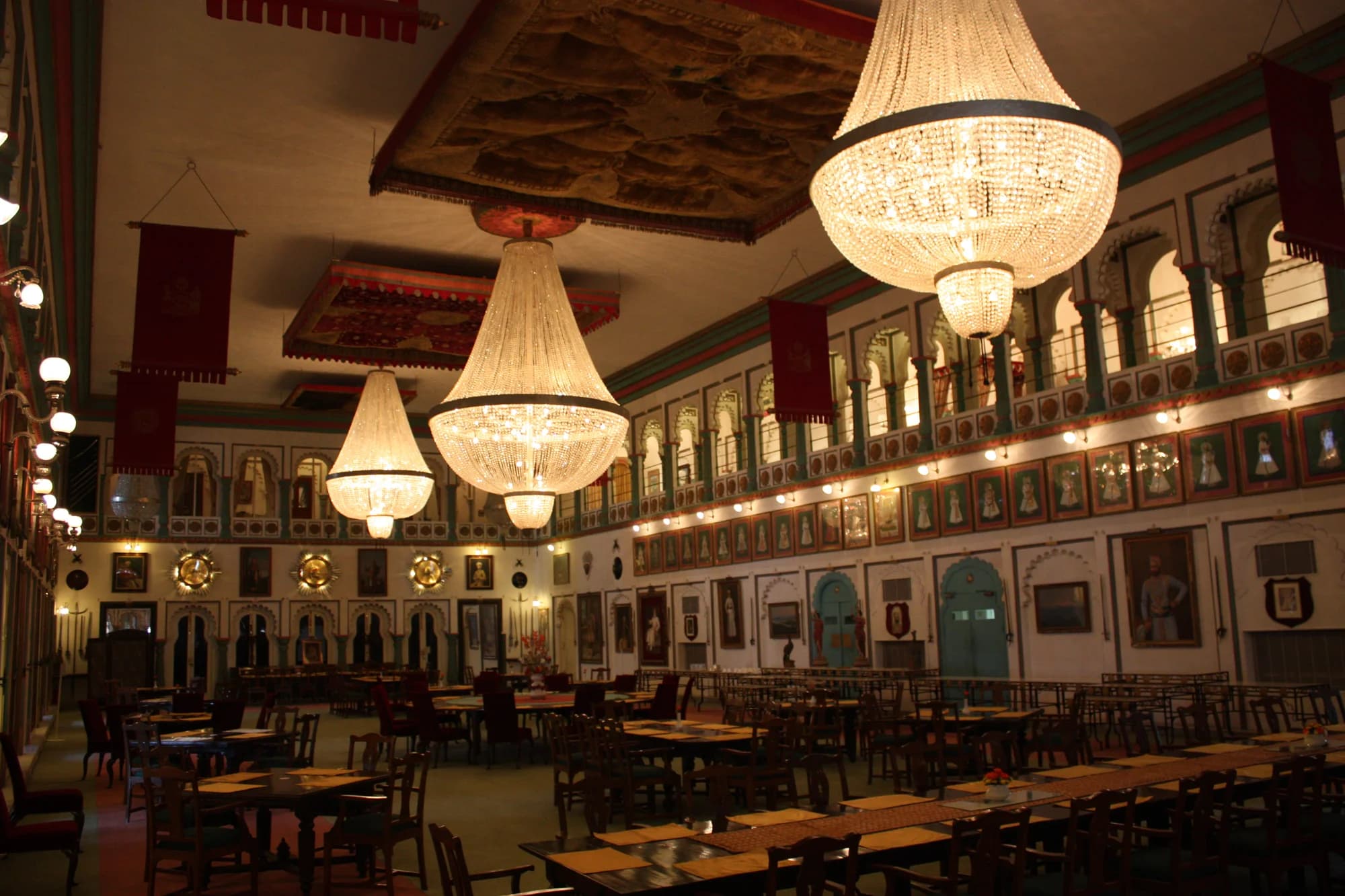
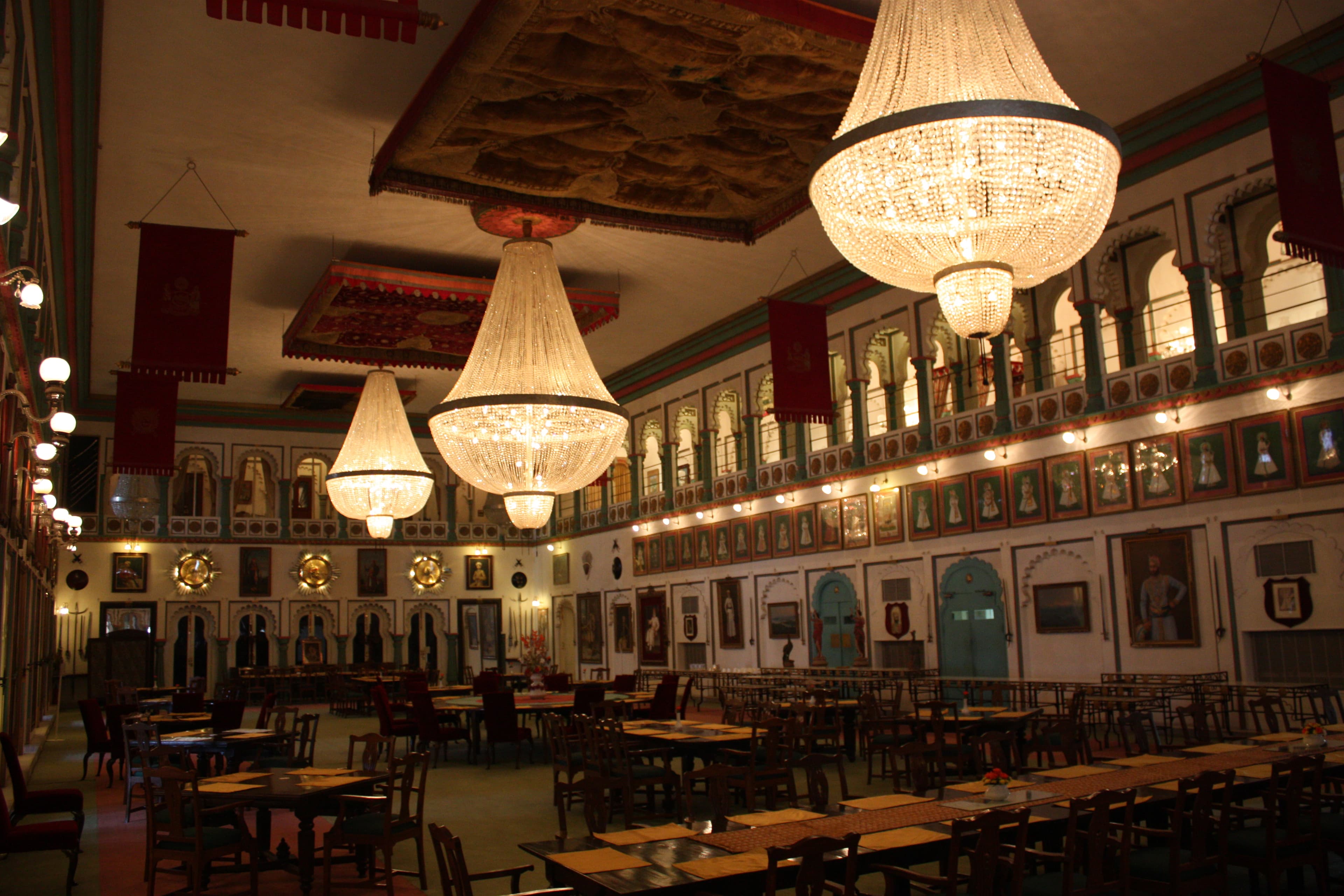
The Durbar Hall at Fateh Prakash Palace — crystal chandeliers, gilded mouldings, and floor-to-ceiling arched windows framing panoramic views of Lake Pichola at golden hour
The Durbar Hall was conceived as the throne room of the Maharanas of Mewar — its double-height ceiling, Bohemian crystal chandeliers imported from what is now the Czech Republic, and upper gallery for courtiers made it the most magnificent ceremonial chamber in Udaipur
Photo: Arian Zwegers, CC BY 2.0
Built in the early twentieth century under Maharana Fateh Singh — the same ruler who gave Shiv Niwas its name — Fateh Prakash was conceived as a statement of Mewari modernity. By 1900, the Mewar dynasty had survived the Mughals, the Marathas, and the creeping encroachment of the British East India Company. It had signed a subsidiary alliance with the British Raj but retained its autonomy. It was wealthy, proud, and conscious of its status as the premier Rajput state. Fateh Prakash was the architectural expression of that confidence: a palace wing that could host the Viceroy of India without apology, a space that declared Mewar's continued relevance at the dawn of a new century.
The Durbar Hall: A Room That Defies Description
The Durbar Hall is the reason to stay at Fateh Prakash. It is not merely the hotel's bar and lounge — though it serves both functions with considerable elegance — but a surviving fragment of an imperial culture that valued spectacle as an instrument of statecraft. The dimensions alone are formidable: a double-height ceiling, arched windows on three sides, and a gallery running around the upper level from which courtiers once watched royal audiences. The chandeliers are Bohemian crystal, imported from what is now the Czech Republic at a cost that the palace archives, with characteristic discretion, do not disclose. The walls are decorated with portraits of the Mewar rulers in their ceremonial finery, their jewelled turbans and curved swords catching the light. The view through the arched windows — the entire sweep of Lake Pichola, from the City Palace ghats to the distant Aravalli Hills — is one of the finest vistas in Rajasthan.
Today, the Durbar Hall serves afternoon tea from three o'clock, cocktails from six, and a dinner service that makes the most of its theatrical setting. The menu leans toward Continental cuisine — a nod to the British guests who were the palace's original clientele — but the kitchen also prepares a creditable Laal Maas and an exceptional dal makhani for those who prefer their dining with a Rajasthani accent. The experience of taking a gin and tonic in the Durbar Hall as the sun sets over Lake Pichola, the chandeliers beginning to glow, the peacocks calling from the courtyard beyond, belongs on any serious list of Rajasthan's essential experiences.
Afternoon tea in the Durbar Hall — three-tiered silver stands laden with sandwiches and pastries, a pot of Darjeeling, the Bohemian crystal chandeliers reflecting the golden light that fills the hall through its towering arched windows
Afternoon tea is served from three o'clock daily — the ritual of taking tea beneath those chandeliers as the sun sets over Lake Pichola belongs on any serious list of Rajasthan's essential experiences
“To take tea in the Durbar Hall is to understand, in a single moment, why the maharanas were reluctant to leave Udaipur for any other place on earth.”
The Crystal Gallery: The World's Largest Private Collection
Attached to Fateh Prakash, and included in the hotel's tour program, is the Crystal Gallery — a collection so improbable that it requires its own paragraph. In 1877, Maharana Sajjan Singh ordered an enormous consignment of crystal from F&C Osler of Birmingham: furniture, tables, chairs, beds, fountains, even a crystal throne. The order was so large, so elaborate, and so extravagantly expensive that Osler's craftsmen required years to complete it. By the time the shipment arrived in India, Sajjan Singh was dead. His successor, Maharana Fateh Singh, had little interest in the collection, and for over a century, the crates sat unopened in the palace storerooms — a lost treasure of the Rajput era, known to a handful of palace retainers but invisible to the world.
The crates were finally opened in the 1990s. What emerged was the largest private collection of Osler crystal in existence: ruby-studded chairs, a crystal bed with matching side tables, serving dishes, decanters, goblets, fountains, and a carpet of crystal beads that required a dozen craftsmen three years to complete. The gallery where it is now displayed, on the upper floor of Fateh Prakash, is a chamber of frozen light — the crystal glowing in carefully positioned spotlights, each piece a testament to the extraordinary tastes of a maharana who never lived to see his commission.
The collection is open to hotel guests and paying visitors, but hotel guests receive complimentary access and the considerable advantage of being able to view it after hours, when the day-trippers have departed and the gallery is silent save for the hum of the climate control.
The Crystal Gallery — a ruby-studded crystal chair glinting under focused lights, shelf after shelf of crystal decanters and goblets catching the illumination, the legacy of a maharana who ordered more beauty than his lifetime could contain
Commissioned by Maharana Sajjan Singh in 1877 from F&C Osler of Birmingham, the collection lay unopened in palace storerooms for over a century — the largest private collection of Osler crystal in existence
The Rooms: Grandeur With a View
The 65 rooms and suites at Fateh Prakash are spread across the palace's upper floors, and they are, by any standard, impressive. High ceilings with ornate plasterwork. Furniture that marries Victorian solidity with Rajput ornament. Windows that frame either the lake or the City Palace courtyards below. The colour palette is a restrained study in cream, gold, and faded rose — the colours of Mewar aristocracy, as distinct from the bolder reds and oranges of Jaipur as a cello is from a trumpet.
The suites, particularly those in the lake-facing wing, are the property's strongest accommodation offering. They are generous in scale — 400 to 600 square feet — with separate sitting areas, walk-in wardrobes, and bathrooms of white Makrana marble. The best suites have private balconies overlooking Lake Pichola, and the experience of taking morning tea on one of these balconies, watching the lake stir to life, the first boats setting out for the Lake Palace, the cormorants diving for their breakfast, is as close to perfection as a hotel morning is likely to get.
The Palace Rooms, while less expansive, are still generous by the standards of heritage hotels, and many of them offer partial lake views. Renovations in recent years have modernised the bathrooms — an essential upgrade in a property of this vintage — and improved the air conditioning, though the thick stone walls do much of the thermal work on their own. The WiFi, as in most heritage properties, is functional rather than fast — a reminder that you are staying in a palace, not a business hotel, and that the view from the window should occupy more of your attention than the screen in your hand.
A lake-view suite at Fateh Prakash Palace — the sitting area framed by arched windows, the furniture an elegant blend of Victorian and Rajput styles, the waters of Lake Pichola glittering beyond
The colour palette is a restrained study in cream, gold, and faded rose — the colours of Mewar aristocracy, as distinct from the bolder reds and oranges of Jaipur as a cello is from a trumpet
Dining Beyond the Durbar Hall
While the Durbar Hall is the star, Fateh Prakash supports a full complement of dining options. The Sunset Terrace, open in the cooler months, serves dinner al fresco on the palace ramparts, with the lake below and the stars above. The menu is a curated tour of Rajasthani cuisine, with a particular emphasis on the game dishes that were a staple of the Mewar royal table: partridge, venison (in season), and the legendary Mewari preparation of lamb cooked with yoghurt, cardamom, and saffron. The vegetarian options are equally accomplished — the royal kitchens of Udaipur, influenced by the Jain traditions of the merchant class, have always excelled at vegetable cookery, and the paneer dishes, the dal preparations, and the seasonal greens are treated with the same care as the meat.
For a more casual meal, the poolside café serves sandwiches, salads, and grills throughout the day, and the setting — a terrace above the lake with the Aravalli Hills in the distance — elevates even a club sandwich into something approaching an occasion.
The City Palace at Your Doorstep
Like Shiv Niwas, Fateh Prakash enjoys immediate access to the City Palace complex. The palace museum, with its unmatched collection of Mewar miniatures, arms, and armour, is a two-minute walk through a connecting passage. Hotel guests enjoy the same after-hours privilege as their Shiv Niwas counterparts — the museum effectively becomes a private gallery after the public gates close. But Fateh Prakash, by virtue of its position within the complex, also offers something its sibling cannot: direct access to the palace's upper terraces, where the rooftop chhatris provide panoramic views of the city, the lake, and the hills beyond.
Getting the Most from Fateh Prakash
Book a lake-facing suite — the upgrade from a Palace Room is worth every rupee. The balconies are private, the views are uninterrupted, and the experience of waking to Lake Pichola framed by your French windows is one of the finest hotel moments in India. Request a room on the upper floor rather than the ground floor, which can feel slightly exposed to the public areas. And make a dinner reservation in the Durbar Hall for your first evening — no arrival ritual sets the tone for a Udaipur visit more effectively than a sunset aperitif beneath those chandeliers.
Combining Shiv Niwas and Fateh Prakash
The two sibling properties, separated by a two-minute walk through the palace complex, complement each other beautifully. Consider splitting a four-night stay: two nights at the grander Fateh Prakash for the Durbar Hall, the Crystal Gallery, and the lake-view suites, followed by two nights at the more intimate Shiv Niwas for its courtyard charm and quieter pace. The HRH Group will happily transfer your luggage between the two properties.
Frequently Asked Questions
Is Fateh Prakash worth the premium over Shiv Niwas? Yes, if the Durbar Hall, the Crystal Gallery, and larger rooms matter to you. Fateh Prakash is roughly 30% more expensive than Shiv Niwas, and the additional cost buys a genuinely grander experience. If your budget permits and you prioritise architectural spectacle, choose Fateh Prakash. If you prefer intimacy and value, choose Shiv Niwas.
How does Fateh Prakash compare to the Taj Lake Palace? They are fundamentally different propositions. The Taj Lake Palace, floating on its island, offers an experience that exists nowhere else in the world — the romance of being surrounded by water, the exclusivity of a private island, and a level of service that has been polished to a high reflective shine. Fateh Prakash, by contrast, is rooted in the City Palace itself — the culture, the history, the museum access — and its rates are roughly 40% lower. The ideal Udaipur visit combines both.
What is the dress code? The Durbar Hall requests smart evening attire — jackets for gentlemen are appreciated but not required outside the winter months, closed shoes and collared shirts are expected. The Sunset Terrace has a similar standard. Daytime dress is resort casual throughout the property.
Is the hotel suitable for children? The Durbar Hall and the Crystal Gallery are not naturally child-friendly spaces, and the property has a quieter, more adult atmosphere than many Rajasthani resorts. That said, the staff are welcoming toward young guests, and the pool provides an outlet for youthful energy. Families with children under ten may be more comfortable at a resort-style property.
What is the best time to visit? October through March for ideal weather. December and January are peak months — book at least three months ahead. The monsoon months (July to September) offer dramatic skies and significantly reduced rates, though some outdoor dining options may be limited by rain.
The Sunset Terrace at Fateh Prakash Palace — candlelit tables arranged along the palace ramparts, the darkening waters of Lake Pichola reflecting the lights of the City Palace, the Aravalli Hills a silhouette against a sky of deepest indigo
Open in the cooler months, the Sunset Terrace serves dinner al fresco on the palace ramparts — the menu a curated tour of Rajasthani cuisine with emphasis on the game dishes of the Mewar royal table