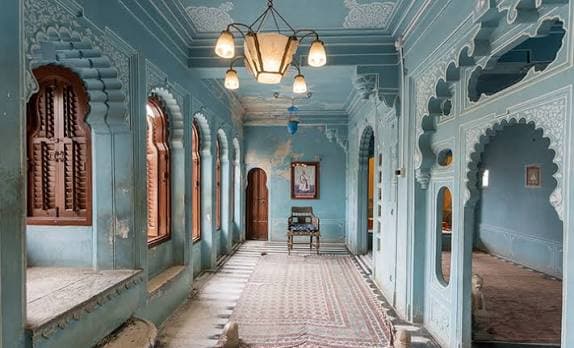
The City Palace, Udaipur, is not a palace. It is a city within a city — an accumulation of eleven separate palaces built across four centuries by successive rulers of the Sisodia dynasty, each adding their own vision to the complex until it became, by any measure, the largest palace compound in Rajasthan and one of the most significant royal architectural ensembles anywhere in the Indian subcontinent.
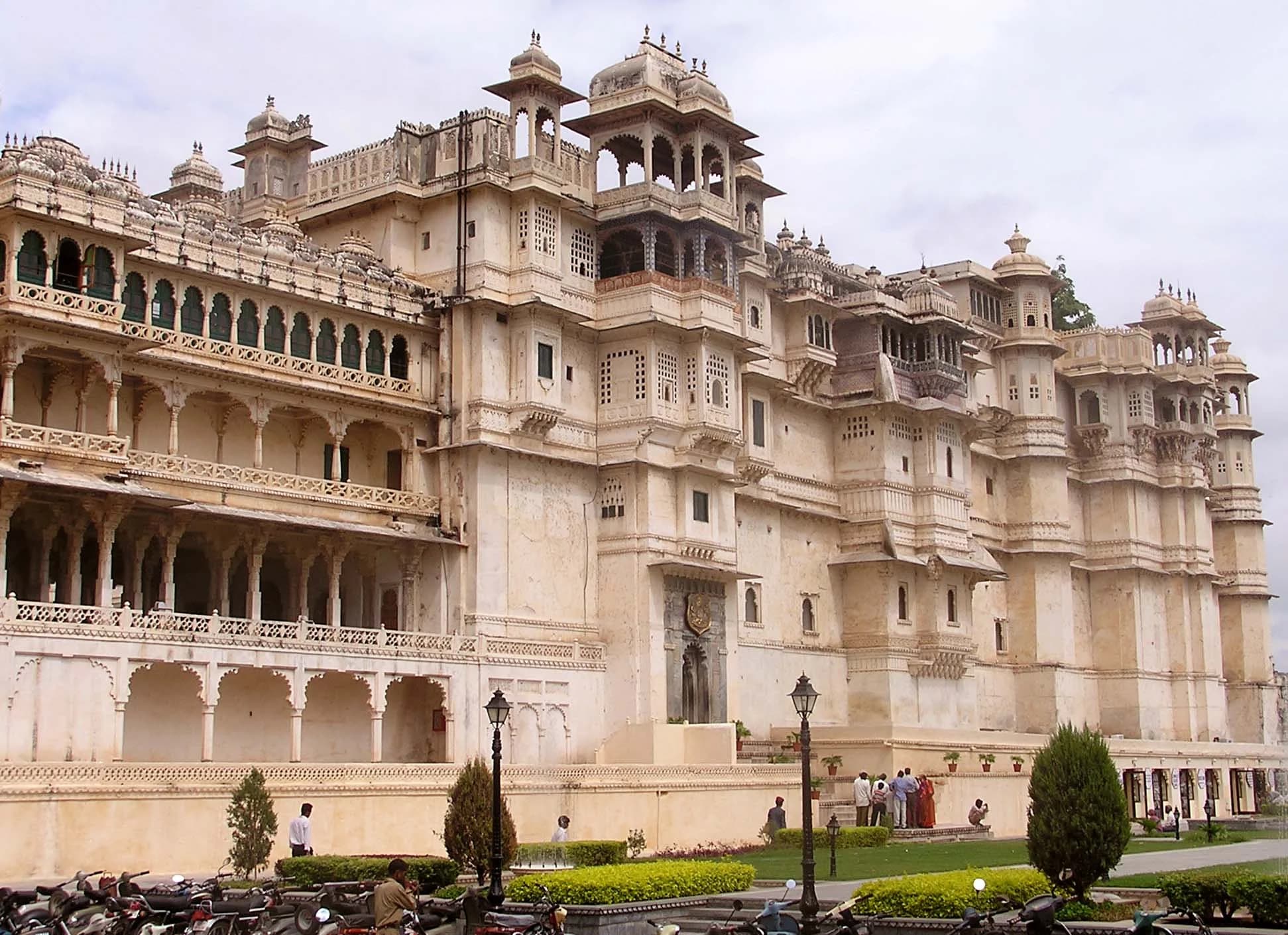
City Palace Udaipur viewed from Lake Pichola at sunset — the entire eastern shore dominated by the sprawling complex, a cascade of domes, cupolas, balconies, and towers rising from the water's edge to the hilltop, every surface glowing gold in the evening light
The palace complex, spanning five acres and eleven interconnected palaces, is the largest royal residence in Rajasthan and remains partially occupied by the Mewar royal family
Photo: Henrik Bennetsen, CC BY-SA 2.0
The Sisodias, the dynasty that has ruled Mewar — the region surrounding Udaipur — for more than fifteen centuries, are not merely one of India's oldest royal families. They are, by their own reckoning and that of most historians, the premier Rajput dynasty: the only major Hindu kingdom to resist Mughal domination through the centuries of Mughal supremacy, the custodians of a martial tradition that considers surrender a fate worse than death, and the descendants of a lineage that traces its origins to the sun itself. The Suryavanshi ("Descendants of the Sun") claim is inscribed on every gate and archway of the City Palace, and if the visitor is inclined to dismiss this as royal hyperbole, the architecture of the complex — a sustained, four-hundred-year argument in stone for the magnificence of the Sisodias — will give them considerable pause.
The Founding: Udai Singh II and the Lake City
The City Palace's story begins in 1553, when Maharana Udai Singh II, the fifty-third ruler of Mewar, encountered a sage meditating on a hill overlooking Lake Pichola. The sage, legend has it, advised the Maharana to establish his capital at this location — protected by the lake to the west, the Aravalli Hills to the east, and the fortifications that could be raised on the hill itself. Udai Singh II, who had spent the previous decades retreating from the advancing Mughal armies of Emperor Akbar, recognised the strategic wisdom of the advice and founded the city of Udaipur on the ridge above the lake in 1559.
The first structures of what would become the City Palace were built shortly thereafter — modest by the standards of what would follow, but establishing the template that successive Maharanas would elaborate across four centuries. Udai Singh II's original palace, the nucleus of the complex, was constructed between 1559 and 1572. It was from this palace that his son, the legendary Maharana Pratap, rode out to fight the Mughals at the Battle of Haldighati in 1576 — a battle he lost, and lost again, and lost again, but never surrendered, becoming the greatest hero of Rajput resistance and the embodiment of Sisodia defiance.
“Maharana Pratap lost every battle but never his kingdom. That is the Sisodia way — you bend, but you never break.”
The Architecture of Accumulation
What makes the City Palace uniquely fascinating among India's royal residences is that it was never planned as a unified whole. Unlike the great Mughal palace complexes at Agra and Delhi, which were conceived by a single emperor and executed under a single architectural vision, the City Palace is an accretion — each Maharana adding a wing, a courtyard, a palace, a gate, a temple, a tower, each addition reflecting not only the tastes of its builder but the political and military fortunes of the kingdom at that moment.
The Maharanas who followed Udai Singh II each left their mark. Maharana Karan Singh (1620-1628) added the Karan Vilas. Maharana Amar Singh II (1698-1710), one of the great arts patrons of Rajput history, added the Amar Vilas and commissioned the exquisite mirror work and miniature paintings that distinguish the palace's interiors. Maharana Sangram Singh II (1710-1734) added the Badi Mahal and the incomparable Manak Chowk courtyard. Maharana Fateh Singh (1884-1930) added the Fateh Prakash wing, now a hotel whose Durbar Hall is among the grandest dining rooms in India. The last major addition, the Shiv Niwas wing, was completed by Maharana Fateh Singh as a guest residence for visiting dignitaries and now operates as a heritage hotel.
The result is an architectural palimpsest — layer upon layer of style, material, and intention that collectively tells the story of the Mewar dynasty more eloquently than any history book. The early structures are pure Rajput: sandstone and marble, brackets and chhatris (domed pavilions), carved jharokhas (overhanging balconies), and pierced jali screens. The later additions incorporate Mughal elements — cusped arches, pietra dura inlay, formal garden layouts — that reflect the shifting balance of power between Mewar and the Mughal court. The most recent additions, from the British colonial period, incorporate European elements — crystal chandeliers, Victorian furniture, stained glass — that speak to the Maharanas' engagement with the wider world.
The Badi Mahal courtyard — a garden courtyard set on a ninety-foot-high natural rock ledge, planted with mature trees and flowering shrubs, surrounded by marble colonnades and carved stone screens, the lake visible through arched windows to the west
The Badi Mahal (Great Palace) is unique among Rajasthan's palace courtyards: it is built on a natural rock formation at the highest point of the ridge, offering views across Lake Pichola that were deliberately framed by the palace's architects
The Eleven Palaces Within
To walk through the City Palace is to walk through four hundred years of architectural history. The visitor moves from courtyard to courtyard, palace to palace, each space revealing a different aspect of Sisodia royal life. The Manak Mahal (Ruby Palace), built by Maharana Amar Singh II, contains some of the finest glass and mirror work in Rajasthan — walls and ceilings encrusted with convex mirrors, coloured glass, and porcelain tiles arranged in floral and geometric patterns that shimmer with reflected light.
The Bhim Vilas, named for Maharana Bhim Singh (1778-1828), contains a gallery of exquisite miniature paintings depicting scenes from the life of Lord Krishna — the deity to whom the Sisodias have maintained a particular devotion for centuries. The paintings, executed in the distinctive Mewar school style with its jewel-bright colours and detailed naturalistic backgrounds, are among the finest surviving examples of eighteenth-century Rajput miniature art.
The Krishna Vilas contains what may be the single most beautiful room in the complex: a small, jewel-like chamber whose walls and ceiling are covered entirely in miniature paintings — hundreds of individual scenes depicting Krishna's dalliance with the gopis (milkmaids), his childhood exploits in Vrindavan, and his role as divine charioteer in the Bhagavad Gita. The paintings were executed over a period of twelve years by a team of artists brought from the Mughal court at Delhi, and the fusion of Rajput subject matter with Mughal technique represents one of the high points of Indian artistic synthesis.
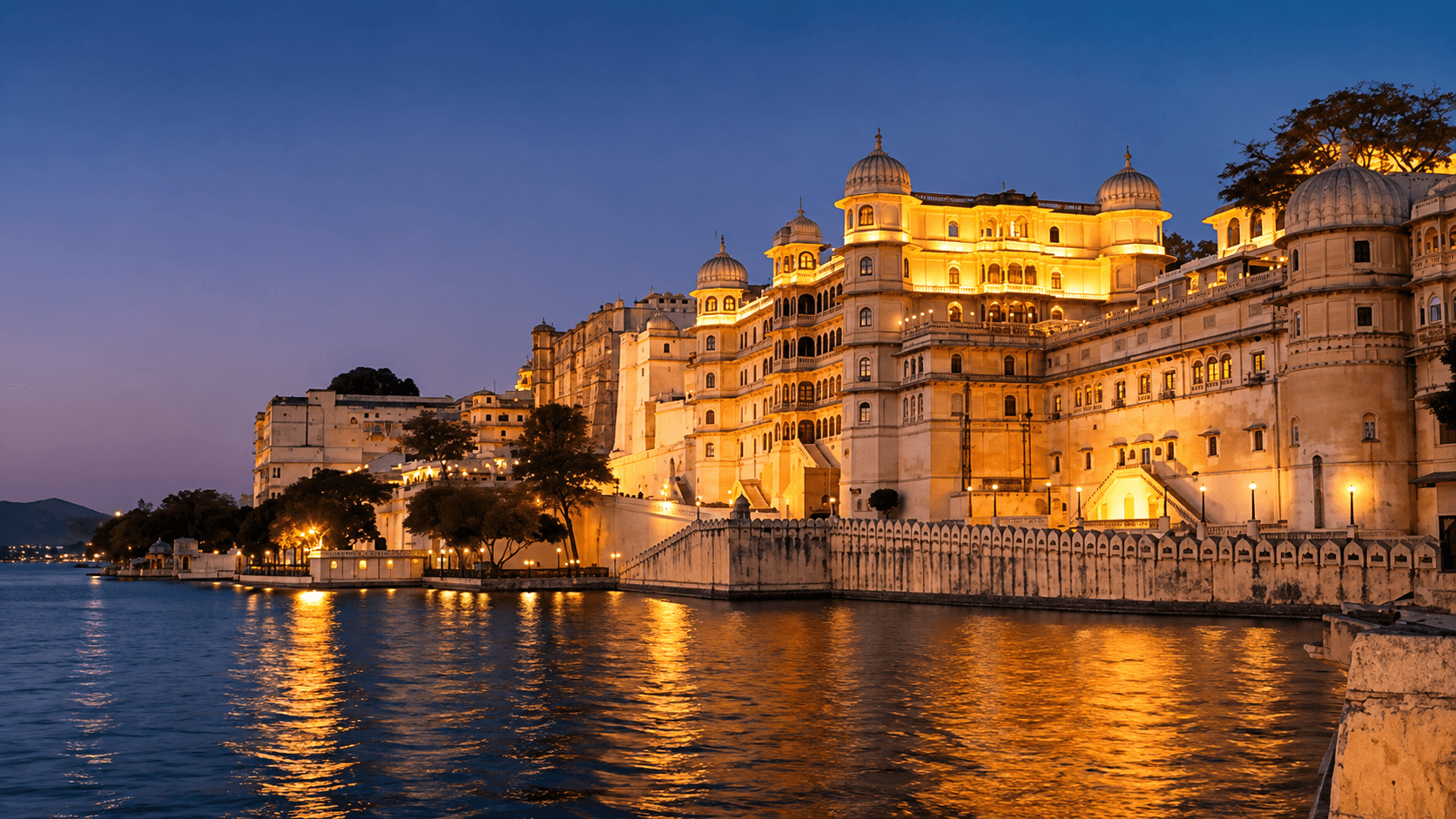
The Krishna Vilas chamber — every square inch of wall and ceiling covered in miniature paintings of Lord Krishna, jewel-bright colours preserved for three centuries, divine figures emerging from backgrounds of lapis blue and burnished gold
The pigments used in these paintings, including lapis lazuli from Afghanistan and gold leaf beaten to extraordinary thinness, were prepared using techniques passed down through generations of court painters
The Mor Chowk (Peacock Courtyard) is the City Palace's most photographed space, and for good reason. Three peacocks, rendered in high relief in glass mosaic, adorn the walls of the courtyard — their plumage picked out in thousands of pieces of coloured glass and mirror in shades of green, blue, and gold. The peacocks represent the three seasons of Mewar — summer, winter, and monsoon — and the central peacock, the largest and most elaborate, is the monsoon peacock, celebrating the season that transforms the arid Rajasthani landscape into something briefly, vividly green.
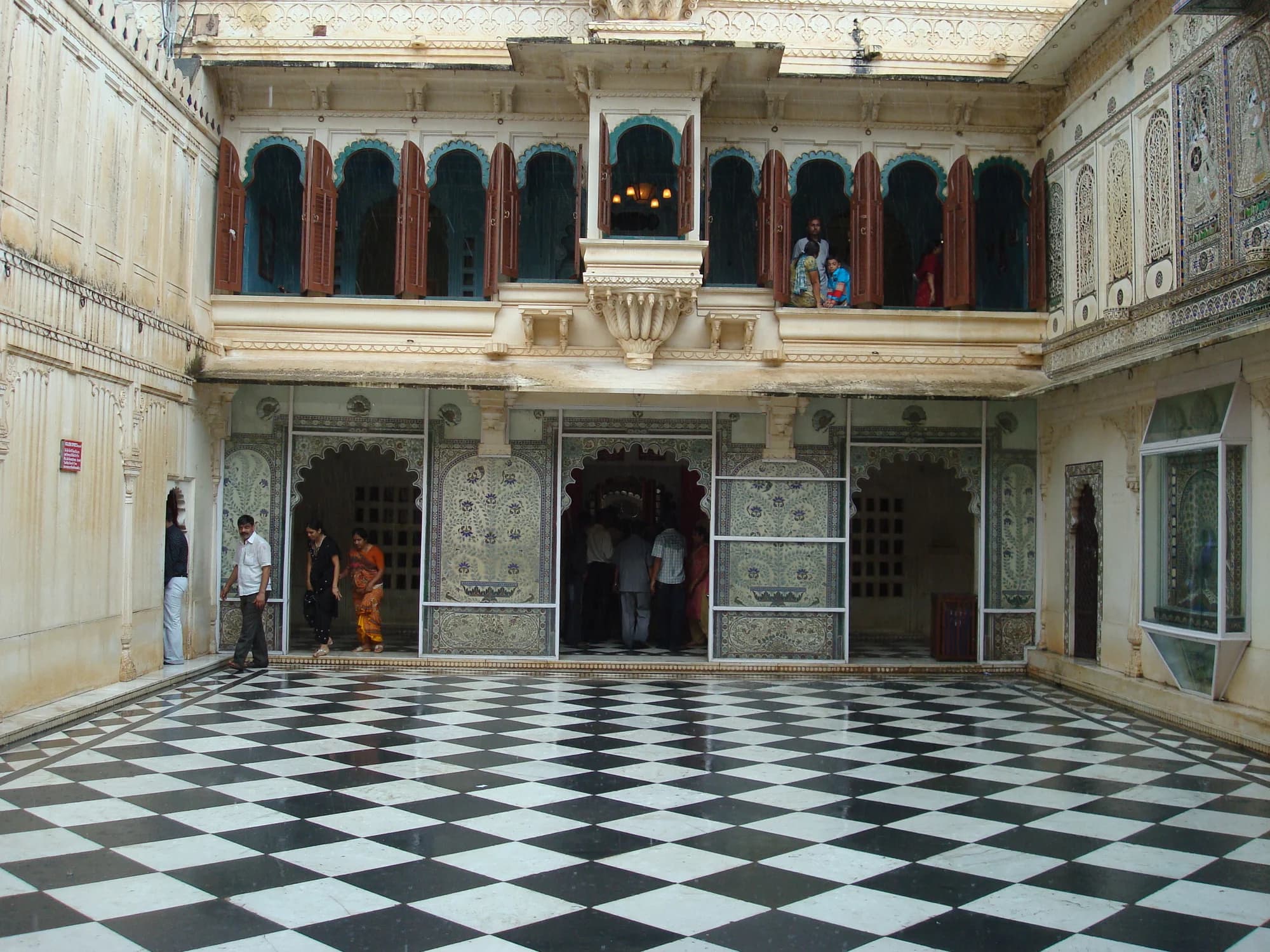
The Mor Chowk (Peacock Courtyard) at the City Palace — three peacocks rendered in high-relief glass mosaic in sapphire, emerald, and gold, their plumage comprising thousands of individual pieces of coloured glass
The three peacocks symbolise the seasons of Mewar: the summer peacock with its brilliant plumage, the monsoon peacock celebrating the life-giving rains, and the winter peacock with its more subdued tones
Photo: nborun, CC BY 2.0
The courtyard also features a series of wall paintings depicting scenes from the life of the Buddha — an unusual subject for a Rajput palace, and a testament to the Sisodias' historical openness to diverse spiritual traditions. The paintings are executed in the distinctively elongated, graceful style of the Mewar school, and their presence in the principal ceremonial courtyard of the palace suggests that the Maharanas saw themselves not merely as Rajput rulers but as inheritors of a broader Indian civilisational tradition.
The Living Palace
What distinguishes the City Palace from virtually every other royal residence in India is that it remains, in part, a living royal residence. The Chandra Mahal, the highest and most private section of the complex, is still occupied by the current Maharana, Shriji Arvind Singh Mewar, the seventy-sixth custodian of the House of Mewar. The family's presence is not a ceremonial fiction — the Maharana continues to perform the daily puja in the palace temple, to preside over the annual Gangaur festival from the palace's Tripolia Gate, and to maintain the traditions of Mewari courtly life that have continued unbroken since Udai Singh II founded the city in 1559.
The Maharana's role in contemporary Udaipur is complex. He holds no official political power — royal titles and privy purses were abolished by the Indian government in 1971 — but his cultural and religious authority remains substantial. The City Palace complex, which he manages through the Maharana of Mewar Charitable Foundation, is Udaipur's principal tourist attraction and its largest private employer. The foundation oversees the palace museums, the conservation of the complex, and a network of charitable hospitals, schools, and cultural institutions that extend the Sisodia legacy into the twenty-first century in a form that is less about ruling than about serving.
“We do not rule Udaipur anymore. But we remain its custodians. That is a responsibility that no constitutional amendment can abolish.”
The Museums and Collections
The City Palace museums, managed by the Maharana of Mewar Charitable Foundation, house one of the finest collections of Rajput and Mewari art, artefacts, and historical objects anywhere in the world. The museum complex occupies several wings of the palace and is organised thematically rather than chronologically.
The Armoury Gallery displays weapons that span five centuries — the curved talwars (swords) of the early Rajput period, the straight khanda blades carried by Pratap's cavalry at Haldighati, the matchlock rifles and flintlock pistols of the Mughal-influenced period, and the intricately damascened (gold-inlaid) weapons that were the ceremonial accoutrements of the late princely era. The single most remarkable object in the collection is Maharana Pratap's battle armour, which weighs seventy-two kilograms — a man who went into battle carrying the weight of another human being on his body, and who was, by all accounts, still a formidable swordsman.
The Painting Gallery contains several hundred miniature paintings from the Mewar school, spanning the sixteenth to nineteenth centuries. The collection is particularly strong in the early Mewar period — the so-called "Primitive" style of the late sixteenth and early seventeenth centuries, characterised by a bold, almost expressionistic use of colour and a certain charming disregard for naturalistic proportion. Later paintings in the collection demonstrate the increasing influence of Mughal technique, as Mewari artists absorbed the Persian-derived naturalism, atmospheric perspective, and refined portraiture that characterised painting at the Mughal court.
The Armoury Gallery — glass display cases containing five centuries of Rajput weaponry, talwars and khandas gleaming under museum lighting, Maharana Pratap's seventy-two-kilogram battle armour standing in heroic silhouette
Pratap's armour, forged by armourers in the Mughal tradition, is a testament to the physical prowess required of Rajput warriors: seventy-two kilograms, worn while wielding a two-handed sword and riding a war horse
The Textile Gallery displays royal garments, including several that belonged to Maharana Sangram Singh II, whose reign in the early eighteenth century marked the peak of Mewari courtly culture. The textiles — brocade angarkhas (court coats), gold-embroidered odhnis (veils), and the impossibly fine muslin jamas (robes) that were the preferred court dress — are rotated every six months due to their fragility, and the curatorial standards of the gallery are a credit to the foundation's conservation team.
The Crystal Gallery and Vintage Car Collection
Two subsidiary collections of the City Palace deserve special mention, both housed within the palace complex but operated as separate attractions. The Crystal Gallery, located in the Fateh Prakash wing, contains the world's largest private collection of Osler crystal — a story so extraordinary that it merits its own chapter (see the Fateh Prakash Palace entry in this series), but which can be summarised here: Maharana Sajjan Singh (1874-1884) placed an enormous order for crystal furniture and objects from the English firm F. & C. Osler in 1878. He died in 1884, before the order arrived. The crystal, shipped from Birmingham to Bombay and then transported by bullock cart to Udaipur, sat in sealed boxes in the palace cellars for one hundred and ten years — unopened, unseen, and largely forgotten — until it was rediscovered and displayed in the 1990s. The collection includes crystal beds, tables, chairs, fountains, chandeliers, and an extraordinary crystal fan (punkah) that is the only one of its kind in the world.
The Vintage and Classic Car Collection, housed in the former palace stables, comprises more than twenty motorcars that belonged to the Maharanas of Udaipur. The collection includes several Rolls-Royces — a 1924 Rolls-Royce Twenty, a 1934 Rolls-Royce Phantom II, and a 1938 Rolls-Royce Phantom III that was the personal vehicle of Maharana Bhupal Singh. Also on display are Cadillacs, Mercedes-Benzes, and a 1939 Chevrolet that was used as a luggage car. The cars are maintained in drivable condition by the palace's own mechanics, and several are available for hire by hotel guests for tours of Udaipur.
The Vintage Car Collection in the former palace stables — a line of immaculately maintained Rolls-Royces from the 1920s and 1930s, their chrome gleaming, their leather interiors bearing the patina of royal use
The 1938 Rolls-Royce Phantom III, the collection's centerpiece, features a V12 engine and custom coachwork commissioned personally by Maharana Bhupal Singh
Boat Rides on Lake Pichola
The City Palace's relationship to Lake Pichola is as fundamental as its relationship to the hills on which it stands. The palace was built facing the lake, its principal facades oriented to catch the morning light over the water and the evening reflections of the sunset. The lake was not merely an aesthetic backdrop — it was a defensive moat, a water supply, and a transportation artery that connected the palace to the Lake Palace, Jag Mandir, and the hunting grounds on the far shore.
Today, the palace operates a fleet of boats that offer tours of Lake Pichola departing from the palace's private jetty. The standard tour, lasting approximately one hour, circles the lake and passes close to the Lake Palace (for exterior viewing only; the hotel remains private), Jag Mandir Island Palace (where guests can disembark and explore the seventeenth-century pleasure palace), and the ghats (stepped embankments) of the old city. The best tours depart ninety minutes before sunset, when the light is golden and the lake is at its most photogenic.
For those seeking a more exclusive experience, the palace offers private boat charters that include champagne, a dedicated guide, and the option to moor at Jag Mandir for a private dinner in the island palace's courtyard. The cost is substantial — approximately ₹50,000 ($600) for a two-hour charter — but the experience of drifting across Lake Pichola at twilight, with the City Palace glowing on the eastern shore and the Aravalli Hills darkening to the west, is one of those moments that defines why people travel to Rajasthan.
Dining at the City Palace
The City Palace complex offers several dining options that range from casual courtyard cafes to the magnificently formal Durbar Hall at Fateh Prakash Palace. The Palki Khana, the palace's main courtyard restaurant, serves Rajasthani thalis and North Indian cuisine in a setting that was once the palace's entrance courtyard — a vast stone-paved space surrounded by arched colonnades where royal processions once assembled. The food is competent rather than extraordinary, but the setting more than compensates.
For a more elevated experience, the Sunset Terrace at Fateh Prakash Palace offers evening cocktails and a pan-Indian menu with views across Lake Pichola that are, without exaggeration, among the finest restaurant views anywhere in India. The restaurant opens at 5:00 PM to capture the sunset hour, and the terrace's western orientation means every table has an unobstructed view of the sun descending behind the Aravalli Hills. Reservations are essential during peak season, and requesting a table along the terrace railing when you book is strongly advised.
The Sunset Terrace at Fateh Prakash Palace — white-linen tables along a marble balustrade, the sun descending behind the Aravalli Hills, Lake Pichola turning from silver to gold to rose, the Lake Palace a distant white jewel on the darkening water
The terrace was added to Fateh Prakash Palace in the early twentieth century specifically to capture the sunset — the Maharanas understood that dining with a view is not a modern invention but a princely tradition
Insider Tips
Timing Your Visit
Arrive at the City Palace at opening time (9:30 AM) to experience the complex before the tour groups arrive — between 9:30 and 11:00 AM, you will have the courtyards and galleries virtually to yourself. The tour buses from Jaipur and Ahmedabad arrive between 11:00 AM and 3:00 PM, and the complex can become genuinely crowded during these hours. Alternatively, visit after 3:30 PM, when the tour groups begin departing and the late-afternoon light is at its most beautiful — the Mor Chowk peacocks in particular are best photographed in afternoon light.
Hiring a Guide
The City Palace's official guides, available at the ticket office, are generally excellent — knowledgeable, articulate, and passionate about Mewari history. Hire one for at least two hours (approximately ₹1,500/$18), and specify that you want to focus on the miniature paintings and the architecture rather than the standard highlights-only tour. The guides know the palace's hidden corners — the rarely visited Amar Vilas courtyard, the private temple, the terrace with the best view of the Lake Palace — and will take you to them if you express genuine interest.
Frequently Asked Questions
How long does it take to see the City Palace? A thorough visit, including the museums and the Crystal Gallery, requires four to five hours. Most visitors spend two to three hours, which covers the principal courtyards, the Mor Chowk, the Armoury Gallery, and a selection of the miniature painting galleries. If you are staying at one of the City Palace hotels, spread your visit over two days — mornings are best for the museums, late afternoons for the courtyards when the light is most beautiful.
Is the City Palace wheelchair accessible? Partial accessibility. The ground-floor courtyards and several of the main galleries are accessible, but the upper floors, terraces, and many of the smaller galleries are reached by stairs. The palace, built across multiple levels on a natural rock formation, was not designed with accessibility in mind, and the heritage status of the complex limits the modifications that can be made. Contact the palace in advance for specific accessibility information.
Can I take photographs inside? Photography is permitted in the courtyards and most of the museum galleries, though flash is prohibited to protect the paintings and textiles. The Crystal Gallery does not permit photography of any kind. Tripods and professional equipment require a separate permit, available from the palace administration office.
City Palace Udaipur illuminated at night — the entire length of the complex glowing golden against the dark lake, every dome, cupola, and balcony picked out in amber light, reflected with mirror precision in the still waters of Lake Pichola
The palace's illumination system, installed in 2015 by the Maharana of Mewar Charitable Foundation, uses energy-efficient LED technology calibrated to replicate the warm glow of traditional oil lamps — modern sustainability in the service of ancient atmosphere