There is a photograph, taken during the renovation of Devi Garh in the late 1990s, that every student of Indian design should study. It shows a 260-year-old fort palace in the Aravalli Hills of southern Rajasthan, stripped to its bones — every layer of paint, plaster, and accumulated ornamentation removed. The walls are bare stone. The courtyards are empty. The rooms are shells. It looks like an archaeological excavation, which, in a sense, it was. What rose from those stripped bones, over seven years of obsessive, uncompromising work, is not merely India's most radical heritage hotel. It is one of the most important works of contemporary design in South Asia.
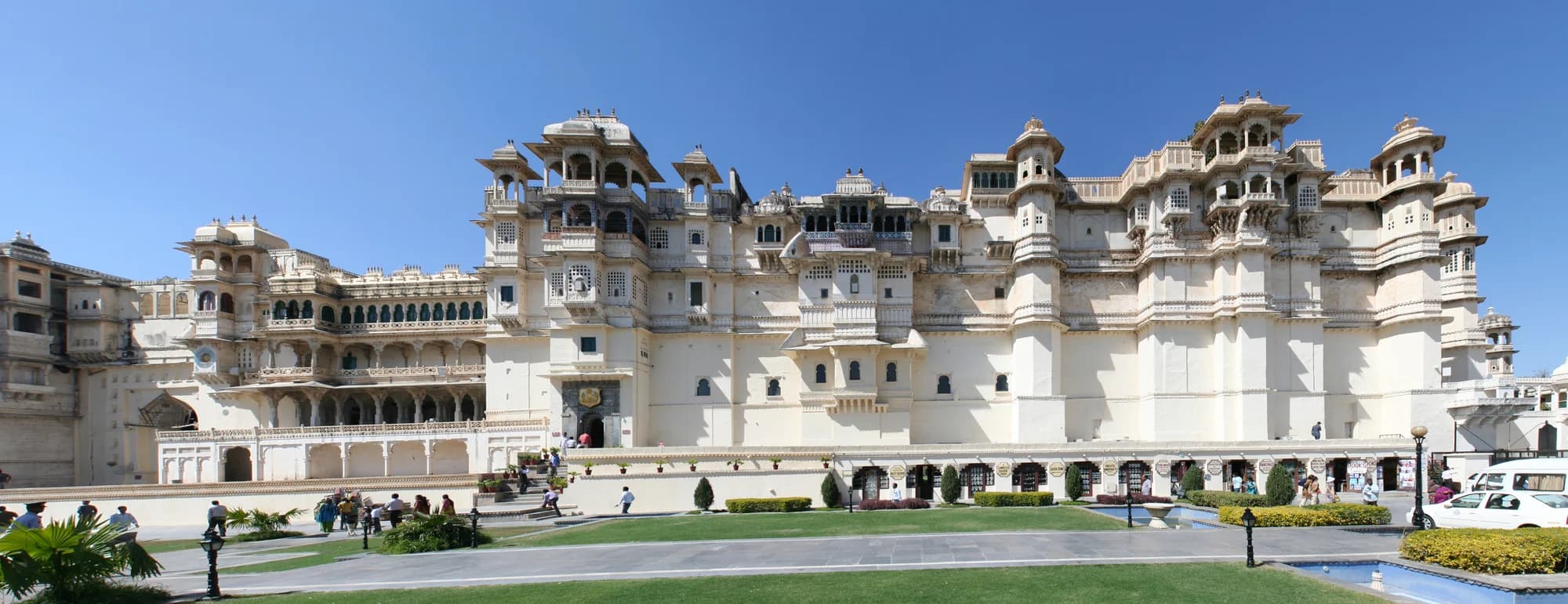
Devi Garh at dawn — the all-white marble and local stone facade of an 18th-century fort palace rising from the Aravalli Hills, the village of Delwara visible in the valley below, the morning mist softening the rugged landscape
Stripped to its bones during a seven-year renovation in the late 1990s, Devi Garh was rebuilt as a temple of contemporary minimalism — white marble floors, white marble walls, and the 260-year-old fort walls left exposed in every room as the only ornament
The vision belonged to a young scion of the family that had owned Devi Garh for two centuries. Instead of restoring the palace to its original Rajput grandeur — the obvious choice, the safe choice, the choice that every other heritage hotel in Rajasthan had made — he stripped it to its structural essence and rebuilt the interiors as temples of contemporary minimalism. White marble floors. White marble walls. Clean lines. Open space. The 260-year-old fort walls, left exposed in every room, became the only ornament — a constant, tactile reminder that you are sleeping inside history, even as your surroundings speak the language of tomorrow.
The Radical Vision
Devi Garh was built in the 1760s as the seat of the Rawat of Delwara, a feudal chieftain who ruled a cluster of villages in the Aravalli Hills under the suzerainty of the Maharana of Udaipur. The fort's architecture was typical of the period — thick stone walls designed for defence, internal courtyards for domestic life, and a series of increasingly private chambers that culminated in the zenana, the women's quarters. For two centuries, it served its purpose. Then, like so many minor forts in Rajasthan, it fell into decay as the feudal system dissolved and the family's resources dwindled.
By the 1990s, Devi Garh was a ruin. Portions of the roof had collapsed. The courtyards were overgrown. The private chambers were uninhabitable. The family faced a choice: sell the fort to a hotel chain, which would almost certainly demolish and rebuild, or find a way to make the fort itself economically viable. They chose the latter, and they brought in an architect — Rahul Mehrotra — whose approach to heritage would prove to be nothing short of revolutionary.
“We did not want to recreate the past. We wanted the past and the present to have a conversation. The fort provides the history. The design provides the frame.”
The guiding principle was radical subtraction. Every non-structural element that had been added to the fort over two centuries was removed. False ceilings were torn down, revealing the original vaulted stonework. Layers of lime wash were stripped from walls, exposing the rough texture of the local schist and marble. Internal partitions that had subdivided the fort's great chambers into smaller rooms were demolished. The result was a revelation: the fort's original volumes, hidden for generations, were cathedral-like in their proportions. The design team decided that these volumes would not be filled. They would be celebrated.
The Suites: 39 Variations on a Theme
Devi Garh offers 39 suites, and no two are alike. This is not marketing hyperbole. Because each suite occupies a unique chamber within the original fort structure, each has its own dimensions, its own relationship to the courtyards and the hills beyond, its own quirks of architecture and light. The design team treated each suite as an individual project, responding to the specific character of its space rather than imposing a standardised template.
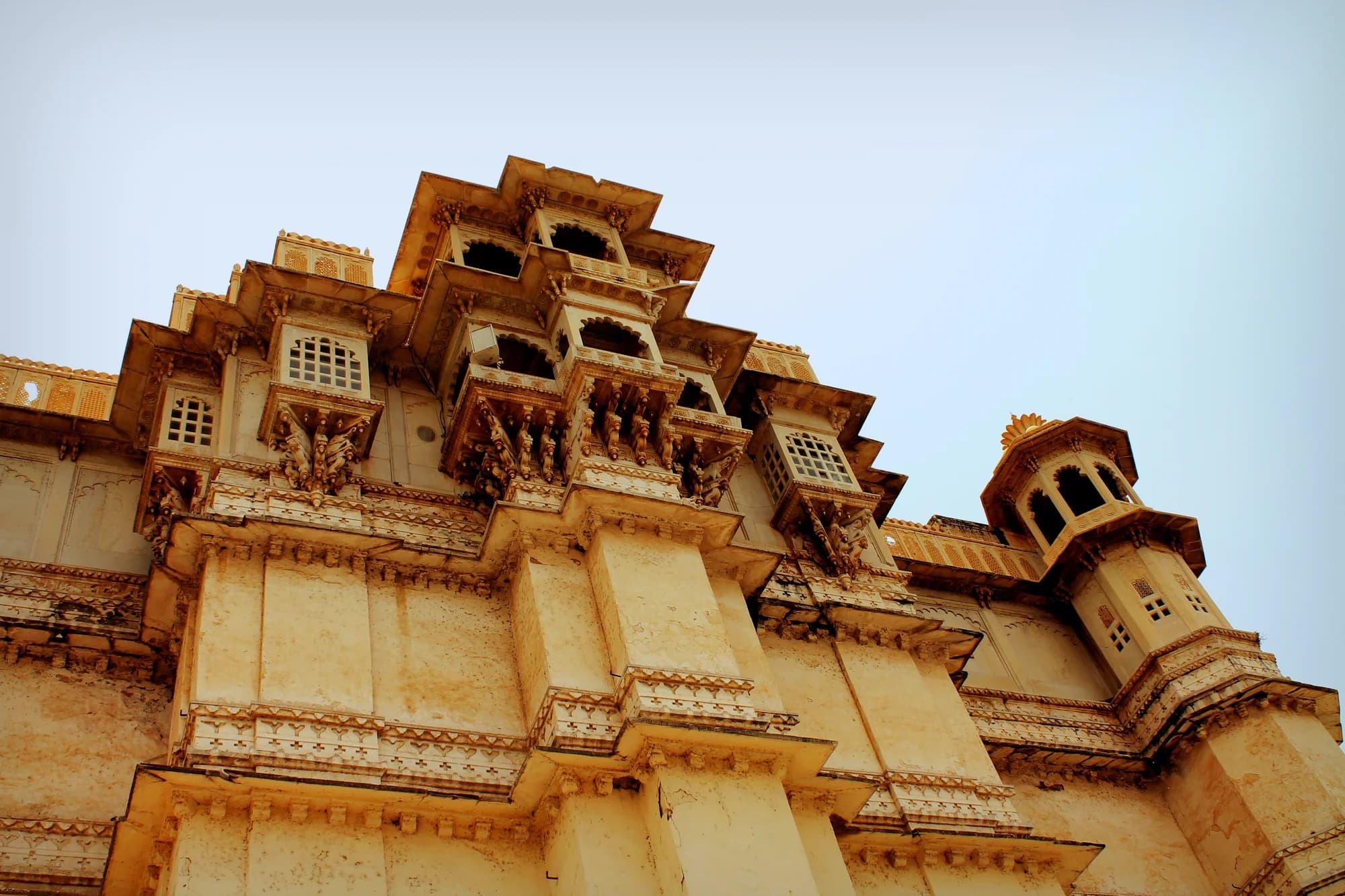
A Devi Garh suite — walls of exposed 18th-century stone meeting floors of white marble, a bed dressed in white linen the only object in a chamber of cathedral-like proportions, a single window framing the Aravalli Hills
Every suite at Devi Garh is different — the design philosophy was to strip away every layer of ornament until only the essential remained: ancient stone, white marble, light, and the landscape beyond
The palette, consistent across all 39 suites, is a study in restraint. White marble, quarried from nearby Makrana — the same quarries that supplied Shah Jahan for the Taj Mahal — covers every floor. Walls are either exposed original stone or smooth white plaster. Furniture is minimal: a bed, a desk, a low daybed, all in dark teak or clean-lined white. Textiles are white cotton and raw silk, with occasional accents of jewel-toned silk cushions that provide the only colour in rooms otherwise defined by the monochrome interplay of light and stone.
The bathrooms deserve separate consideration. In most suites, they are open to the bedroom, separated only by a low wall or a sheet of glass — a layout that makes spatial sense when every suite is a single chamber, and that feels, in the context of Devi Garh's minimalist aesthetic, entirely natural. The bathtubs are carved from single blocks of white marble. The showers are walk-in, with rainfall heads set into the ceiling. The toiletries, developed exclusively for the hotel, are scented with local jasmine and tuberose.
The Devi Garh Suite, occupying the fort's former zenana, is the hotel's most extraordinary accommodation. A sequence of three chambers connected by open doorways, it features a private terrace with 360-degree views of the Aravalli Hills, a bathroom that occupies an entire chamber of the original fort, and a master bedroom whose domed ceiling, stripped of all ornament, reveals the exquisite precision of 18th-century Rajasthani stone vaulting.
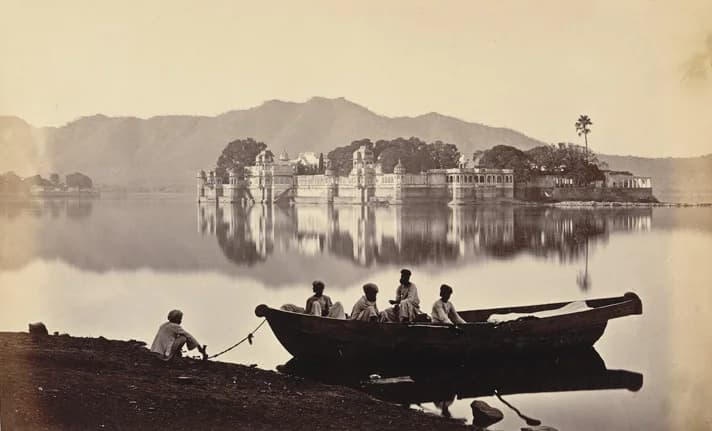
The Devi Garh Suite bathroom — a marble tub carved from a single block of Makrana stone positioned beneath an 18th-century domed ceiling, the original stonework exposed and illuminated by concealed lighting, a window framing the Aravalli Hills
The bathroom occupies a tower chamber of the original fort — the tub carved from a single block of Makrana marble, the same stone that built the Taj Mahal
The Public Spaces
Devi Garh's public spaces continue the dialogue between ancient structure and contemporary design. The lobby occupies the fort's original durbar hall — a vast stone chamber with a ceiling so high that it disappears into shadow. The space is furnished with a single long table, a cluster of low white sofas, and nothing else. The effect is of entering a gallery rather than a hotel, and it sets a tone that the rest of the property maintains with admirable discipline.
The courtyard, the heart of any Rajasthani fort, has been transformed into an all-white plaza — marble floors, whitewashed walls, white linen umbrellas shading white cane chairs. At night, concealed lighting washes the stone walls in a soft glow, and the courtyard becomes a dreamscape of white geometries under a canopy of stars.
The pool, carved into a terrace on the fort's eastern flank, is a rectangle of turquoise water surrounded by white marble decking and views of the Aravalli Hills stretching toward Udaipur, 28 kilometres away. The poolside service, attentive and unobtrusive, includes a menu of fresh juices, light Rajasthani cuisine, and a signature cocktail — the Devi Garh Martini, a concoction of vodka, desert lime, and a hint of chilli — that has earned a quiet reputation among Rajasthan's luxury traveller circuit.
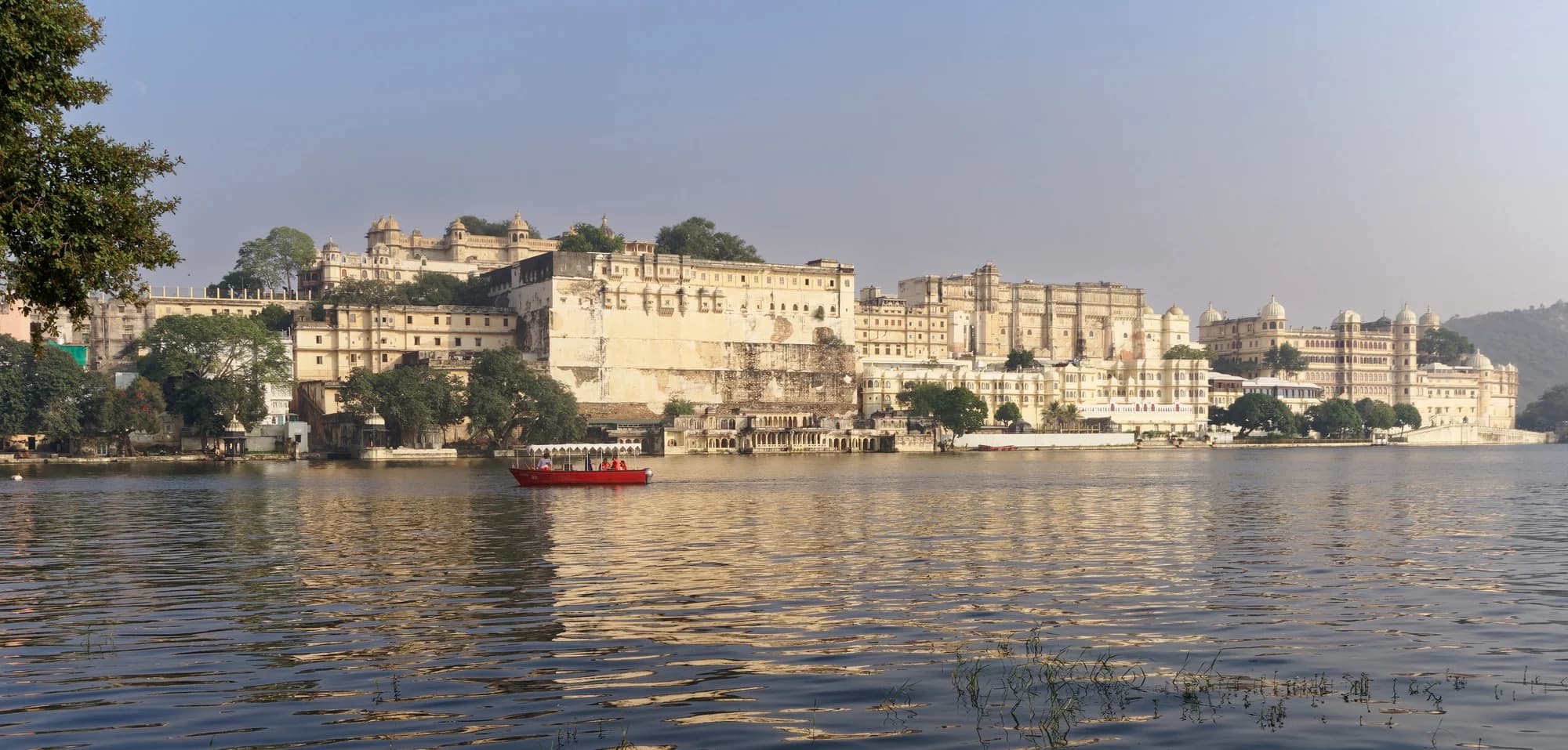
The pool terrace at Devi Garh — turquoise water set into white marble decking, the Aravalli Hills stretching to the horizon, white linen umbrellas providing the only shade under the Rajasthani sun
The pool, like everything at Devi Garh, is a study in the tension between ancient and modern — turquoise water floating above the 260-year-old walls of the fort's lower ramparts
Dining in the Fort
Devi Garh's signature restaurant occupies the fort's former armoury — a long, narrow stone chamber with a vaulted ceiling and walls that still bear the scars of the weapons that once hung from them. The kitchen is helmed by a chef who trained at the Oberoi group before being seduced by the creative freedom that Devi Garh offered, and the menu reflects that blend of classical training and creative ambition.
The food is described, somewhat inadequately, as "contemporary Indian." In practice, this means Rajasthani and pan-Indian dishes executed with European techniques and plated with an artist's eye. The Laal Maas is deconstructed — the mutton cooked sous-vide for eighteen hours before being finished in a tandoor, the Mathania chilli sauce served as a reduction rather than a gravy. The Ker Sangri is reimagined as a warm salad with roasted cumin and pomegranate. The thali, served at lunch on a slab of white marble, is a tasting menu of eight dishes that change daily depending on what is available from the local markets and the hotel's organic garden.
For a more casual meal, the courtyard restaurant serves wood-fired pizzas, grilled meats, and a selection of pastas that might seem incongruous in a Rajasthani fort until you taste them and realise that the chef's hand with Italian food is as sure as his hand with Rajasthani.
The bar, occupying a chamber off the courtyard, is intimate and moody — dark teak, low lighting, and a cocktail list that draws on local spirits and ingredients. The standout is the Delwara Sour, made with a local citrus called kagzi nimboo, gin distilled in Goa, and a rim of black salt that brings the entire drink into sharp, savoury focus.
The Holistic Spa
The spa at Devi Garh, located in the fort's lower levels, is a destination in its own right. The treatment rooms occupy chambers that once served as the fort's storerooms — cool, dark, and silent, their walls the original stone, their floors heated white marble. The spa's philosophy is holistic in the genuine sense, drawing on Ayurveda, Tibetan medicine, and international wellness practices with equal respect.
The Devi Garh spa — a treatment room carved into the fort's lower levels, exposed stone walls illuminated by candlelight, a marble treatment bed dressed in white linen, the silence absolute
Set in the fort's subterranean chambers, the spa offers Ayurvedic and international treatments in rooms where the only lighting is candlelight, the only soundtrack the distant call of peacocks from the Aravalli Hills
The signature treatment, the Devi Garh Ritual, is a five-hour sequence that begins with a consultation with the spa's Ayurvedic doctor, continues through abhyanga massage, shirodhara, and a herbal wrap, and concludes with a vegetarian meal served in a private courtyard. It is, by any measure, one of the most comprehensive spa experiences available in India, and guests have been known to book stays at Devi Garh specifically for it.
Delwara and Rural Rajasthan
Devi Garh's location, in the village of Delwara, sets it apart from Udaipur's other luxury hotels, which cluster around Lake Pichola in the city centre. Delwara is a working village of approximately 4,000 people, and the hotel's relationship with the community is genuine and reciprocal. Many of the hotel's staff come from Delwara and its surrounding villages. The hotel's organic garden supplies not only the kitchen but also the village market. The hotel's foundation supports local schools and healthcare initiatives.
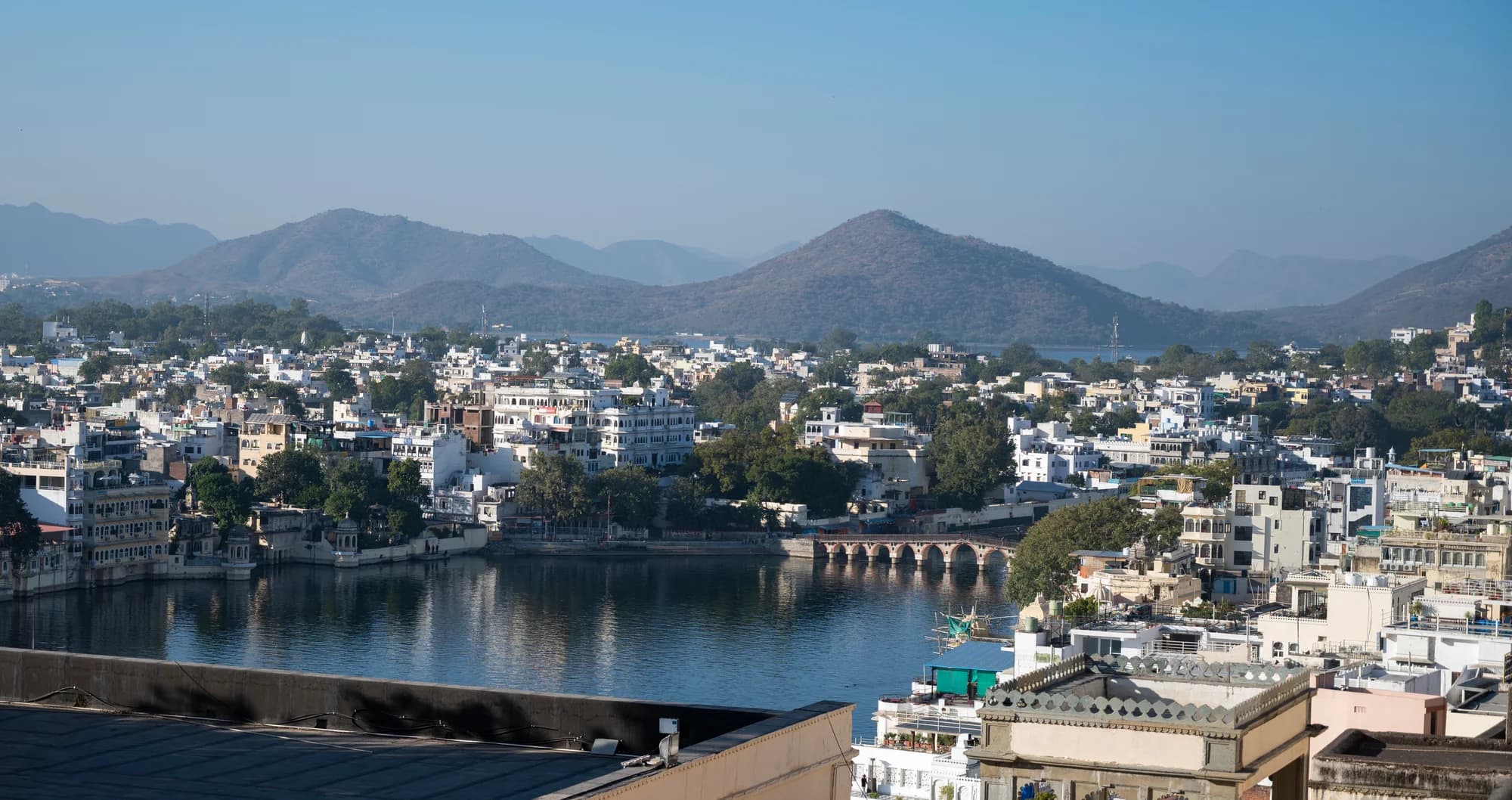
The village of Delwara at dawn — terracotta roofs and temple spires emerging from the morning mist, women in vivid saris walking to the stepwell, the Aravalli Hills rising beyond, Devi Garh visible on the hilltop above
The village is home to the remarkable stepwell of Delwara — an ancient baoli whose carved stone galleries descend over 200 steps into the earth, a masterpiece of medieval Rajput engineering
For guests, this means an experience that goes beyond the walls of the fort. The hotel can arrange guided walks through Delwara — visits to the 11th-century stepwell, the Jain temples, the workshops where local artisans produce the embroidered textiles for which the region is known. These walks are not staged for tourists; they are introductions to a living community that has existed, with its own rhythms and traditions, for a thousand years. The contrast between the austerity of Devi Garh's interiors and the vitality of the village below is deliberate, and one of the hotel's most profound pleasures.
Insider Tips
Design-Lover's Strategy
Devi Garh is a pilgrimage for design enthusiasts, but it is not for everyone. If your ideal luxury hotel involves opulent decor, antique furniture, and the atmosphere of a royal palace, head to Udaipur's lake palace hotels. Devi Garh is for those who find luxury in space, silence, and the confident minimalism of contemporary design. Know yourself, and choose accordingly.
Suite Selection
Each suite is unique, but a few generalisations hold: suites in the zenana wing are the most private and romantic. Suites on the upper levels offer the best views but require climbing steep stone staircases — the fort has no elevator. The Devi Garh Suite is worth the splurge for a special occasion. Request photographs of available suites when booking, as the variations are significant.
Udaipur Access
Devi Garh is 28 kilometres from Udaipur, roughly a 45-minute drive. The hotel can arrange a car and driver for the duration of your stay — essential if you plan to explore Udaipur's palaces, lakes, and restaurants. Alternatively, embrace the isolation. Many guests never leave the fort during a three- or four-night stay, and the hotel's architecture, spa, and village walks provide sufficient engagement.
Frequently Asked Questions
Is Devi Garh suitable for those who prefer traditional luxury? With qualification. The service is warm, attentive, and professional. The food is excellent. The spa is world-class. But the aesthetic — exposed stone, white marble, minimal furniture, open bathrooms — is aggressively contemporary. If your definition of luxury involves chandeliers, antique furniture, and rich textiles, Devi Garh may feel cold. If your definition of luxury involves space, silence, and the confident restraint of great design, Devi Garh may be your favourite hotel in India.
How does Devi Garh compare to Udaipur's palace hotels? They are different species. The Oberoi Udaivilas, the Taj Lake Palace, and the Leela Palace are traditional luxury hotels that trade in opulence — gilded ceilings, antique furniture, formal gardens. Devi Garh trades in space, design, and a kind of ascetic luxury that is closer in spirit to a contemporary art gallery than to a Rajasthani palace. The comparison is not qualitative — both categories contain exceptional properties — but philosophical. Choose what moves you.
Is the hotel suitable for children? Devi Garh welcomes children but is fundamentally an adult-oriented property. The open architecture — staircases, terraces, low walls — requires constant supervision of young children. There are no dedicated children's facilities. The atmosphere is quiet and contemplative. Families with older teenagers who appreciate design and culture will find it rewarding; families with young children may prefer a resort with more structured activities.
What is the best time to visit? October through March offers the most comfortable climate for exploring the Aravalli Hills and the village. July to September brings the monsoon, which transforms the landscape into a lush green and provides dramatic skies for photography — this is a beautiful and underrated time to visit, with lower rates and fewer guests. April to June is hot (35-40°C), but the fort's thick stone walls and modern air-conditioning make the interiors comfortable, and the value proposition is excellent.
How many nights should I stay? Three nights minimum. Four to five is ideal. Devi Garh rewards slow inhabitation. You need a day to adjust to the aesthetic — guests often find it disorienting on arrival, seductive by the second morning. You need a day for the spa. You need a day for Delwara village and the surrounding hills. One night is worse than none — you will leave before you have begun to understand the place.
Devi Garh at twilight — the all-white fort palace glowing against the darkening Aravalli Hills, lights beginning to appear in the village of Delwara below, the sky in transition from gold to indigo, the fort's silhouette clean and sharp against the last light of day
Devi Garh is not merely India's most radical heritage hotel — it is one of the most important works of contemporary design in South Asia, and at twilight, when the white marble catches the dying sun, the architecture speaks for itself