The Catastrophe of 1887: The Dispersal of a Sovereign Treasury
In May 1887, in the Pavillon de Flore of the Palais des Tuileries, the Third Republic of France committed what many art historians consider the greatest act of vandalism in the history of decorative arts. Terrified of a monarchist resurgence, the republican parliament voted to melt down or auction off the historic Crown Jewels of France (*Diamants de la Couronne*).
Over twelve days of bidding, centuries of royal commissions spanning the Renaissance, the reign of Louis XIV, the First Empire of Napoleon Bonaparte, and the Second Empire of Napoleon III were broken up and sold to international dealers. Charles Tiffany of New York purchased nearly a third of the collection; Parisian jewellers Bapst and Boucheron bought pieces for resetting; and private collectors carried away historic parures into anonymity. Only a tiny fraction — deemed of purely mineralogical or historic value, such as the 140.64-carat Regent Diamond — were withheld for the Muséum National d’Histoire Naturelle and the Louvre.
“The 1887 auction scattered centuries of royal French treasures, but a century of heroic curatorial detective work brought them home to the Louvre.”
The Century-Long Campaign: The Louvre’s Patient Repatriation
What followed is one of the most heroic chapters in modern curatorial history. For more than a century, the curators of the Musée du Louvre, backed by the Société des Amis du Louvre and national heritage subscriptions, launched a methodical campaign to track down, purchase, and repatriate the dispersed masterpieces.
Piece by piece, as items surfaced at international auctions in Geneva, London, and New York, the Louvre reclaimed its heritage:
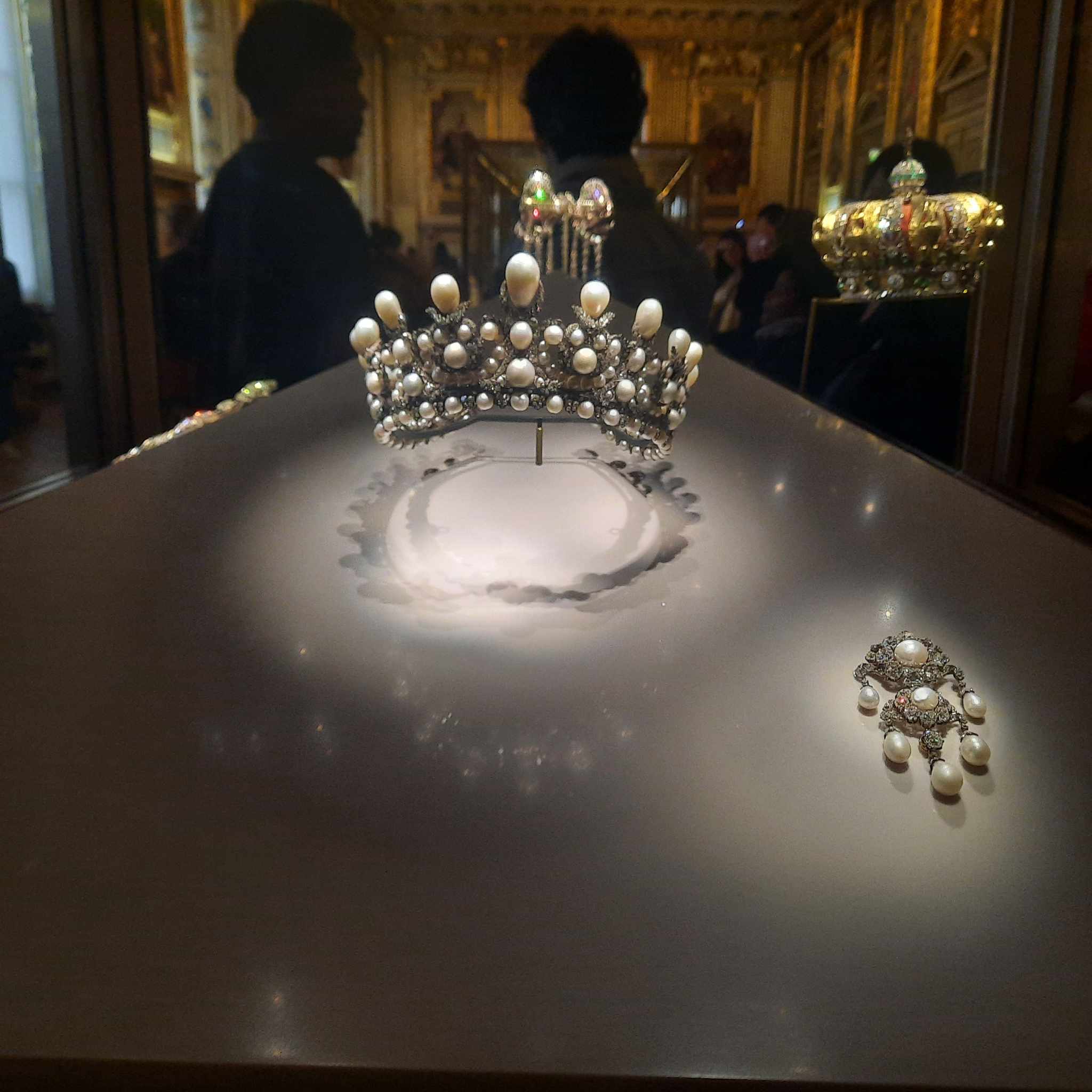
- The Empress Eugénie Pearl Tiara (1853) by Alexandre-Gabriel Lemonnier, reacquired in 1992 from the princely House of Thurn und Taxis. - The Grand Noeud de Corsage (1855) by François Kramer, a monumental diamond bow brooch originally part of Eugénie’s coronation belt, repurchased in 2008 for €6.72 million from the estate of Mrs William B. Astor. - The Duchess of Angoulême Emerald and Diamond Tiara (1819) by Bapst, incorporating 40 unenhanced Colombian emeralds, reacquired in 2002. - The Empress Eugénie Diamond Diadem (1853), featuring 2,490 diamonds, recovered in 2015.
Lemonnier's Pearl Tiara: The Apex of Second Empire Elegance
Among these repatriated treasures, none captivates visitors to the Louvre quite like the Empress Eugénie Pearl Tiara. Crafted in 1853 by Alexandre-Gabriel Lemonnier to celebrate the Spanish-born Empress’s marriage to Napoleon III, the diadem represents the pinnacle of French Second Empire romanticism.
Set in silver and gold, the tiara incorporates 212 natural orient pearls totaling over 500 carats, framed by 1,998 brilliant-cut diamonds. Its design eschews the severe neoclassical geometry of the First Empire in favor of supple palmettes, scrolled arabesques, and shimmering pearl drops that evoke a wave of radiant light. It remains the supreme archetype of imperial Parisian goldsmithing.
“Lemonnier's 1853 pearl tiara set 212 orient pearls and nearly two thousand diamonds into undulating palmettes that defined Second Empire romanticism.”
The Reborn Galerie d’Apollon: Shrine to French Lapidary Art
In January 2020, following an extensive multi-year architectural restoration, the Louvre unveiled the reorganized Galerie d’Apollon. Designed by Charles Le Brun for Louis XIV and completed by Eugène Delacroix, this gilded hall now presents the French Crown Jewels in state-of-the-art climate-controlled vitrines with fiber-optic illumination.
Here, visitors stand before the Regent Diamond, the Hortensia diamond, the Côte-de-Bretagne spinel, and the restored diadems of France’s queens and empresses. It is not merely an exhibition of precious stones; it is the physical testimony of France’s cultural soul — scattered by political panic in 1887, but painstakingly reconstituted through curatorial dedication and national pride.
THE ROYAL GALLERYS is the international magazine for heritage, culture and luxury — documenting the people, places and ideas shaping the worlds of royalty, jewellery, design, travel and contemporary life. Our editorial authority rests on deep engagement with India's cultural ecosystem and a commitment to telling the stories that matter.
For editorial inquiries, story proposals, and partnership discussions, contact our editors at hey.theroyalgallerys@gmail.com.
Éloïse de Saint-Germain
Haute Joaillerie Historian, Paris. THE ROYAL GALLERYS is the international magazine for heritage, culture and luxury — editorial authority on the people, places and ideas shaping our world.
Part of Jewellery
This article is part of THE ROYAL GALLERYS Jewellery section — our international editorial destination for jewellery, heritage and luxury.
Explore All Jewellery Stories →